RICOH R1180x Series User's Guide and Manual
Summary
The R1180x series is a highly efficient CMOS LDO regulator, providing stable power up to 150mA while maintaining an ultra-low quiescent current (typical 1µA). This design makes it perfect for battery-powered and sleep-mode electronic devices. Designed for communications equipment, consumer electronics, and automotive uses, the manual provides comprehensive selection guides, technical specifications, and application details needed to integrate this reliable, low-power solution efficiently into your project.
Page 1 Text Content
R1180x Series Low Supply Current 150m A LDO
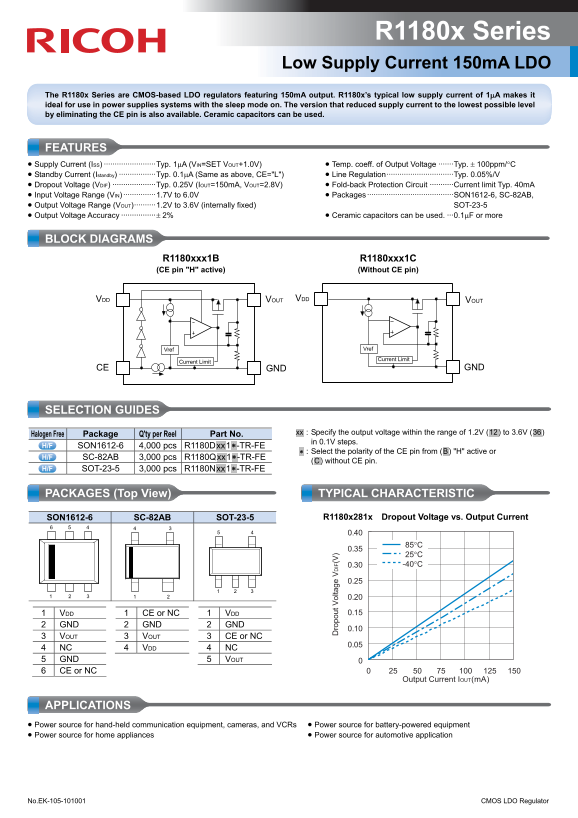
The R1180x Series are CMOS-based LDO regulators featuring 150m A output. R1180x’s typical low supply current of 1μA makes it ideal for use in power supplies systems with the sleep mode on. The version that reduced supply current to the lowest possible level by eliminating the CE pin is also available. Ceramic capacitors can be used.
FEATURES • Supply Current (ISS) ························Typ. 1μA (VIN=SET VOUT+1.0V) • Temp. coeff. of Output Voltage ·······Typ. ± 100ppm/°C • Standby Current (Istandby) ·················Typ. 0.1μA (Same as above, CE="L") • Line Regulation·······························Typ. 0.05%/V • Dropout Voltage (VDIF) ····················Typ. 0.25V (IOUT=150m A, VOUT=2.8V) • Fold-back Protection Circuit ···········Current limit Typ. 40m A • Input Voltage Range (VIN) ···············1.7V to 6.0V • Packages········································SON1612-6, SC-82AB, • Output Voltage Range (VOUT)··········1.2V to 3.6V (internally fixed) SOT-23-5 • Output Voltage Accuracy ················± 2% • Ceramic capacitors can be used. ···0.1μF or more
BLOCK DIAGRAMS R1180xxx1B R1180xxx1C (CE pin "H" active) (Without CE pin)
VDD VOUT VDD VOUT
ro lt IF (V
Vref Vref
Current Limit
Current Limit
CE GND GND
SELECTION GUIDES
Part No. .xx. : Specify the output voltage within the range of 1.2V (.12.) to 3.6V (.36.)
Halogen Free Package Q'ty per Reel
in 0.1V steps.
SON1612-6 4,000 pcs R1180D.xx.1.∗ -TR-FE
.∗ : Select the polarity of the CE pin from (.B.) "H" active or
SC-82AB 3,000 pcs R1180Q.xx.1.∗ -TR-FE
(.C.) without CE pin.
SOT-23-5 3,000 pcs R1180N.xx.1.∗ -TR-FE
PACKAGES (Top View) TYPICAL CHARACTERISTIC
SON1612-6 SC-82AB SOT-23-5 R1180x281x Dropout Voltage vs. Output Current
1 VDD 1 CE or NC 1 VDD 0.15
2 GND 2 GND 2 GND
3 VOUT 3 VOUT 3 CE or NC
4 NC 4 VDD 4 NC 5 GND 5 VOUT 6 CE or NC
Output Current IOUT(m A)
APPLICATIONS • Power source for hand-held communication equipment, cameras, and VCRs • Power source for battery-powered equipment • Power source for home appliances • Power source for automotive application
No.EK-105-101001 CMOS LDO Regulator
Page Summary Contents For RICOH R1180x Series User's Guide and Manual
Manual Details
| Brand | Ricoh |
|---|---|
| Pages | 2 |
| File Size | 178.15 KB |
| Published | June 04, 2026 |
Enter the captcha to get the download link:

Frequently Asked Questions
What is the typical standby current for this LDO regulator?
It has a typical standby current of 0.1μA when the CE pin is set to "L".
What type and value of capacitors are recommended for use with this component?
Ceramic capacitors can be used, specifically 0.1μF or more.
Are there different packages available for the R1180x series regulator?
Yes, available packages include SON1612-6, SC-82AB, and SOT-23-5.
Can this product be used in applications requiring extreme reliability, like aircraft systems?
No; customers intending to use the product in such highly specified environments should contact the vendor first.