LINEAR AN82-1 Data Handbook/Specifications Sheet
Summary
Explore advanced principles of electronic voltage referencing for precision circuit design. This guide is essential reading for engineers needing to master the selection and application of high-stability reference sources, including bandgap and buried Zener types. It provides comprehensive insights into key performance metrics—such as initial accuracy, temperature coefficients (Tempco), and load regulation—ensuring optimal component selection for demanding analog systems.
Page 1 Text Content
Application Note 82
November 1999
Understanding and Applying Voltage References By Mitchell Lee
Specifying the right reference and applying it correctly is a more difficult task than one might first surmise, consid- ering that references are only 2- or 3-terminal devices. Although the word “accuracy” is most often spoken in
reference to references, it is dangerous to use this word
too freely because it can mean different things to different people. Even more perplexing is the fact that a reference
classified as a dog in one application is a panacea in another. This application note will familiarize the reader with the various aspects of reference “accuracy” and
present some tips on extracting maximum performance from any reference.
HP MIRRORED
SCALE CO UN TS
As with other specialized electronic fields, the field of
monolithic references has its own vocabulary. We’ve
already learned the first word in our reference vocabulary, 0.3 3,000
“accuracy.” This is the yardstick with which references are BI TS graded and compared. Unfortunately, there are at least five
–60 0.1 –3 1,000 PE RC EN
or six good units for gauging accuracy. To keep you from
reaching a full understanding of the topic, industry pundits
–70 0.03 PO ER OF EN
use a special technique called “unit-hopping” to confuse
and confound everyone from newcomer to seasoned PP
veteran. You mention an accuracy figure and the pundit
quickly hops to a new unit so that you cannot follow his line
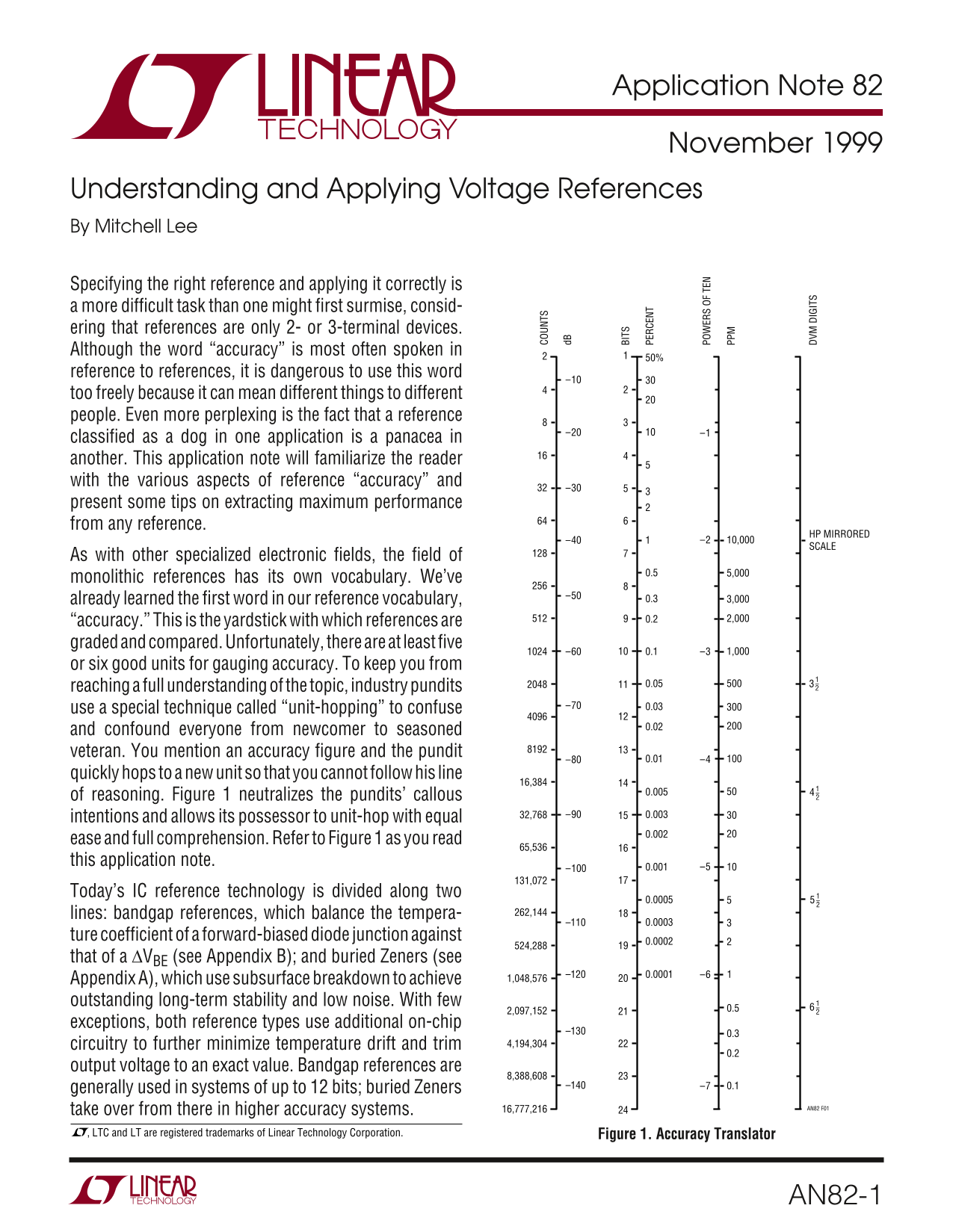
of reasoning. Figure 1 neutralizes the pundits’ callous
32,768 –90 0.003 DV IG IT
intentions and allows its possessor to unit-hop with equal
ease and full comprehension. Refer to Figure 1 as you read
this application note.
Today’s IC reference technology is divided along two 1–2
lines: bandgap references, which balance the tempera- 262,144
ture coefficient of a forward-biased diode junction against
that of a ∆VBE (see Appendix B); and buried Zeners (see
Appendix A), which use subsurface breakdown to achieve 1,048,576
outstanding long-term stability and low noise. With few 1–2
exceptions, both reference types use additional on-chip
circuitry to further minimize temperature drift and trim 4,194,304
output voltage to an exact value. Bandgap references are
generally used in systems of up to 12 bits; buried Zeners
16,777,216 AN82 F01
take over from there in higher accuracy systems. , LTC and LT are registered trademarks of Linear Technology Corporation. Figure 1. Accuracy Translator
AN82-1
Page Summary Contents For LINEAR AN82-1 Data Handbook/Specifications Sheet
Manual Details
| Brand | Linear |
|---|---|
| Pages | 12 |
| File Size | 168.38 KB |
| Published | June 22, 2026 |
Enter the captcha to get the download link:

Frequently Asked Questions
What two main technologies comprise modern reference voltage circuits?
IC technology is primarily divided between bandgap references and buried Zeners.
How is accuracy quantified across an entire operating temperature range?
The average error over this range is calculated using the 'box' method, which measures min/max recorded output voltages.
Which reference type is optimized for 12-bit applications or lower?
Bandgap references are generally used in systems of up to 12 bits.
What does a high 'Tempco' value indicate about the reference?
The Tempco (temperature coefficient) measures the average temperature drift of the output voltage over the operating range.