Texas Instruments TLC3544, TLC3548 User's Manual and Specifications
Summary
The TLC3544 and TLC3548 are high-performance, low-power 14-bit Analog-to-Digital Converters (ADCs) designed for robust multi-channel data acquisition. These converters accept pseudodifferential analog inputs up to 5V and feature a versatile serial interface compatible with both SPI and DSP protocols. The manual details the advanced features, including programmable sampling periods, automatic multiplexing, and low-power modes. Ideal for engineers and designers requiring high-speed, accurate data conversion solutions in systems that demand reliability and efficient power use.
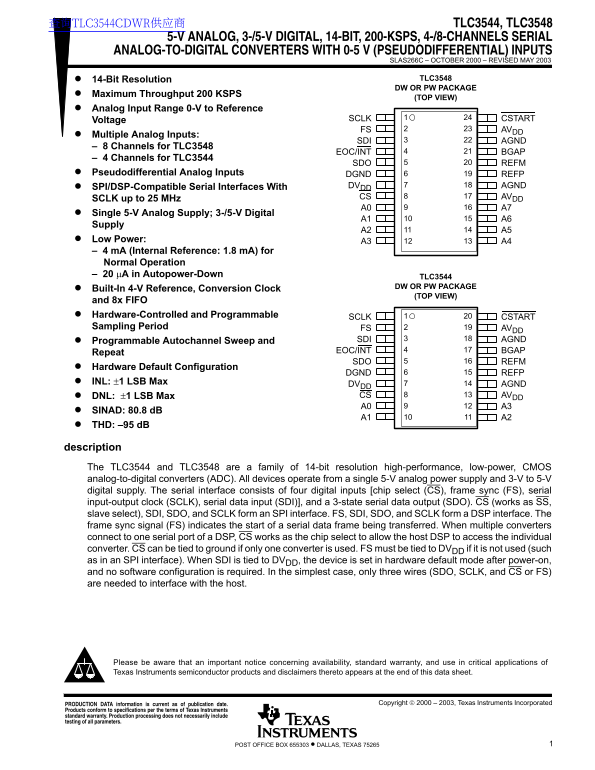
Page 1 Text Content
查询TLC3544CDWR供应商 TLC3544, TLC3548
5-V ANALOG, 3-/5-V DIGITAL, 14-BIT, 200-KSPS, 4-/8-CHANNELS SERIAL ANALOG-TO-DIGITAL CONVERTERS WITH 0-5 V (PSEUDODIFFERENTIAL) INPUTS
SLAS266C – OCTOBER 2000 – REVISED MAY 2003
14-Bit Resolution TLC3548 DW OR PW PACKAGE
Maximum Throughput 200 KSPS
(TOP VIEW)
Analog Input Range 0-V to Reference
Voltage SCLK CSTART
FS AVDD
Multiple Analog Inputs:
SDI AGND
– 8 Channels for TLC3548
EOC/INT BGAP
– 4 Channels for TLC3544
SDO REFM
Pseudodifferential Analog Inputs DGND REFP
SPI/DSP-Compatible Serial Interfaces With DVDD AGND SCLK up to 25 MHz CS AVDD
Single 5-V Analog Supply; 3-/5-V Digital
Supply
Low Power: A3 A4 – 4 m A (Internal Reference: 1.8 m A) for Normal Operation – 20 µA in Autopower-Down
TLC3544 DW OR PW PACKAGE
Built-In 4-V Reference, Conversion Clock
(TOP VIEW)
and 8x FIFO Hardware-Controlled and Programmable SCLK CSTART Sampling Period FS AVDD
Programmable Autochannel Sweep and SDI AGND Repeat EOC/INT BGAP
SDO REFM
Hardware Default Configuration
DGND REFP
INL: ±1 LSB Max
DVDD AGND DNL: ±1 LSB Max CS AVDD
SINAD: 80.8 d B
THD: –95 d B
description The TLC3544 and TLC3548 are a family of 14-bit resolution high-performance, low-power, CMOS analog-to-digital converters (ADC). All devices operate from a single 5-V analog power supply and 3-V to 5-V digital supply. The serial interface consists of four digital inputs [chip select (CS), frame sync (FS), serial input-output clock (SCLK), serial data input (SDI)], and a 3-state serial data output (SDO). CS (works as SS, slave select), SDI, SDO, and SCLK form an SPI interface. FS, SDI, SDO, and SCLK form a DSP interface. The frame sync signal (FS) indicates the start of a serial data frame being transferred. When multiple converters connect to one serial port of a DSP, CS works as the chip select to allow the host DSP to access the individual converter. CS can be tied to ground if only one converter is used. FS must be tied to DVDD if it is not used (such as in an SPI interface). When SDI is tied to DVDD, the device is set in hardware default mode after power-on, and no software configuration is required. In the simplest case, only three wires (SDO, SCLK, and CS or FS) are needed to interface with the host.
Please be aware that an important notice concerning availability, standard warranty, and use in critical applications of Texas Instruments semiconductor products and disclaimers thereto appears at the end of this data sheet.
Copyright 2000 – 2003, Texas Instruments Incorporated PRODUCTION DATA information is current as of publication date.
Products conform to specifications per the terms of Texas Instruments standard warranty. Production processing does not necessarily include testing of all parameters.
1POST OFFICE BOX 655303 • DALLAS, TEXAS 75265
Page Summary Contents For Texas Instruments TLC3544, TLC3548 User's Manual and Specifications
Manual Details
| Brand | Texas Instruments |
|---|---|
| Pages | 40 |
| File Size | 770.52 KB |
| Published | June 17, 2026 |
Enter the captcha to get the download link:

Frequently Asked Questions
What are the essential wires needed for the simplest host interface setup?
Only three wires—the serial data output (SDO), serial input-output clock (SCLK), and either CS or FS—are required to connect with a host.
How can I ensure the device initializes in default mode without software configuration?
Tie SDI to DV, and the device will set itself into hardware default mode immediately after power-on.
What is the specified Signal-to-Noise Ratio (SINAD) of this ADC family?
The devices are specified with a SINAD of 80.8 dB.
Does the converter offer low-power options for energy efficiency?
Yes, it features software power-down/autopower-down modes and programmable conversion speeds to enhance power saving.