ROHM Operation notes
Summary
This is an operation notes document from ROHM CO.,LTD. covering handling guidelines for infrared photodiodes, phototransistors, and photo ICs. It provides detailed soldering conditions, lead forming procedures, and cleaning solvent recommendations. The document explains that these optical devices use pure epoxy resin packaging which is more sensitive to heat and chemicals than standard black molding compounds. Proper handling techniques are described to prevent illumination failure. Target users are electronics assembly technicians and manufacturing engineers working with ROHM optical sensor components in PCB assembly and production environments.
Page 1 Text Content
Sensors Operation notes
Operation notes
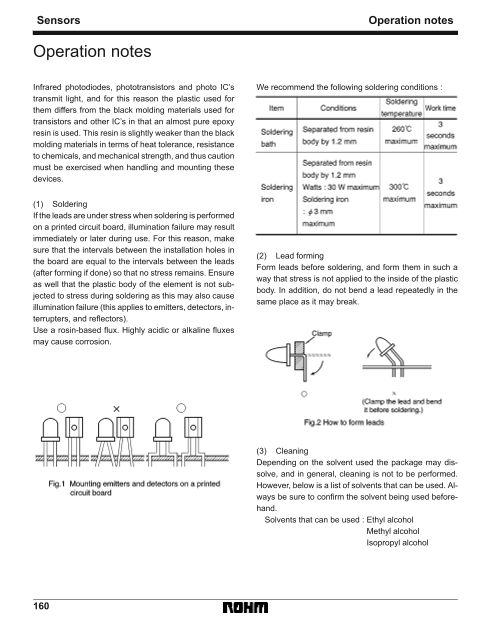
Infrared photodiodes, phototransistors and photo IC’s We recommend the following soldering conditions
transmit light, and for this reason the plastic used for them differs from the black molding materials used for transistors and other IC’s in that an almost pure epoxy resin is used. This resin is slightly weaker than the black molding materials in terms of heat tolerance, resistance to chemicals, and mechanical strength, and thus caution must be exercised when handling and mounting these devices.
(1) Soldering If the leads are under stress when soldering is performed on a printed circuit board, illumination failure may result immediately or later during use. For this reason, make sure that the intervals between the installation holes in
(2) Lead forming
the board are equal to the intervals between the leads
Form leads before soldering, and form them in such a
(after forming if done) so that no stress remains. Ensure
way that stress is not applied to the inside of the plastic
as well that the plastic body of the element is not sub-
body. In addition, do not bend a lead repeatedly in the
jected to stress during soldering as this may also cause
same place as it may break.
illumination failure (this applies to emitters, detectors, in- terrupters, and reflectors). Use a rosin-based flux. Highly acidic or alkaline fluxes may cause corrosion.
(3) Cleaning Depending on the solvent used the package may dis- solve, and in general, cleaning is not to be performed. However, below is a list of solvents that can be used. Al- ways be sure to confirm the solvent being used before- hand. Solvents that can be used Ethyl alcohol Solvents that can be used Methyl alcohol Solvents that can be used Isopropyl alcohol
Page Summary Contents For ROHM Operation notes
Manual Details
| Brand | ROHM |
|---|---|
| Pages | 2 |
| File Size | 31.02 KB |
| Published | June 16, 2026 |
Enter the captcha to get the download link:

Frequently Asked Questions
What soldering precautions should I take for these optical sensors?
Ensure lead intervals match board holes, use rosin-based flux, avoid stressing the plastic body during soldering, and form leads beforehand without bending repeatedly.
Can I clean these sensors with common solvents?
Cleaning is generally not recommended, but if necessary, only use ethyl alcohol, methyl alcohol, or isopropyl alcohol after confirming suitability.
Why are these sensors more delicate than standard ICs?
They use a clear, slightly weaker epoxy resin for light transmission, making them less heat, chemical, and mechanically resistant than black molded components.