ROHM MCR25JZHJS User Guide
Summary
These highly reliable low ohmic thick film chip resistors are designed for high performance in demanding electronic circuit applications. Featuring superior ruthenium oxide resistive materials and excellent solderability for re-flow processes, these components ensure stability across vast temperature ranges (-55°C to +155°C). This manual provides comprehensive specifications on component ratings, power derating, detailed testing procedures (solderability, endurance), and selection guides. Ideal for engineers and designers integrating reliable passive resistors into commercial electronic equipment.
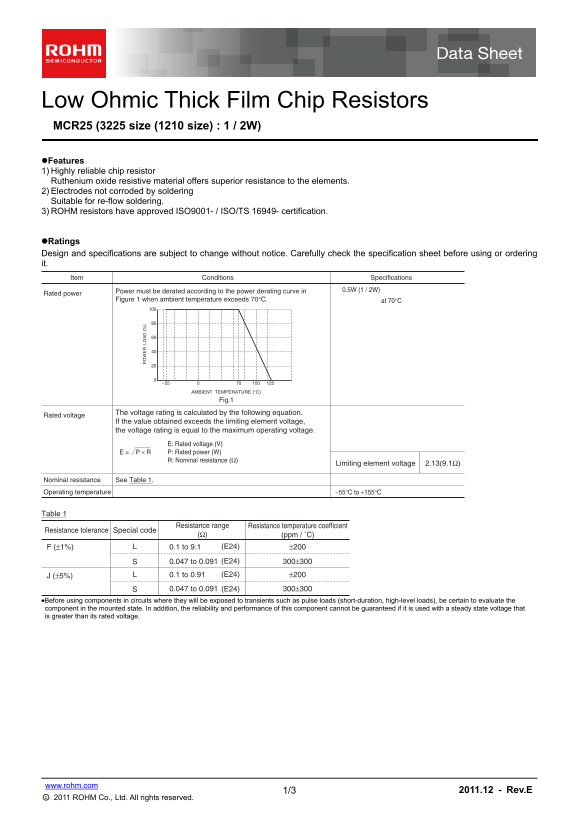
Page 1 Text Content
Low Ohmic Thick Film Chip Resistors MCR25 (3225 size (1210 size) : 1 / 2W) Features 1) Highly reliable chip resistor Ruthenium oxide resistive material offers superior resistance to the elements. 2) Electrodes not corroded by soldering Suitable for re-flow soldering. 3) ROHM resistors have approved ISO9001- / ISO/TS 16949- certification.
Ratings Design and specifications are subject to change without notice. Carefully check the specification sheet before using or ordering it. Item Conditions Specifications
Power must be derated according to the power derating curve in 0.5W (1 / 2W)
Rated power
Figure 1 when ambient temperature exceeds 70°C. at 70°C
AMBIENT TEMPERATURE (°C)
Fig.1
The voltage rating is calculated by the following equation.
Rated voltage
If the value obtained exceeds the limiting element voltage, the voltage rating is equal to the maximum operating voltage.
E: Rated voltage (V) E = P × R P: Rated power (W) R: Nominal resistance (Ω)
Limiting element voltage 2.13(9.1Ω)
Nominal resistance See Table 1.
Operating temperature −55°C to +155°C
Table 1
Resistance range Resistance temperature coefficient
Resistance tolerance Special code
(Ω) (ppm / ˚C) F (±1%) 0.1 to 9.1 (E24) ±200
0.047 to 0.091 (E24) 300±300 J (±5%) 0.1 to 0.91 (E24) ±200
0.047 to 0.091 (E24) 300±300
Before using components in circuits where they will be exposed to transients such as pulse loads (short-duration, high-level loads), be certain to evaluate the component in the mounted state. In addition, the reliability and performance of this component cannot be guaranteed if it is used with a steady state voltage that is greater than its rated voltage.
www.rohm.com
1/3 2011.12 - Rev.E
○c 2011 ROHM Co., Ltd. All rights reserved.
Page Summary Contents For ROHM MCR25JZHJS User Guide
Manual Details
| Brand | ROHM |
|---|---|
| Pages | 4 |
| File Size | 168.95 KB |
| Published | June 06, 2026 |
Enter the captcha to get the download link:

Frequently Asked Questions
How must I adjust my power rating at high temperatures?
If ambient temperature exceeds 70°C, the applied power must be derated according to the power derating curve in Figure 1.
What is the calculation for the rated voltage of this resistor?
Rated voltage (E) equals Rated power (P) multiplied by Nominal resistance (R): E = P × R.
Can these resistors undergo re-flow soldering processes?
Yes, suitable for re-flow soldering. The recommended condition is 235±5°C for a duration of 2.0±0.5s.
Are these components suitable for life-critical applications?
No. They are not designed for equipment requiring an extremely high level of reliability (e.g., medical instruments or aerospace machinery).