ROHM BU4584BBU4584BFBU4584BFVHex Schmitt triggerUser Manual
Summary
This manual provides comprehensive technical specifications for the BU4584 Schmitt trigger series, an inverter-type integrated circuit featuring six circuits per chip. These devices are engineered for applications requiring enhanced noise immunity and are ideal for signal conditioning or waveform rectification with slow input transitions. The documentation details electrical characteristics (DC and switching), operational limits, power dissipation curves, and physical dimensions, making it essential reference material for electronics engineers designing reliable digital logic systems.
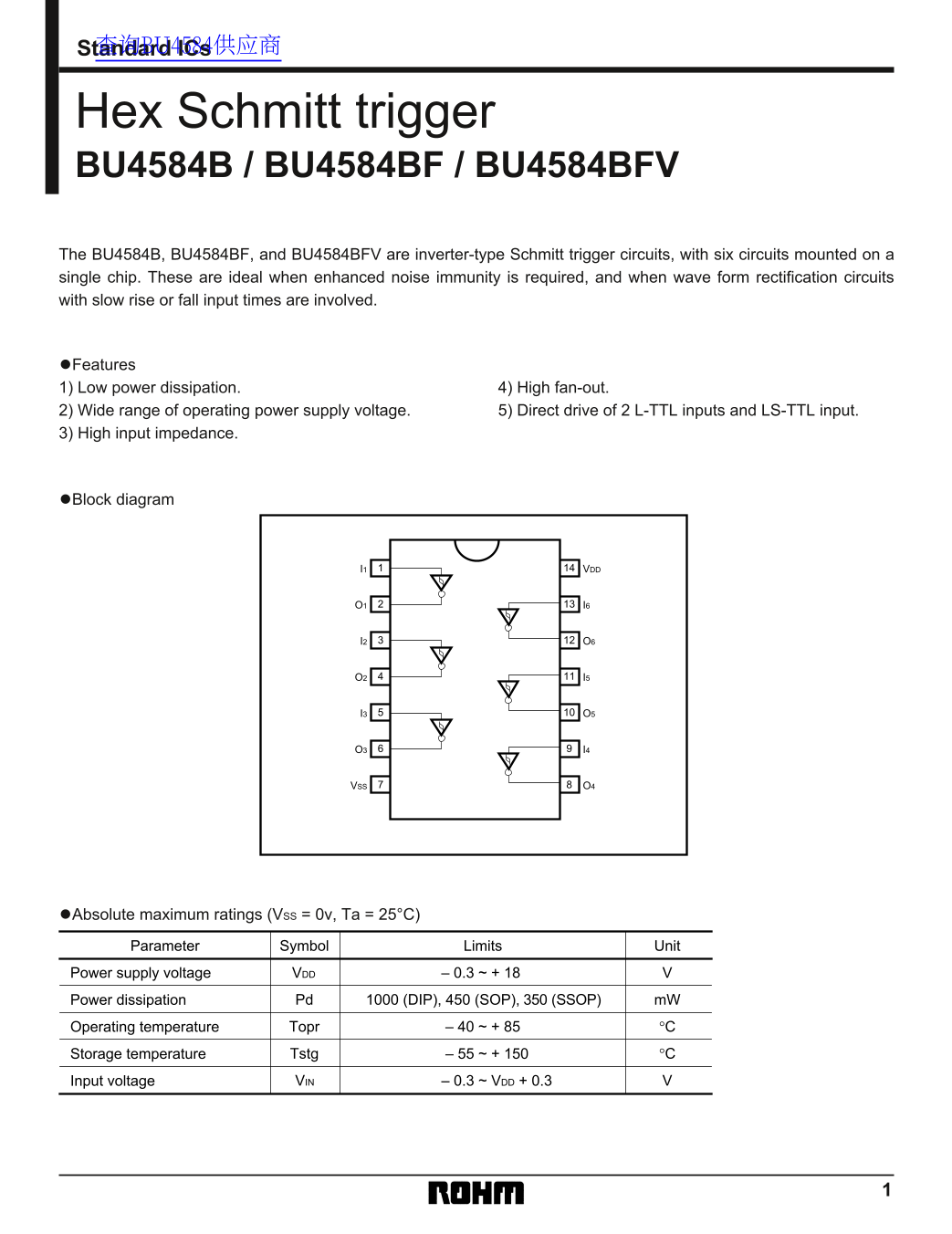
Page 1 Text Content
Standard ICs 查询BU4584供应商
Hex Schmitt trigger BU4584B / BU4584BF / BU4584BFV The BU4584B, BU4584BF, and BU4584BFV are inverter-type Schmitt trigger circuits, with six circuits mounted on a single chip. These are ideal when enhanced noise immunity is required, and when wave form rectification circuits with slow rise or fall input times are involved.
•Features 1) Low power dissipation. 4) High fan-out. 2) Wide range of operating power supply voltage. 5) Direct drive of 2 L-TTL inputs and LS-TTL input. 3) High input impedance.
•Block diagram
1I1 VDD
8VSS O4
•Absolute maximum ratings (VSS = 0v, Ta = 25°C)
Parameter Symbol Limits Unit
Power supply voltage VDD – 0.3 ~ + 18
Power dissipation Pd 1000 (DIP), 450 (SOP), 350 (SSOP) m W
Operating temperature Topr – 40 ~ + 85 °C
Storage temperature Tstg – 55 ~ + 150 °C
Input voltage VIN – 0.3 ~ VDD + 0.3
Page Summary Contents For ROHM BU4584BBU4584BFBU4584BFVHex Schmitt triggerUser Manual
Manual Details
| Brand | ROHM |
|---|---|
| Pages | 4 |
| File Size | 34.81 KB |
| Published | July 15, 2026 |
Enter the captcha to get the download link:

Frequently Asked Questions
What is the primary function of the BU4584 series chips?
They are inverter-type Schmitt trigger circuits with six circuits mounted on a single chip, ideal for applications requiring enhanced noise immunity.
Can I use this chip in high-noise environments or with slow signal edges?
Yes. They are specifically suitable when enhanced noise immunity is required and when wave form rectification circuits have slow rise or fall input times.
What is the operating temperature range for this component?
The operating temperature range (Topr) is from -40°C to +85°C.
How does power dissipation change with ambient temperature?
Power dissipation increases as the ambient temperature rises, which can be observed in Figure 3.