LINEAR LTC4312 Technical Specifications User Guide
Summary
This technical guide details advanced I²C/SMBus multiplexers designed for building robust, large-scale electronic systems. The LTC4314/LTC4312 is a pin-selectable MUX that overcomes common bus limitations by managing capacitance, performing logic level translation (from 1.5V to 5V), and integrating powerful stuck-bus recovery features. Ideal for engineers needing reliable communication isolation across multiple I/O channels and varying voltage standards within complex, high-density circuit designs.
Page 1 Text Content
design features
2-Channel and 4-Channel Pin-Selectable I2C Multiplexer Features High Noise Margin, Capacitance Buffering, Level Translation and Stuck Bus Recovery Rajesh Venugopal
The inherent simplicity of I2C and SMBus 2-wire protocols The buffers provide capacitance isola- tion between the upstream bus and the
has made them a popular choice for communicating vital
downstream buses, allowing for parti-
information in large systems. Both standards employ
tioning of the bus capacitance. In single
simple open-drain pull-down drivers with resistive or
supply systems, the buffers regulate the
current source pull-ups. Nevertheless, several practical
bus up to 0.33 • VCC, providing a large
problems arise as systems grow in complexity. logic low noise margin. Rise time accel-
erators (RTAs) of appropriate strength
The first problem with large systems is buffers address these issues with a num-
can be activated to overcome bus capaci-
that devices with hard-wired I2C addresses ber of powerful features (see Table 1).
tance limitations, reduce rise time and
require address expansion to prevent Since these two devices share the same
allow for higher switching frequencies
conflicts. Second, noise causes glitches that features, except for the number of chan-
even when operating with heavy loads.
can be interpreted as legitimate clock or nels, this article focuses on the LTC4314. data transitions, compromising data reli- The LTC4314 is compatible with the
An upstream I2C bus (SDAIN, SCLIN) can be
ability. Third, I2C devices can cause the bus I2C standard and Fast Mode, SMBus and
connected to any combination of down-
to stick low. Finally, timing specifications PMBus specifications. Stuck bus recovery
stream buses through the LTC4314’s bus
are increasingly difficult to meet, and clock circuitry disconnects the upstream bus
buffers and multiplexer switches by driv-
frequencies are limited by the equivalent from downstream buses when SDA and
ing the ENABLE pins of the desired output
bus capacitance, which increases with SCL have not been simultaneously high at
buses high. Multiple devices having the
system size and complexity. The LTC4312 least once in 45ms, freeing the upstream
same address can be placed on different
and LTC4314 pin-selectable 2-channel bus to resume communications. The recov-
buses and isolated using the ENABLE pins,
and 4-channel I2C multiplexers with bus ery circuitry also attempts to convince
thereby achieving address expansion.
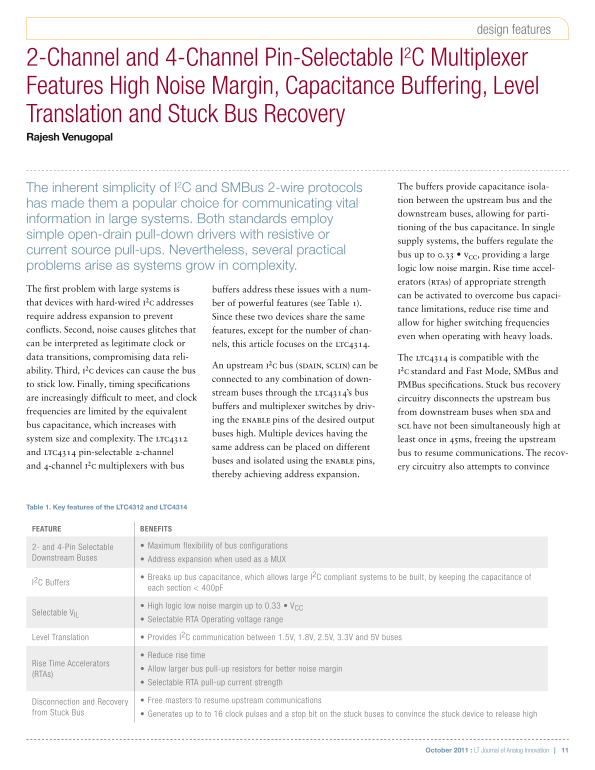
Table 1. Key features of the LTC4312 and LTC4314
FEATURE BENEFITS
2- and 4-Pin Selectable • Maximum flexibility of bus configurations
Downstream Buses • Address expansion when used as a MUX
• Breaks up bus capacitance, which allows large I2C compliant systems to be built, by keeping the capacitance of
I2C Buffers
each section < 400p F
• High logic low noise margin up to 0.33 • VCC
Selectable VIL
• Selectable RTA Operating voltage range
Level Translation • Provides I2C communication between 1.5V, 1.8V, 2.5V, 3.3V and 5V buses
• Reduce rise time
Rise Time Accelerators
• Allow larger bus pull-up resistors for better noise margin
(RTAs)
• Selectable RTA pull-up current strength
Disconnection and Recovery • Free masters to resume upstream communications
from Stuck Bus • Generates up to to 16 clock pulses and a stop bit on the stuck buses to convince the stuck device to release high
October 2011 : LT Journal of Analog Innovation | 11
Page Summary Contents For LINEAR LTC4312 Technical Specifications User Guide
Manual Details
| Brand | Linear |
|---|---|
| Pages | 5 |
| File Size | 2.36 MB |
| Published | June 05, 2026 |
Enter the captcha to get the download link:

Frequently Asked Questions
Which models are compatible with I²C, SMBus, and PMBus?
Both the LTC4312 and LTC4314 are compatible with the I²C standard, Fast Mode, SMBus, and PMBus specifications.
How does the LTC4314 improve reliability in large systems?
It addresses bus capacitance and noise issues by acting as a multiplexer (MUX) and providing buffers to maintain high logic levels.
What is Stuck Bus Recovery doing?
The circuitry detects if SDA and SCL voltage are not simultaneous high at least once in 45ms, then generates cycles up to 16 clock pulses to free the bus.
Can I adjust the rise time based on my needs?
Yes, the LTC4314 features selectable Rise Time Accelerators (RTAs), allowing users to select from a constant current source, slew-limited switch mode, or fully disabled operation.