LINEAR dn421f Data Sheet / Manual
Summary
The LTC4215-1 is a smart power gateway engineered to provide robust auxiliary control functions for Hot Swap cards in mixed signal circuits. This manual details its use for monitoring backplane health by managing supply voltage and current, offering fault isolation, and controlling system initialization. Featuring three dedicated GPIO pins and an ADC channel, the controller allows engineers (in telecommunications or data acquisition) to precisely manage power sequencing, monitor button states, and enable graceful card shutdowns, ensuring reliable operation in high-density systems.
Page 1 Text Content
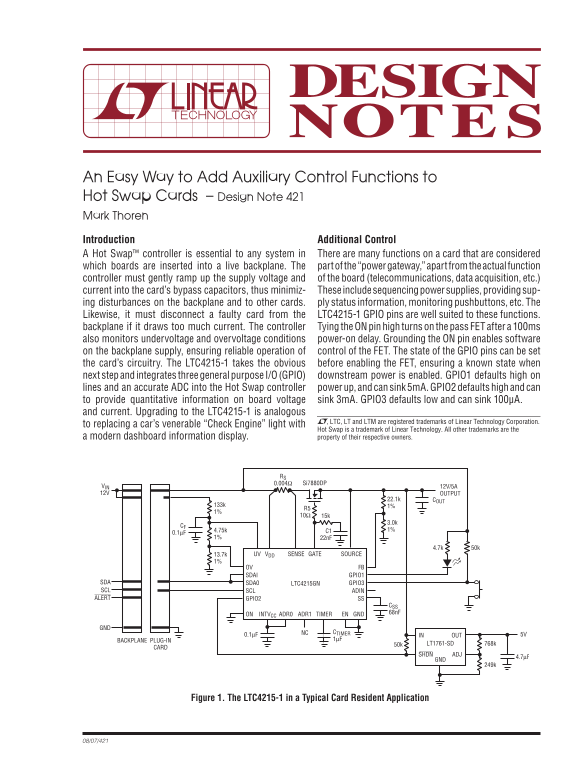
An Easy Way to Add Auxiliary Control Functions to Hot Swap Cards – Design Note 421 Mark Thoren Introduction Additional Control A Hot Swap™ controller is essential to any system in There are many functions on a card that are considered which boards are inserted into a live backplane. The part of the “power gateway,” apart from the actual function controller must gently ramp up the supply voltage and of the board (telecommunications, data acquisition, etc.) current into the card’s bypass capacitors, thus minimiz- These include sequencing power supplies, providing sup- ing disturbances on the backplane and to other cards. ply status information, monitoring pushbuttons, etc. The Likewise, it must disconnect a faulty card from the LTC4215-1 GPIO pins are well suited to these functions. backplane if it draws too much current. The controller Tying the ON pin high turns on the pass FET after a 100ms also monitors undervoltage and overvoltage conditions power-on delay. Grounding the ON pin enables software on the backplane supply, ensuring reliable operation of control of the FET. The state of the GPIO pins can be set the card’s circuitry. The LTC4215-1 takes the obvious before enabling the FET, ensuring a known state when next step and integrates three general purpose I/O (GPIO) downstream power is enabled. GPIO1 defaults high on lines and an accurate ADC into the Hot Swap controller power up, and can sink 5m A. GPIO2 defaults high and can to provide quantitative information on board voltage sink 3m A. GPIO3 defaults low and can sink 100µA. and current. Upgrading to the LTC4215-1 is analogous
, LTC, LT and LTM are registered trademarks of Linear Technology Corporation.
to replacing a car’s venerable “Check Engine” light with
Hot Swap is a trademark of Linear Technology. All other trademarks are the
a modern dashboard information display. property of their respective owners.
RS 0.004Ω Si7880DP
VIN 12V/5A 12V OUTPUT
22.1k COUT
13.7k UV VDD SENSE GATE SOURCE
OV FB SDAI GPIO1
SDA SDA0 LTC4215GN GPIO3 SCL SCL ADIN ALERT GPIO2 SS
CSS 68n F
ON INTVCC ADR1 TIMER ENADR0 GND
NC CTIMER
0.1µF IN OUT 5V
BACKPLANE PLUG-IN 1µF
50k LT1761-SD 768k
SHDN ADJ
Figure 1. The LTC4215-1 in a Typical Card Resident Application
Page Summary Contents For LINEAR dn421f Data Sheet / Manual
Manual Details
| Brand | Linear |
|---|---|
| Pages | 2 |
| File Size | 657.18 KB |
| Published | June 18, 2026 |
Enter the captcha to get the download link:

Frequently Asked Questions
What are key functions of a Hot Swap controller?
It provides fault isolation, monitors the power path health, and offers control over the inrush current profile for reliable operation.
How does the LTC4215-1 GPIO simplify system design?
It integrates three general purpose I/O (GPIO) and an ADC channel, allowing expanded control without additional sequencing circuits.
Which pin controls the pass FET to power on a card?
Tying the ON pin high turns on the pass FET after a 100ms power-on delay.
Can GPIO pins be used for status monitoring?
Yes, they can control devices like multiplexers or monitor pushbuttons and LEDs.