Fairchild Semiconductor FPF2500-FFP2506 IntelliMAX Advanced Load Management Products User Manual and Specifications
Summary
These Intelligent Load Management Switches feature advanced current protection and stable power delivery across a 4.5V to 20V range. They offer crucial features like adjustable constant-current limiting, Undervoltage Lockout, and thermal shutdown to safeguard sensitive electronics from damaging surges. This product manual details how these reliable switches can manage dynamic power loads in demanding applications, making them perfect for developers working on sophisticated devices like motor drivers, cell phones, PDAs, and digital cameras requiring maximum system durability.
Page 1 Text Content
2500-F 2506 In telli M van ced ad an ag em en t P ro cts
February 2006
FPF2500-FPF2506 Intelli MAX™ Advanced Load Management Products Features General Description 4.5 to 20V Input Voltage Range The FPF2500 through FPF2506 is a family of load switches
which provide full protection to systems and loads which may
Controlled Turn-On
encounter large current conditions. These devices contain a
0.4A, 0.8A and Adjustable Current Limit Option
0.23Ω current-limited N-channel MOSFET which can operate
Undervoltage Lockout
over an input voltage range of 4.5-20V. Switch control is by a
Thermal Shutdown logic input (ON) capable of interfacing directly with low voltage
<10u A Shutdown Current control signals. Each part contains thermal shutdown protection which shuts off the switch to prevent damage to the part when a
Auto Restart
continuous over-current condition causes excessive heating.
Fault Blanking
When the switch current reaches the current limit, the part Applications operates in a constant-current mode to prohibit excessive currents from causing damage. For the FPF2500, FPF2501,
FPF2503 and FPF2505, if the constant current condition still
Motor Drivers
persists after 5ms, these parts will shut off the switch and, for Cell Phones the FPF2503 and FPF2505, the fault signal pin (FLAGB) will be pulled low. The FPF2500, FPF2503, and FPF2505, have an
Digital Cameras
auto-restart feature which will turn the switch on again after 640ms if the ON pin is still active. The FPF2501 does not have this auto-restart feature so the switch will remain off until the ON pin is cycled. For the FPF2502, FPF2504 and FPF2506, a current limit condition will immediately pull the fault signal pin low and the part will remain in the constant-current mode until the switch current falls below the current limit. For the FPF2500 through FPF2502, the minimum current limit is adjustable from 500m A to 2A. For the FPF2503 and FPF2504 the minimum current is internally fixed at 400m A while that for the FPF2505 and FPF2506 is internally fixed at 800m A.
These parts are available in a space-saving 5 pin SOT23 package.
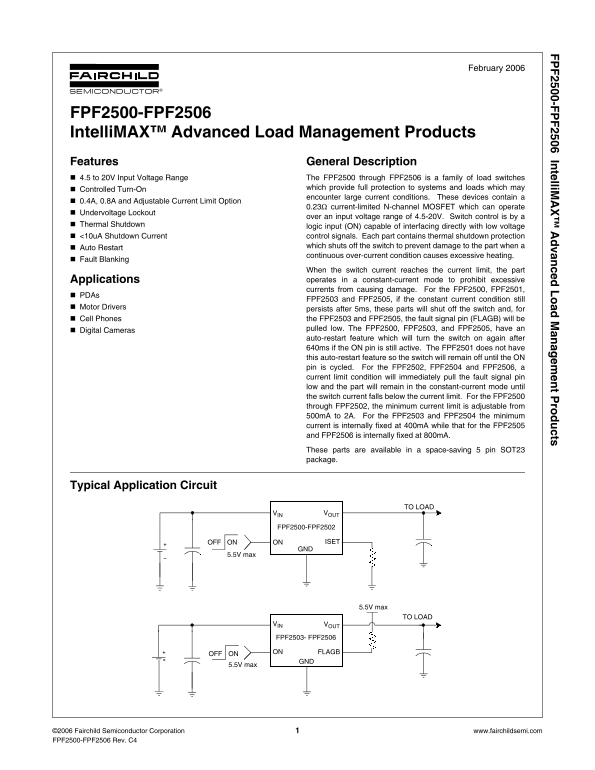
Typical Application Circuit
TO LOAD
VIN VOUT
FPF2500-FPF2502
OFF ON ON ISET
5.5V max
5.5V max
TO LOAD
VIN VOUT
FPF2503- FPF2506
ON FLAGB
OFF ON
5.5V max
©20 06 Fairchild Semiconductor Corporation www.fairchildsemi.com FPF 2500-FPF2506 Rev. C4
Page Summary Contents For Fairchild Semiconductor FPF2500-FFP2506 IntelliMAX Advanced Load Management Products User Manual and Specifications
Manual Details
| Brand | Fairchild |
|---|---|
| Pages | 13 |
| File Size | 567.59 KB |
| Published | June 06, 2026 |
Enter the captcha to get the download link:

Frequently Asked Questions
What is the recommended input voltage range for these load switches?
The FPF2500 through FPF2506 operate over a recommended input voltage range of 4.5V to 20V.
Which specific models support automatic restart after an overload condition?
The FPF2500, FPF2503, and FPF2505 parts feature auto-restart functionality (640ms); the FPF2501 does not.
How can I adjust the maximum current limit for my application?
On models FPF2500 through FPF2502, the current limit is adjustable using an external resistor connected to the ISET pin.
What critical protection mechanism prevents damage due to excessive heat?
Each device includes thermal shutdown protection, ensuring the switch shuts off automatically if continuous over-current conditions cause excessive heating.