Vishay High Intensity LED, ∅ 5mm Untinted Non-Diffused Data Sheet
Summary
Power your designs with the TLHF5800, a high-intensity Soft Orange LED engineered for demanding status indicators and visible lighting applications requiring extreme brightness. This detailed manual is essential for electrical engineers and designers, offering comprehensive technical specifications on performance parameters. It features critical graphs detailing luminous intensity decay versus temperature and current, ensuring optimal component selection reliability across extreme operating ranges (-40°C to +100°C). Use these precise data sheets for reliable integration into indicators, maintenance lights, and specialized electronic displays.
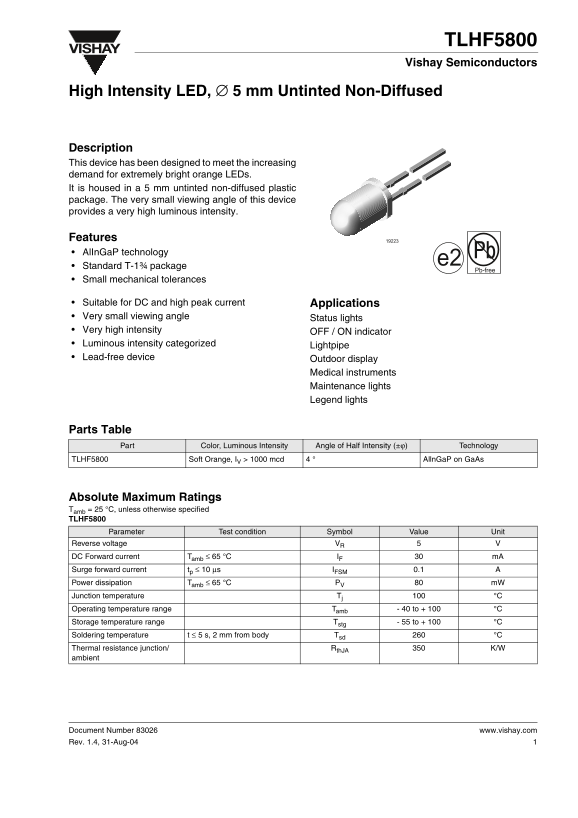
Page 1 Text Content
TLHF5800
VISHAY
Vishay Semiconductors
High Intensity LED, ∅ 5 mm Untinted Non-Diffused
Description This device has been designed to meet the increasing demand for extremely bright orange LEDs. It is housed in a 5 mm untinted non-diffused plastic package. The very small viewing angle of this device provides a very high luminous intensity.
Features Al In Ga P technology Pb
Standard T-1¾ package
Pb-free
Small mechanical tolerances
Suitable for DC and high peak current Applications Very small viewing angle Status lights Very high intensity OFF / ON indicator Luminous intensity categorized Lightpipe Lead-free device Outdoor display
Medical instruments Maintenance lights Legend lights
Parts Table
Part Color, Luminous Intensity Angle of Half Intensity (±ϕ) Technology
TLHF5800 Soft Orange, IV > 1000 mcd Alln Ga P on Ga As
Absolute Maximum Ratings Tamb = 25 °C, unless otherwise specified TLHF5800
Parameter Test condition Symbol Value Unit
Reverse voltage VR
DC Forward current Tamb ≤ 65 °C IF m A
Surge forward current tp ≤ 10 µs IFSM 0.1
Power dissipation Tamb ≤ 65 °C PV m W
Junction temperature Tj °C
Operating temperature range Tamb - 40 to + 100 °C Storage temperature range Tstg - 55 to + 100 °C
Soldering temperature t ≤ 5 s, 2 mm from body Tsd °C Thermal resistance junction/ Rth JA K/W
ambient
Document Number 83026 www.vishay.com Rev. 1.4, 31-Aug-04
Page Summary Contents For Vishay High Intensity LED, ∅ 5mm Untinted Non-Diffused Data Sheet
Manual Details
| Brand | Vishay |
|---|---|
| Pages | 6 |
| File Size | 159.90 KB |
| Published | June 15, 2026 |
Enter the captcha to get the download link:

Frequently Asked Questions
Are these LEDs suitable for life-sustaining medical applications?
No, the products shown herein are not designed for use in medical, life-saving, or life-sustaining applications.
What is the recommended operating voltage range (Reverse Voltage)?
The maximum specified reverse voltage (V_R) is 5V.
How does power dissipation change with ambient temperature?
Power dissipation decreases as the ambient temperature increases, shown by Figure 1.
What is the typical luminous intensity at 20 mA current?
The minimum specified luminous intensity (I) is 1000 mcd.