Vishay TLBR5410 Data Sheet - Blinking LED in ∅ 5 mm Plastic Package
Summary
This advanced blinking LED offers reliable red illumination for clear indicator signaling. Designed to be vibration-resistant and featuring an integrated blink function, it ensures consistent performance across various applications. The accompanying manual is a comprehensive technical guide providing detailed electrical ratings, optical characteristics, and essential performance curves—including intensity vs. temperature and duty cycle analysis. This resource is crucial for engineers and product designers needing precise component data to successfully integrate high-reliability indicator displays into any electronic circuit.
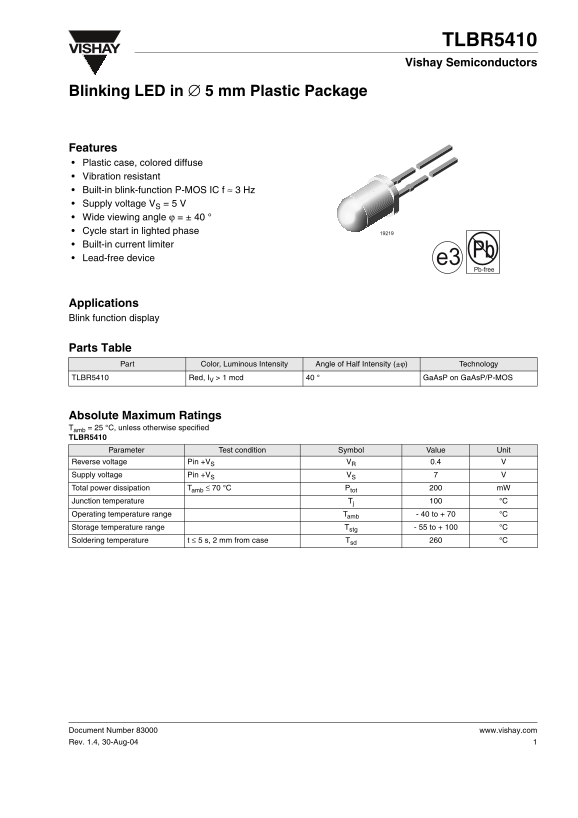
Page 1 Text Content
TLBR5410
VISHAY
Vishay Semiconductors
Blinking LED in ∅ 5 mm Plastic Package
Features Plastic case, colored diffuse Vibration resistant Built-in blink-function P-MOS IC f ≈ 3 Hz Supply voltage VS = 5 V Wide viewing angle ϕ = ± 40 Cycle start in lighted phase Built-in current limiter
Lead-free device e3
Pb-free
Applications Blink function display
Parts Table
Part Color, Luminous Intensity Angle of Half Intensity (±ϕ) Technology
TLBR5410 Red, IV > 1 mcd Ga As P on Ga As P/P-MOS
Absolute Maximum Ratings Tamb = 25 °C, unless otherwise specified TLBR5410
Parameter Test condition Symbol Value Unit
Reverse voltage Pin +VS VR 0.4 Supply voltage Pin +VS VS
Total power dissipation Tamb ≤ 70 °C Ptot m W
Junction temperature Tj °C
Operating temperature range Tamb - 40 to + 70 °C
Storage temperature range Tstg - 55 to + 100 °C
Soldering temperature t ≤ 5 s, 2 mm from case Tsd °C
Document Number 83000 www.vishay.com Rev. 1.4, 30-Aug-04
Page Summary Contents For Vishay TLBR5410 Data Sheet - Blinking LED in ∅ 5 mm Plastic Package
Manual Details
| Brand | Vishay |
|---|---|
| Pages | 7 |
| File Size | 227.56 KB |
| Published | June 06, 2026 |
Enter the captcha to get the download link:

Frequently Asked Questions
What is the safe ambient operating temperature range?
The specified operating temperature range for this device is -40 to +70°C.
Are these components suitable for medical uses?
No; the products shown herein are not designed for use in medical, life-saving, or life-sustaining applications.
How does ambient temperature affect blinking frequency?
As temperature changes, the blink frequency varies; for example, it ranges from 1.1 Hz at -40°C to 7.2 Hz at +70°C.
What is the typical supply voltage requirement?
The device generally operates optimally with a standard V = 5V supply but can handle up to 7V (depending on the maximum ratings).