Texas Instruments EGP20A - EGP20K 2.0 Ampere Glass Passivated High Efficiency Rectifiers Data Sheet
Summary
Discover the EGP20A–EGP20K series of high-efficiency, glass-passivated rectifiers designed for demanding power systems. This datasheet provides engineering professionals with comprehensive specifications, including electrical characteristics, thermal resistance data, and absolute maximum ratings across a wide voltage range (up to 800V). Ideal for electronics designers building reliable and super-efficient power supplies, these rectifiers feature high surge current capabilities and rapid recovery times, ensuring optimal performance in critical applications.
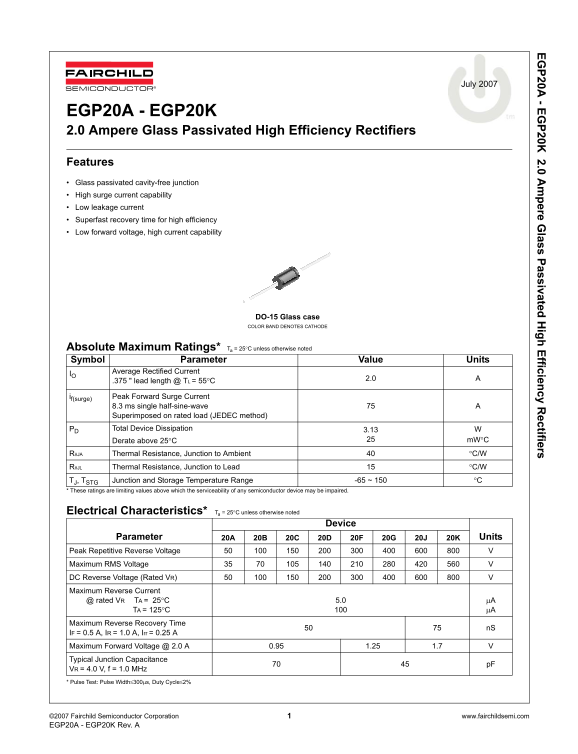
Page 1 Text Content
EG P20A - EG P20K 2.0 A pere G lass Passivated H igh Efficiency R ectifiers
July 2007
EGP20A - EGP20K 2.0 Ampere Glass Passivated High Efficiency Rectifiers
Features Glass passivated cavity-free junction High surge current capability Low leakage current Superfast recovery time for high efficiency Low forward voltage, high current capability
DO-15 Glass case COLOR BAND DENOTES CATHODE
Absolute Maximum Ratings* Ta = 25°C unless otherwise noted Symbol Parameter Value Units
Average Rectified Current
.375 " lead length @ TL = 55°C
if(surge) Peak Forward Surge Current
8.3 ms single half-sine-wave Superimposed on rated load (JEDEC method) PD Total Device Dissipation 3.13
Derate above 25°C m W°C
RθJA Thermal Resistance, Junction to Ambient °C/W RθJL Thermal Resistance, Junction to Lead °C/W TJ, TSTG Junction and Storage Temperature Range -65 ~ 150 °C * These ratings are limiting values above which the serviceability of any semiconductor device may be impaired.
Electrical Characteristics* Ta = 25°C unless otherwise noted
Device
Parameter 20B 20C 20D 20F 20G 20J 20K Units20A
Peak Repetitive Reverse Voltage Maximum RMS Voltage DC Reverse Voltage (Rated VR) Maximum Reverse Current @ rated VR TA = 25°C 5.0 μA TA = 125°C μA Maximum Reverse Recovery Time
IF = 0.5 A, IR = 1.0 A, Irr = 0.25 A Maximum Forward Voltage @ 2.0 A 0.95 1.25 1.7 Typical Junction Capacitance
VR = 4.0 V, f = 1.0 MHz * Pulse Test: Pulse Width≤300μs, Duty Cycle≤2%
©2007 Fairchild Semiconductor Corporation www.fairchildsemi.com EGP20A - EGP20K Rev. A
Page Summary Contents For Texas Instruments EGP20A - EGP20K 2.0 Ampere Glass Passivated High Efficiency Rectifiers Data Sheet
Manual Details
| Brand | Texas Instruments |
|---|---|
| Pages | 4 |
| File Size | 146.26 KB |
| Published | June 18, 2026 |
Enter the captcha to get the download link:

Frequently Asked Questions
What are the operating temperature ranges?
The junction and storage temperature range is -65 to 150 °C.
How does thermal derating work?
Device dissipation (P Total) must be derated if operation exceeds 25°C, using the RθJA value.
What is the maximum surge current capability?
The peak forward surge current f(surge) maximum rating is 75 A for an 8.3 ms single half-sine-wave pulse.
Does the product have a guaranteed low leakage current?
A typical junction capacitance of '20A' is 70 pF, and the reverse current at rated VR/TA = 25°C is 5.0 μA.
Are these components suitable for life support applications?
No, Fairchild’s products are not authorized for use as critical components in life support devices without express written approval.