Siemens KPY 41-_MR, KPY 46-MA MR Data Handbook
Summary
This robust silicon piezoresistive module provides highly stable measurement of absolute or relative pressure using a rugged stainless-steel construction. It offers excellent linearity, temperature compensation, and reliable 5 V output for diverse industrial automation applications. The comprehensive manual assists technical users and engineers by detailing full electrical specifications, operating ranges (up to 25 bar), material compatibility requirements, and precise ordering guidelines for optimal system integration.
Page 1 Text Content
Silicon Pressure Sensor Module KPY 41-MR
KPY 46-MA/MR
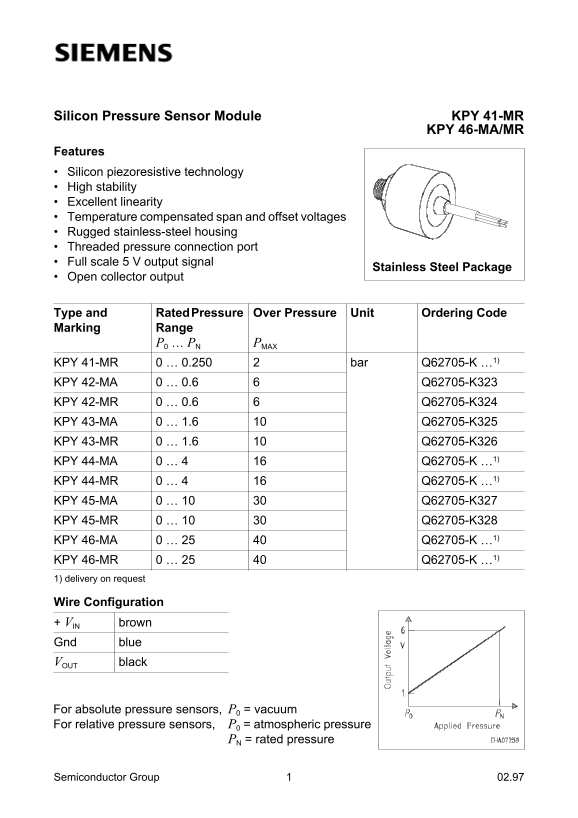
Features Silicon piezoresistive technology High stability Excellent linearity Temperature compensated span and offset voltages Rugged stainless-steel housing Threaded pressure connection port Full scale 5 V output signal
Stainless Steel Package
Open collector output
Type and Rated Pressure Over Pressure Unit Ordering Code Marking Range
P0 PN PMAX
KPY 41-MR … 0.250 bar Q62705-K …1) KPY 42-MA … 0.6 Q62705-K323 KPY 42-MR … 0.6 Q62705-K324 KPY 43-MA … 1.6 Q62705-K325 KPY 43-MR … 1.6 Q62705-K326 KPY 44-MA … 4 Q62705-K …1) KPY 44-MR … 4 Q62705-K …1) KPY 45-MA … 10 Q62705-K327 KPY 45-MR … 10 Q62705-K328 KPY 46-MA … 25 Q62705-K …1) KPY 46-MR … 25 Q62705-K …1) 1) delivery on request
Wire Configuration VIN brown Gnd blue VOUT black
For absolute pressure sensors, P0 = vacuum For relative pressure sensors, P0 = atmospheric pressure
PN = rated pressure
Semiconductor Group 02.97
Page Summary Contents For Siemens KPY 41-_MR, KPY 46-MA MR Data Handbook
Manual Details
| Brand | Siemens |
|---|---|
| Pages | 3 |
| File Size | 129.85 KB |
| Published | June 04, 2026 |
Enter the captcha to get the download link:

Frequently Asked Questions
What technology is used for measuring pressure?
The device utilizes silicon piezoresistive technology which provides high stability and excellent linearity.
What materials can the sensor safely handle regarding the applied medium?
The pressure medium cannot be ionic or otherwise conductive, as this will cause malfunction or destruction of the sensor diaphragm.
How is the sensor housed and what is its connection port like?
It features a rugged stainless-steel housing and has a threaded pressure connection port.
What electrical specifications should be noted for installation?
The device operates on a 12 to 20 V supply voltage while functioning optimally at T = 25°C.