Ricoh R1215D Series PWM Step-up DC DC Controller Manual
Summary
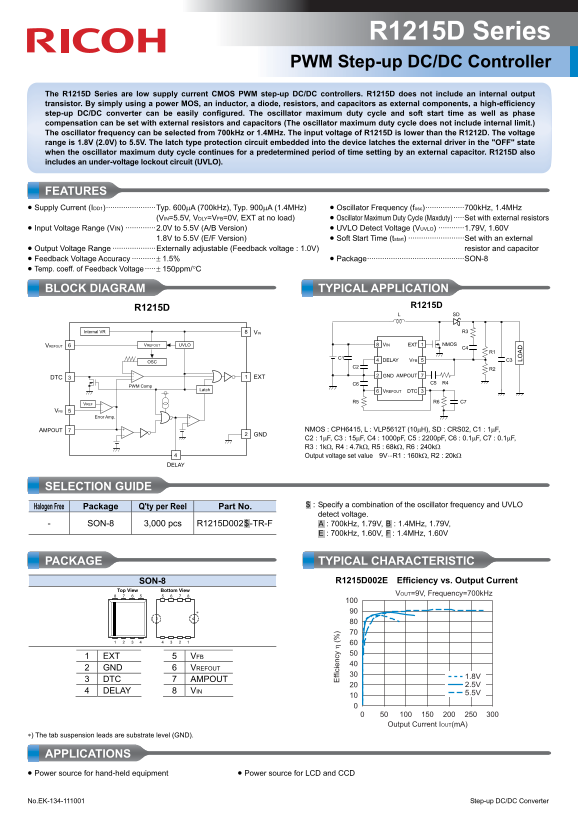
The R1215D is a high-efficiency CMOS PWM step-up DC/DC controller designed for powering handheld and consumer electronic equipment. This advanced component allows users to easily configure a step-up system using external components like MOS transistors and inductors. The product manual details technical specifications, focusing on adjustable features such as oscillator frequency (700kHz or 1.4MHz), soft start time, and inherent protection circuits like UVLO and latch type detection. It is intended for engineers developing stable power sources for applications including LCDs, CCD cameras, and various industrial electronics.
Page 1 Text Content
R1215D Series PWM Step-up DC/DC Controller
The R1215D Series are low supply current CMOS PWM step-up DC/DC controllers. R1215D does not include an internal output transistor. By simply using a power MOS, an inductor, a diode, resistors, and capacitors as external components, a high-efficiency step-up DC/DC converter can be easily configured. The oscillator maximum duty cycle and soft start time as well as phase compensation can be set with external resistors and capacitors (The oscillator maximum duty cycle does not include internal limit.) The oscillator frequency can be selected from 700k Hz or 1.4MHz. The input voltage of R1215D is lower than the R1212D. The voltage range is 1.8V (2.0V) to 5.5V. The latch type protection circuit embedded into the device latches the external driver in the "OFF" state when the oscillator maximum duty cycle continues for a predetermined period of time setting by an external capacitor. R1215D also includes an under-voltage lockout circuit (UVLO).
FEATURES • Supply Current (IDD1)·······················Typ. 600μA (700k Hz), Typ. 900μA (1.4MHz) • Oscillator Frequency (fosc)··················700k Hz, 1.4MHz
(VIN=5.5V, VDLY=VFB=0V, EXT at no load) • Oscillator Maximum Duty Cycle (Maxduty) ·····Set with external resistors
• Input Voltage Range (VIN) ··············2.0V to 5.5V (A/B Version) • UVLO Detect Voltage (VUVLO) ············1.79V, 1.60V
1.8V to 5.5V (E/F Version) • Soft Start Time (tstart) ··························Set with an external
• Output Voltage Range ····················Externally adjustable (Feedback voltage : 1.0V) resistor and capacitor • Feedback Voltage Accuracy ···········± 1.5% • Package·············································SON-8 • Temp. coeff. of Feedback Voltage·····± 150ppm/°C
BLOCK DIAGRAM TYPICAL APPLICATION
Internal VR VIN R3
ffi ci en cy
VREFOUT VREFOUT UVLO VIN EXT NMOS
OSC DELAY VFB C3
EXT GND AMPOUT
PWM Comp
Latch VREFOUT DTC
Error Amp.
AMPOUT NMOS : CPH6415, L : VLP5612T (10μH), SD : CRS02, C1 : 1μF,
C2 : 1μF, C3 : 15μF, C4 : 1000p F, C5 : 2200p F, C6 : 0.1μF, C7 : 0.1μF, R3 : 1kΩ, R4 : 4.7kΩ, R5 : 68kΩ, R6 : 240kΩ Output voltage set value 9V⋅⋅⋅R1 : 160kΩ, R2 : 20kΩ
DELAY
SELECTION GUIDE
.$. : Specify a combination of the oscillator frequency and UVLO
Halogen Free Package Q'ty per Reel Part No.
detect voltage.
LO AD
- SON-8 3,000 pcs R1215D002.$ -TR-F .A. : 700k Hz, 1.79V, .B. : 1.4MHz, 1.79V, .E. : 700k Hz, 1.60V, .F. : 1.4MHz, 1.60V
PACKAGE TYPICAL CHARACTERISTIC
SON-8 R1215D002E Efficiency vs. Output Current
Bottom View Top View
VOUT=9V, Frequency=700k Hz
1 EXT VFB 2 GND VREFOUT
3 DTC AMPOUT
4 DELAY VIN 5.5V
Output Current IOUT(m A)
∗) The tab suspension leads are substrate level (GND).
APPLICATIONS • Power source for hand-held equipment • Power source for LCD and CCD
No.EK-134-111001 Step-up DC/DC Converter
Page Summary Contents For Ricoh R1215D Series PWM Step-up DC DC Controller Manual
Manual Details
| Brand | Ricoh |
|---|---|
| Pages | 2 |
| File Size | 173.84 KB |
| Published | June 02, 2026 |
Enter the captcha to get the download link:
