Panasonic MAZ2xxx Series Data Handbook
Summary
These Zener Diodes are designed for critical power supply stabilization, ensuring a reliable, constant voltage output in electronic systems. This comprehensive manual provides detailed specifications and operating parameters for the entire MAZ2xxx series, covering essential electrical characteristics, absolute maximum ratings, and model-specific details via color coding. It is essential reading for electronic engineers, hardware designers, and technical professionals building communications equipment, measuring instruments, and industrial control applications who require high reliability voltage regulation.
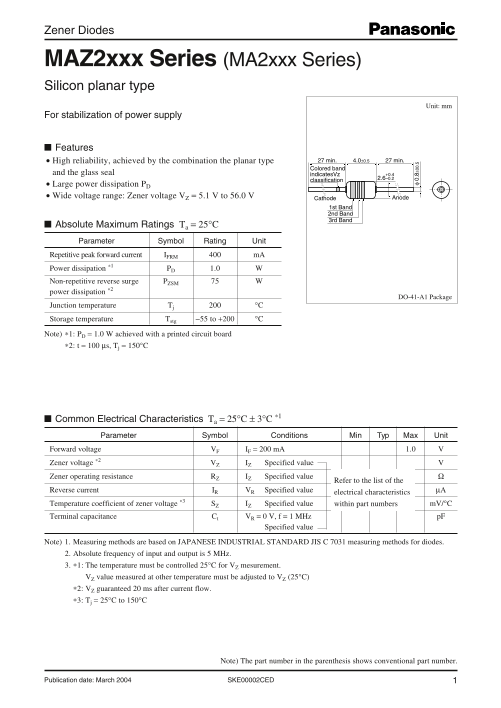
Page 1 Text Content
Zener Diodes
MAZ2xxx Series (MA2xxx Series) Silicon planar type
Unit: mm
For stabilization of power supply
Features
High reliability, achieved by the combination the planar type 27 min. 4.0±0.5 27 min. Colored band
and the glass seal indicates Vz +0.4
classification
Large power dissipation PD Wide voltage range: Zener voltage VZ = 5.1 V to 56.0 V Anode
Cathode 1st Band 2nd Band 3rd Band
Absolute Maximum Ratings Ta = 25°C Parameter Symbol Rating Unit Repetitive peak forward current IFRM m A Power dissipation *1 PD 1.0 Non-repetitive reverse surge PZSM power dissipation *2
DO-41-A1 Package
Junction temperature Tj °C Storage temperature Tstg −55 to +200 °C Note) *1: PD = 1.0 W achieved with a printed circuit board *2: t = 100 µs, Tj = 150°C
Common Electrical Characteristics Ta = 25°C ± 3°C *1
Parameter Symbol Conditions Min Typ Max Unit
Forward voltage VF IF = 200 m A 1.0 Zener voltage *2 VZ IZ Specified value Zener operating resistance RZ IZ Specified value
Refer to the list of the
Reverse current IR VR Specified value µA
electrical characteristics
Temperature coefficient of zener voltage *3 SZ IZ Specified value within part numbers m V/°C Terminal capacitance Ct VR = 0 V, f = 1 MHz p F
Specified value
Note) 1. Measuring methods are based on JAPANESE INDUSTRIAL STANDARD JIS C 7031 measuring methods for diodes. 2. Absolute frequency of input and output is 5 MHz. 3. *1: The temperature must be controlled 25°C for VZ mesurement.
VZ value measured at other temperature must be adjusted to VZ (25°C) *2: VZ guaranteed 20 ms after current flow. *3: Tj = 25°C to 150°C
Note) The part number in the parenthesis shows conventional part number.
SKE00002CED 1Publication date: March 2004
Page Summary Contents For Panasonic MAZ2xxx Series Data Handbook
Manual Details
| Brand | Panasonic |
|---|---|
| Pages | 5 |
| File Size | 114.64 KB |
| Published | June 04, 2026 |
Enter the captcha to get the download link:

Frequently Asked Questions
What is the maximum allowed operational power dissipation ($P_D$)?
The repetitive peak forward current has a maximum rated power dissipation of 1.0 W, which must be achieved using a printed circuit board.
Are there special or non-standard applications requiring specific advice?
Yes; for specialized uses like aerospace or automotive equipment where high reliability is needed, customers should consult sales staff in advance.
If I test the Zener voltage at a temperature other than 25°C, how must I proceed?
The $V_Z$ value measured at any temperature other than 25°C must be adjusted to reflect the standard rating at 25°C.