MOTOROLA 56857 Data Sheet
Summary
This high-performance Hybrid MCU/DSP features a 120 MIPS core, making it ideal for complex embedded applications like advanced telephony systems, automotive controls, and medical devices. Equipped with abundant peripherals—including DMA, Quad Timers, multiple serial interfaces, and Time of Day functions—it supports everything from voice recognition to surround sound output. The accompanying manual provides comprehensive technical details on integration, development environment setup, memory architecture, and real-time debugging methods, guiding embedded engineers in creating efficient, scalable solutions for diverse consumer electronics markets.
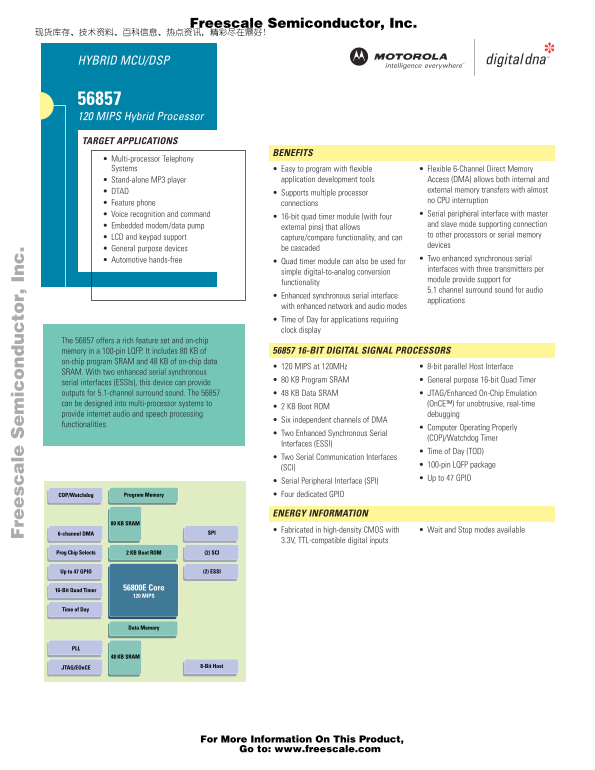
Page 1 Text Content
re sc le ic to r, Freescale Semiconductor, Inc.
HYBRID MCU/DSP
120 MIPS Hybrid Processor
TARGET APPLICATIONS
BENEFITS
Multi-processor Telephony Systems Easy to program with flexible Flexible 6-Channel Direct Memory
Stand-alone MP3 player application development tools Access (DMA) allows both internal and DTAD external memory transfers with almost
Supports multiple processor
no CPU interruption
Feature phone connections
Voice recognition and command Serial peripheral interface with master
16-bit quad timer module (with four
Embedded modem/data pump and slave mode supporting connection
external pins) that allows
to other processors or serial memory
LCD and keypad support capture/compare functionality, and can
devices
General purpose devices be cascaded
Automotive hands-free Two enhanced synchronous serial
Quad timer module can also be used for
interfaces with three transmitters per
simple digital-to-analog conversion
module provide support for
functionality
5.1 channel surround sound for audio
Enhanced synchronous serial interface
applications
with enhanced network and audio modes Time of Day for applications requiring clock display
The 56857 offers a rich feature set and on-chip
memory in a 100-pin LQFP. It includes 80 KB of 56857 16-BIT DIGITAL SIGNAL PROCESSORS
on-chip program SRAM and 48 KB of on-chip data
120 MIPS at 120MHz 8-bit parallel Host Interface
SRAM. With two enhanced serial synchronous
80 KB Program SRAM General purpose 16-bit Quad Timer
serial interfaces (ESSIs), this device can provide outputs for 5.1-channel surround sound. The 56857 48 KB Data SRAM JTAG/Enhanced On-Chip Emulation can be designed into multi-processor systems to (On CE™) for unobtrusive, real-time
2 KB Boot ROM
provide internet audio and speech processing debugging
Six independent channels of DMA
functionalities.
Computer Operating Properly
Two Enhanced Synchronous Serial
(COP)/Watchdog Timer
Interfaces (ESSI)
Time of Day (TOD)
Two Serial Communication Interfaces
100-pin LQFP package
(SCI)
Up to 47 GPIO
Serial Peripheral Interface (SPI)
COP/Watchdog Program Memory Four dedicated GPIO
ENERGY INFORMATION
80 KB SRAM
Fabricated in high-density CMOS with Wait and Stop modes available
6-channel DMA SPI
3.3V, TTL-compatible digital inputs
Prog Chip Selects 2 KB Boot ROM (2) SCI
Up to 47 GPIO (2) ESSI
16-Bit Quad Timer 56800E Core 120 MIPS
Time of Day
Data Memory
48 KB SRAM
JTAG/EOn CE 8-Bit Host
For More Information On This Product, Go to: www.freescale.com
Page Summary Contents For MOTOROLA 56857 Data Sheet
Manual Details
| Brand | Motorola |
|---|---|
| Pages | 2 |
| File Size | 263.25 KB |
| Published | May 27, 2026 |
Enter the captcha to get the download link:

Frequently Asked Questions
What is the operating frequency and performance of the 56857 processor?
The device operates at 120 MIPS, running at a core frequency of 120MHz.
What types of on-chip memory are available?
It includes 80 KB Program SRAM, 48 KB Data SRAM, and 2 KB Boot ROM.
Which standard interfaces does the 56857 support for audio and serial data?
It supports 5.1-channel surround sound, SPI, two Serial Communication Interfaces (SCI), and Enhanced Synchronous Serial Interfaces (ESSI).
How is real-time debugging supported in multi-processor designs?
Debugging can be done using JTAG/Enhanced On-Chip Emulation (OnCE™) for unobtrusive, real-time monitoring.