LINEAR TECHNOLOGY - 1 LT1078 LT1079 Data Sheet Manual
Summary
The LT1078/LT1079 are professional micropower operational amplifiers designed for high-precision, low-power applications. These dual and quad op amps excel in single-supply operation, requiring minimal current ideal for battery or solar-powered instrumentation. The comprehensive manual details performance specifications, including ultra-low voltage noise, offset voltages, and wide input ranges, making these components perfect for remote sensing, portable test equipment, and satellite circuitry development.
Page 1 Text Content
LT1078/LT1079
Micropower, Dual and
Quad, Single Supply, Precision Op Amps
FEATURES DESCRIPTIO ®1078 is a micropower dual op amp in 8-pin Available in 8-Pin SO Package The LT 50µA Max Supply Current per Amplifier packages including the small outline surface mount pack- 70µV Max Offset Voltage age. The LT1079 is a micropower quad op amp offered in 180µA Max Offset Voltage in 8-Pin SO the standard 14-pin packages. Both devices are optimized 250p A Max Offset Current for single supply operation at 5V. ±15V specifications are 0.6µVP-P, 0.1Hz to 10Hz Voltage Noise also provided.
3p AP-P, 0.1Hz to 10Hz Current Noise
Micropower performance of competing devices is achieved
0.4µV/°C Offset Voltage Drift
at the expense of seriously degrading precision, noise,
200k Hz Gain Bandwidth Product
speed and output drive specifications. The design effort of
0.07V/µs Slew Rate
the LT1078/LT1079 was concentrated on reducing sup-
Single Supply Operation
ply current without sacrificing other parameters. The
Input Voltage Range Includes Ground
offset voltage achieved is the lowest on any dual or quad
Output Swings to Ground while Sinking Current
nonchopper stabilized op amp—micropower or other-
No Pull-Down Resistors Needed
wise. Offset current, voltage and current noise, slew rate
Output Sources and Sinks 5m A Load Current
and gain bandwidth product are all two to ten times better than on previous micropower op amps.
APPLICATIO The 1/f corner of the voltage noise spectrum is at 0.7Hz,
PE RC EN OF NI TS at least three times lower than on any monolithic op amp.
Battery or Solar-Powered Systems
This results in low frequency (0.1Hz to 10Hz) noise
Portable Instrumentation
performance which can only be found on devices with an
Remote Sensor Amplifier
order of magnitude higher supply current.
Satellite Circuitry Micropower Sample-and-Hold Both the LT1078 and LT1079 can be operated from a Thermocouple Amplifier single supply (as low as one lithium cell or two Ni-Cad Micropower Filters batteries). The input range goes below ground. The all-
NPN output stage swings to within a few millivolts of ground while sinking current—no power consuming pull
, LTC and LT are registered trademarks of Linear Technology Corporation. down resistors are needed.
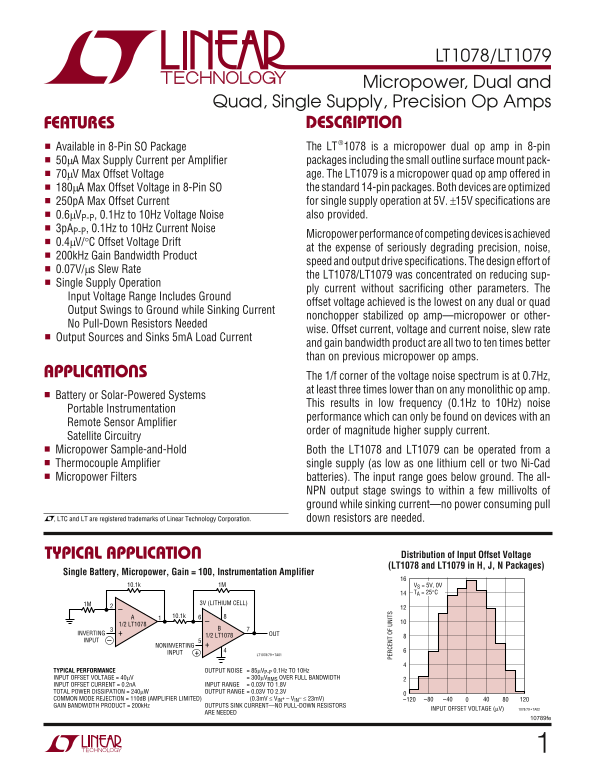
TYPICAL APPLICATIO Distribution of Input Offset Voltage (LT1078 and LT1079 in H, J, N Packages)
Single Battery, Micropower, Gain = 100, Instrumentation Amplifier
10.1k 1M VS = 5V, 0V
TA = 25°C
1M 3V (LITHIUM CELL)
1/2 LT1078
INVERTING OUT
1/2 LT1078
INPUT
NONINVERTING INPUT LT1078/79 • TA01
TYPICAL PERFORMANCE OUTPUT NOISE = 85µVP-P 0.1Hz TO 10Hz INPUT OFFSET VOLTAGE = 40µV = 300µVRMS OVER FULL BANDWIDTH
INPUT OFFSET CURRENT = 0.2n A INPUT RANGE = 0.03V TO 1.8V TOTAL POWER DISSIPATION = 240µW OUTPUT RANGE = 0.03V TO 2.3V
COMMON MODE REJECTION = 110d B (AMPLIFIER LIMITED) (0.3m V ≤ VIN+ – VIN– ≤ 23m V) –120 –80 –40
GAIN BANDWIDTH PRODUCT = 200k Hz OUTPUTS SINK CURRENT—NO PULL-DOWN RESISTORS
INPUT OFFSET VOLTAGE (µV) 1078/79 • TA02
ARE NEEDED
10789fe
Page Summary Contents For LINEAR TECHNOLOGY - 1 LT1078 LT1079 Data Sheet Manual
Manual Details
| Brand | Linear |
|---|---|
| Pages | 20 |
| File Size | 327.48 KB |
| Published | May 30, 2026 |
Enter the captcha to get the download link:

Frequently Asked Questions
What is the difference between the LT1078 and LT1079?
The LT1078 is a micropower dual op amp, while the LT1079 is a quad op amp. Both are optimized for single supply operation.
Can these amplifiers operate from batteries or solar sources?
Yes, both devices can be operated on a single supply, using low power sources like a lithium cell or Ni-Cad batteries.
Is the LT1078/LT1079 suitable for instrumentation applications with ground swing?
The typical input offset voltage for both devices shown in the application example is 40µV over full bandwidth RMS.