LINEAR Application Note AN32 High Efficiency Linear Regulators User Guide
Summary
This technical application guide provides an in-depth comparison and optimal selection criteria for linear versus switching voltage regulators. It covers crucial aspects of power efficiency, dropout voltage minimization, and thermal management required for reliable circuit design. Ideal for electrical engineers or power electronics designers needing to maximize energy savings while selecting the most appropriate regulation method, particularly when handling unstable AC line inputs.
Page 1 Text Content
Application Note 32 March 1989
High Effi ciency Linear Regulators Jim Williams
Introduction
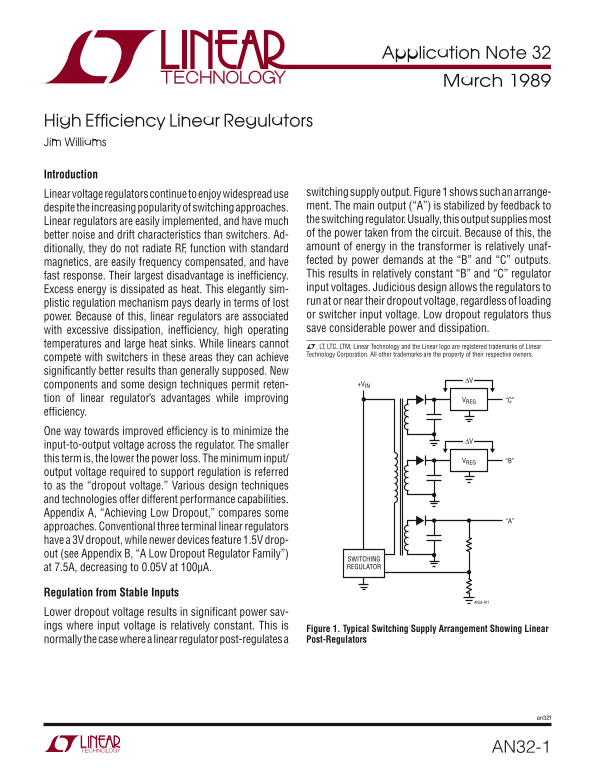
Linear voltage regulators continue to enjoy widespread use switching supply output. Figure 1 shows such an arrange- despite the increasing popularity of switching approaches. ment. The main output (“A”) is stabilized by feedback to Linear regulators are easily implemented, and have much the switching regulator. Usually, this output supplies most better noise and drift characteristics than switchers. Ad- of the power taken from the circuit. Because of this, the ditionally, they do not radiate RF, function with standard amount of energy in the transformer is relatively unaf- magnetics, are easily frequency compensated, and have fected by power demands at the “B” and “C” outputs. fast response. Their largest disadvantage is ineffi ciency. This results in relatively constant “B” and “C” regulator Excess energy is dissipated as heat. This elegantly sim- input voltages. Judicious design allows the regulators to plistic regulation mechanism pays dearly in terms of lost run at or near their dropout voltage, regardless of loading power. Because of this, linear regulators are associated or switcher input voltage. Low dropout regulators thus with excessive dissipation, ineffi ciency, high operating save considerable power and dissipation.
temperatures and large heat sinks. While linears cannot L, LT, LTC, LTM, Linear Technology and the Linear logo are registered trademarks of Linear
Technology Corporation. All other trademarks are the property of their respective owners.
compete with switchers in these areas they can achieve signifi cantly better results than generally supposed. New
components and some design techniques permit reten- +VIN
tion of linear regulator’s advantages while improving VREG “C” effi ciency.
One way towards improved effi ciency is to minimize the input-to-output voltage across the regulator. The smaller this term is, the lower the power loss. The minimum input/ VREG “B” output voltage required to support regulation is referred to as the “dropout voltage.” Various design techniques and technologies offer different performance capabilities. Appendix A, “Achieving Low Dropout,” compares some
approaches. Conventional three terminal linear regulators have a 3V dropout, while newer devices feature 1.5V drop- out (see Appendix B, “A Low Dropout Regulator Family”)
SWITCHING at 7.5A, decreasing to 0.05V at 100μA. REGULATOR
Regulation from Stable Inputs
AN32 F01
Lower dropout voltage results in signifi cant power sav- ings where input voltage is relatively constant. This is
Figure 1. Typical Switching Supply Arrangement Showing Linear normally the case where a linear regulator post-regulates a Post-Regulators
an32f
AN32-1
Page Summary Contents For LINEAR Application Note AN32 High Efficiency Linear Regulators User Guide
Manual Details
| Brand | Linear |
|---|---|
| Pages | 12 |
| File Size | 798.64 KB |
| Published | June 06, 2026 |
Enter the captcha to get the download link:

Frequently Asked Questions
What level of dropout voltage is achievable with newer regulators?
Newer devices feature a lower dropout voltage, such as 1.5V, compared to conventional three terminal regulators which have a 3V dropout.
How do fluctuating AC line voltages impact regulator efficiency?
AC line swing causes the linear regulator's efficiency to degrade significantly due to proportionate input voltage change, particularly noticeable at lower output voltages.
What is a key safety warning for this circuit board?
Extreme caution must be used because of dangerous, AC line-connected high voltage potentials. Do not connect grounded floating test equipment.
What performance characteristic do linear regulators offer over switchers?
Linear regulators generally provide better noise and drift characteristics than switching approaches, and they also minimize RF radiation.