LINEAR Application Note 131
Summary
Discover Acoustic Thermometry, a novel, non-traditional method for precise temperature measurement utilizing the sound's time-dependent transit delay within any medium—gas, liquid, or solid. This guide details the fundamental principles of this technique, which reports path delay rather than relying on conventional sensors susceptible to environmental fluctuations. It is essential reading for engineers and students requiring ultra-stable, high-fidelity temperature sensors capable of operating in extreme or challenging environments.
Page 1 Text Content
Application Note 131 February 2011
An Introduction to Acoustic Thermometry An Air Filled Olive Jar Teaches Signal Conditioning Jim Williams and Omar Sanchez-Felipe
Introduction is the measurand. Additionally, an acoustic thermometer’s
reported “temperature” represents the total measurement
We occasionally lecture to university engineering students.
path transit time as opposed to a conventional sensor’s
A goal of these lectures is to present technology in a novel,
single point determination. As such, an acoustic thermom-
even charming, way. This hopefully entices the student
eter is blind to temperature variations within the measure-
towards the topic; an aroused curiosity is fertile ground
ment path. It reports the measurement path’s delay as its
for education. One such lecture investigates acoustic ther-
“temperature,” whether or not the path is iso-thermal.
mometry as an example of signal conditioning techniques. This subject has drawn enough interest that it is presented A pleasant surprise is that the sonic transit time in a gas here for wider dissemination and as supplementary mate- path thermometer is almost entirely insensitive to pressure rial for future acoustic thermometry lectures. and humidity, leaving temperature as the sole determinant.
Additionally, sonic speed in air varies predictably as the
Acoustic Thermometry square root of temperature. Acoustic thermometry is an arcane, elegant temperature
Practical Considerations
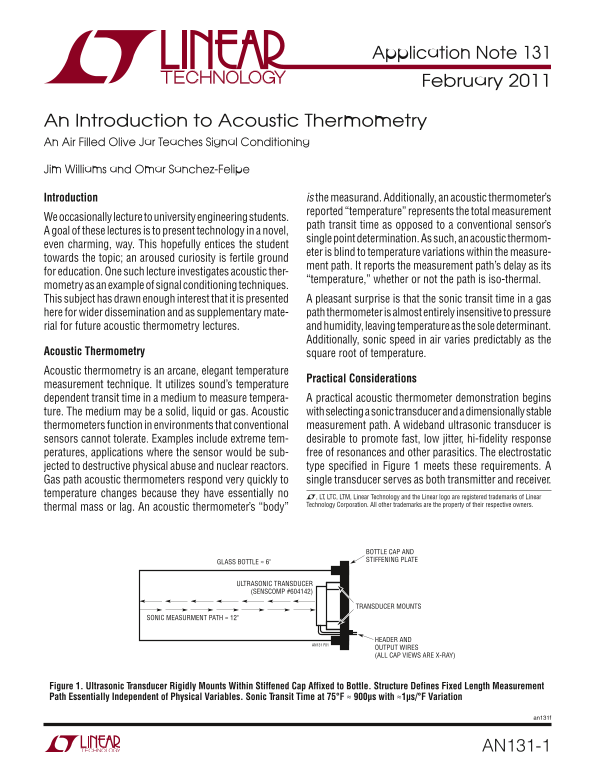
measurement technique. It utilizes sound’s temperature dependent transit time in a medium to measure tempera- A practical acoustic thermometer demonstration begins ture. The medium may be a solid, liquid or gas. Acoustic with selecting a sonic transducer and a dimensionally stable thermometers function in environments that conventional measurement path. A wideband ultrasonic transducer is sensors cannot tolerate. Examples include extreme tem- desirable to promote fast, low jitter, hi-fidelity response peratures, applications where the sensor would be sub- free of resonances and other parasitics. The electrostatic jected to destructive physical abuse and nuclear reactors. type specified in Figure 1 meets these requirements. A Gas path acoustic thermometers respond very quickly to single transducer serves as both transmitter and receiver. temperature changes because they have essentially no
L, LT, LTC, LTM, Linear Technology and the Linear logo are registered trademarks of Linear Technology Corporation. All other trademarks are the property of their respective owners.
thermal mass or lag. An acoustic thermometer’s “body”
BOTTLE CAP AND STIFFENING PLATE
GLASS BOTTLE ≈ 6"
ULTRASONIC TRANSDUCER (SENSCOMP #604142)
TRANSDUCER MOUNTS
SONIC MEASURMENT PATH ≈ 12"
HEADER AND
AN131 F01
OUTPUT WIRES (ALL CAP VIEWS ARE X-RAY)
Figure 1. Ultrasonic Transducer Rigidly Mounts Within Stiffened Cap Affixed to Bottle. Structure Defines Fixed Length Measurement Path Essentially Independent of Physical Variables. Sonic Transit Time at 75°F ≈ 900µs with ≈1µs/°F Variation
an131f
AN131-1
Page Summary Contents For LINEAR Application Note 131
Manual Details
| Brand | Linear |
|---|---|
| Pages | 16 |
| File Size | 445.49 KB |
| Published | June 05, 2026 |
Enter the captcha to get the download link:
