LINEAR Application Note 95 Data Handbook
Summary
This essential guide provides technical analysis and a comparative overview of flash illumination sources for advanced cellular cameras. It details the performance differences between traditional xenon flashlamps and modern LED arrays, helping engineers determine the optimal lighting solution. The manual covers critical performance metrics, including light output consistency, ideal color temperature range (5500K–6000K), and power efficiency, allowing developers to ensure high-quality imaging capabilities for next-generation mobile devices.
Page 1 Text Content
Application Note 95
March 2004
Simple Circuitry for Cellular Telephone/Camera Flash Illumination A Practical Guide for Successfully Implementing Flashlamps Jim Williams and Albert Wu
INTRODUCTION Next generation cellular telephones will include high qual- Their line source light output is hundreds of times greater ity photographic capability. Improved image sensors and than point source LEDs, resulting in dense, easily diffused optics are readily utilized, but high quality “Flash” illumi- light over a wide area. Additionally, the flashlamp color nation requires special attention. Flash lighting is crucial temperature of 5500°K to 6000°K, quite close to natural for obtaining good photographic performance and must light, eliminates the color correction necessitated by a be quite carefully considered. white LED’s blue peaked output.
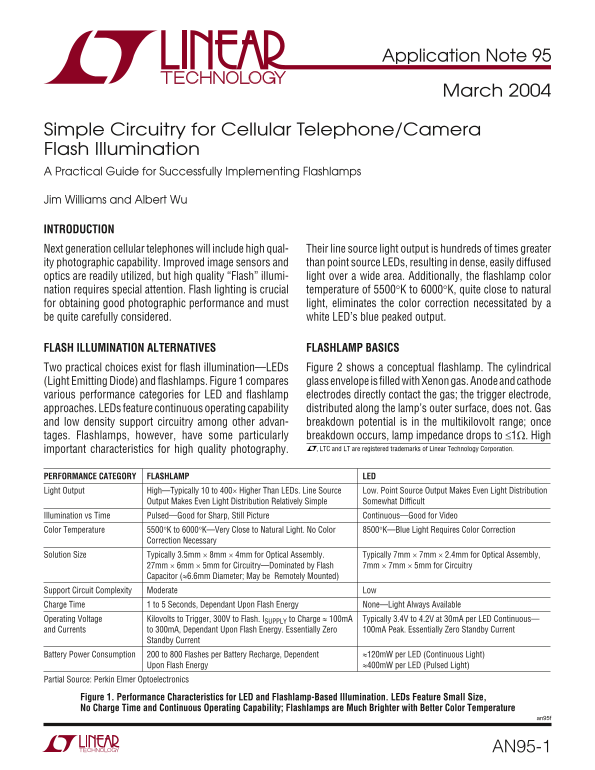
FLASH ILLUMINATION ALTERNATIVES FLASHLAMP BASICS Two practical choices exist for flash illumination—LEDs Figure 2 shows a conceptual flashlamp. The cylindrical (Light Emitting Diode) and flashlamps. Figure 1 compares glass envelope is filled with Xenon gas. Anode and cathode various performance categories for LED and flashlamp electrodes directly contact the gas; the trigger electrode, approaches. LEDs feature continuous operating capability distributed along the lamp’s outer surface, does not. Gas and low density support circuitry among other advan- breakdown potential is in the multikilovolt range; once tages. Flashlamps, however, have some particularly breakdown occurs, lamp impedance drops to ≤1Ω. High
important characteristics for high quality photography. , LTC and LT are registered trademarks of Linear Technology Corporation.
PERFORMANCE CATEGORY FLASHLAMP LED Light Output High—Typically 10 to 400× Higher Than LEDs. Line Source Low. Point Source Output Makes Even Light Distribution
Output Makes Even Light Distribution Relatively Simple Somewhat Difficult
Illumination vs Time Pulsed—Good for Sharp, Still Picture Continuous—Good for Video Color Temperature 5500°K to 6000°K—Very Close to Natural Light. No Color 8500°K—Blue Light Requires Color Correction
Correction Necessary
Solution Size Typically 3.5mm × 8mm × 4mm for Optical Assembly. Typically 7mm × 7mm × 2.4mm for Optical Assembly,
27mm × 6mm × 5mm for Circuitry—Dominated by Flash 7mm × 7mm × 5mm for Circuitry Capacitor (≈6.6mm Diameter; May be Remotely Mounted)
Support Circuit Complexity Moderate Low Charge Time 1 to 5 Seconds, Dependant Upon Flash Energy None—Light Always Available Operating Voltage Kilovolts to Trigger, 300V to Flash. ISUPPLY to Charge ≈ 100m A Typically 3.4V to 4.2V at 30m A per LED Continuous— and Currents to 300m A, Dependant Upon Flash Energy. Essentially Zero 100m A Peak. Essentially Zero Standby Current
Standby Current
Battery Power Consumption 200 to 800 Flashes per Battery Recharge, Dependent ≈120m W per LED (Continuous Light)
Upon Flash Energy ≈400m W per LED (Pulsed Light)
Partial Source: Perkin Elmer Optoelectronics
Figure 1. Performance Characteristics for LED and Flashlamp-Based Illumination. LEDs Feature Small Size, No Charge Time and Continuous Operating Capability; Flashlamps are Much Brighter with Better Color Temperature
an95f
AN95-1
Page Summary Contents For LINEAR Application Note 95 Data Handbook
Manual Details
| Brand | Linear |
|---|---|
| Pages | 12 |
| File Size | 649.02 KB |
| Published | June 21, 2026 |
Enter the captcha to get the download link:

Frequently Asked Questions
What is the ideal color temperature for flash illumination?
The flashlamp color temperature should be between 5500°K to 6000°K, which is close to natural light.
How do LEDs compare to traditional flashlamps in terms of usage?
LEDs offer continuous operating capability and small size, while flashlamps are much brighter with better color temperature.
What is the typical charge time for a flashlamp capacitor circuit?
Charge times for flashlamps range from 1 to 5 seconds, depending on available input power and capacitor value.
Does using LEDs require any necessary color correction?
No, blue-peaked LED output requires no color correction, unlike some alternative sources.