LINEAR Application Note 93 Specifications User Guide
Summary
The LTC1799 is a highly accurate and broadly tunable monolithic oscillator ideal for demanding instrumentation applications. This manual details the device's use in generating stable clock signals with performance that bridges the gap between fixed resonator types and traditional RC oscillators. Learn how to achieve excellent temperature stability, programmable frequency output (1kHz to 33MHz), and minimize EMI using its simple, robust design features. It is perfect for engineers needing a dependable, high-performance oscillator solution in compact electronic devices.
Page 1 Text Content
Application Note 93 February 2003
Instrumentation Applications for a Monolithic Oscillator A Clock for All Reasons Jim Williams
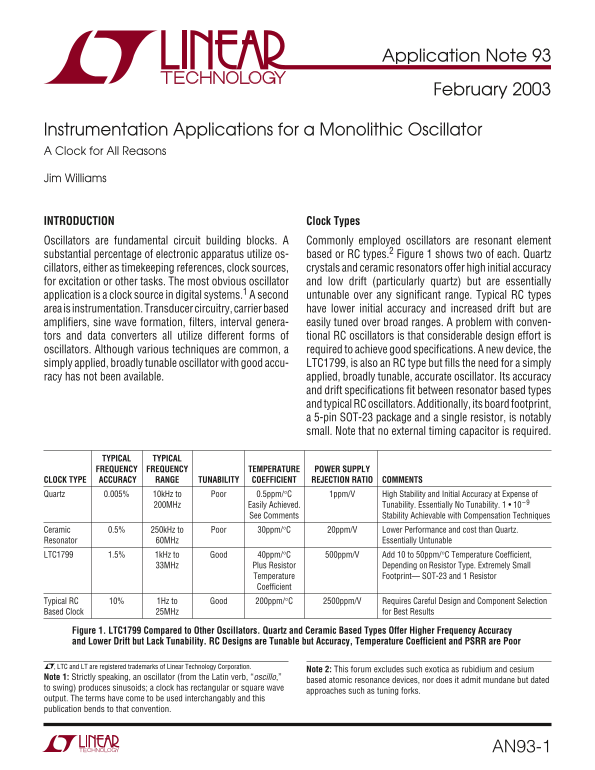
INTRODUCTION Clock Types Oscillators are fundamental circuit building blocks. A Commonly employed oscillators are resonant element substantial percentage of electronic apparatus utilize os- based or RC types.2 Figure 1 shows two of each. Quartz cillators, either as timekeeping references, clock sources, crystals and ceramic resonators offer high initial accuracy for excitation or other tasks. The most obvious oscillator and low drift (particularly quartz) but are essentially application is a clock source in digital systems.1 A second untunable over any significant range. Typical RC types area is instrumentation. Transducer circuitry, carrier based have lower initial accuracy and increased drift but are amplifiers, sine wave formation, filters, interval genera- easily tuned over broad ranges. A problem with conven- tors and data converters all utilize different forms of tional RC oscillators is that considerable design effort is oscillators. Although various techniques are common, a required to achieve good specifications. A new device, the simply applied, broadly tunable oscillator with good accu- LTC1799, is also an RC type but fills the need for a simply racy has not been available. applied, broadly tunable, accurate oscillator. Its accuracy
and drift specifications fit between resonator based types and typical RC oscillators. Additionally, its board footprint, a 5-pin SOT-23 package and a single resistor, is notably small. Note that no external timing capacitor is required.
TYPICAL TYPICAL FREQUENCY FREQUENCY TEMPERATURE POWER SUPPLY
CLOCK TYPE ACCURACY RANGE TUNABILITY COEFFICIENT REJECTION RATIO COMMENTS Quartz 0.005% 10k Hz to Poor 0.5ppm/°C 1ppm/V High Stability and Initial Accuracy at Expense of
200MHz Easily Achieved. Tunability. Essentially No Tunability. 1 • 10–9
See Comments Stability Achievable with Compensation Techniques
Ceramic 0.5% 250k Hz to Poor 30ppm/°C 20ppm/V Lower Performance and cost than Quartz. Resonator 60MHz Essentially Untunable LTC1799 1.5% 1k Hz to Good 40ppm/°C 500ppm/V Add 10 to 50ppm/°C Temperature Coefficient,
33MHz Plus Resistor Depending on Resistor Type. Extremely Small
Temperature Footprint— SOT-23 and 1 Resistor Coefficient
Typical RC 10% 1Hz to Good 200ppm/°C 2500ppm/V Requires Careful Design and Component Selection Based Clock 25MHz for Best Results
Figure 1. LTC1799 Compared to Other Oscillators. Quartz and Ceramic Based Types Offer Higher Frequency Accuracy and Lower Drift but Lack Tunability. RC Designs are Tunable but Accuracy, Temperature Coefficient and PSRR are Poor
, LTC and LT are registered trademarks of Linear Technology Corporation.
Note 2: This forum excludes such exotica as rubidium and cesium
Note 1: Strictly speaking, an oscillator (from the Latin verb, “oscillo,”
based atomic resonance devices, nor does it admit mundane but dated
to swing) produces sinusoids; a clock has rectangular or square wave
approaches such as tuning forks.
output. The terms have come to be used interchangably and this publication bends to that convention.
AN93-1
Page Summary Contents For LINEAR Application Note 93 Specifications User Guide
Manual Details
| Brand | Linear |
|---|---|
| Pages | 20 |
| File Size | 1.05 MB |
| Published | June 19, 2026 |
Enter the captcha to get the download link:

Frequently Asked Questions
Which oscillator type offers the best combination of accuracy, tunability, and size?
The LTC1799 fills this need, offering broad tunability, good accuracy, and a tiny SOT-23 board footprint with just one resistor, eliminating the need for external timing capacitors.
What are the advantages of using the LTC1799 over standard oscillator types?
Compared to quartz/ceramic (less tunable) and typical RC oscillators (poor accuracy/temperature coefficient), the LTC1799 provides a versatile balance with high stability and tunability in a small package.
How can I program or adjust the output frequency of the LTC1799?
The device's internal clock is programmed using a single resistor (R) connected to the R pin, and the output frequency can be further scaled via settable decade dividers.