FAIRCHILD Single-Channel 6N138, 6N139 Dual-Channel HCPL-2730, HCPL-2731 Low Input Current High Gain Split Darlington Optocouplers User Manual
Summary
These low input current, high gain optocouplers are engineered to provide superior signal isolation for various electronic systems. This technical guide details single-channel (6N138/6N139) and dual-channel (HCPL-2730/HCPL-2731) devices featuring a stable Split Darlington structure. The manual covers comprehensive electrical characteristics, transfer curves, and robust performance metrics, making it essential for engineers designing interfaces that require high common mode rejection (CMR), rapid switching, or specialized line receiver isolation (e.g., RS-232C).
Page 1 Text Content
查询6N138S供应商 Single-Channel: 6N138, 6N139 Dual-Channel: HCPL-2730, HCPL-2731 Low Input Current High Gain Split Darlington Optocouplers
July 2005
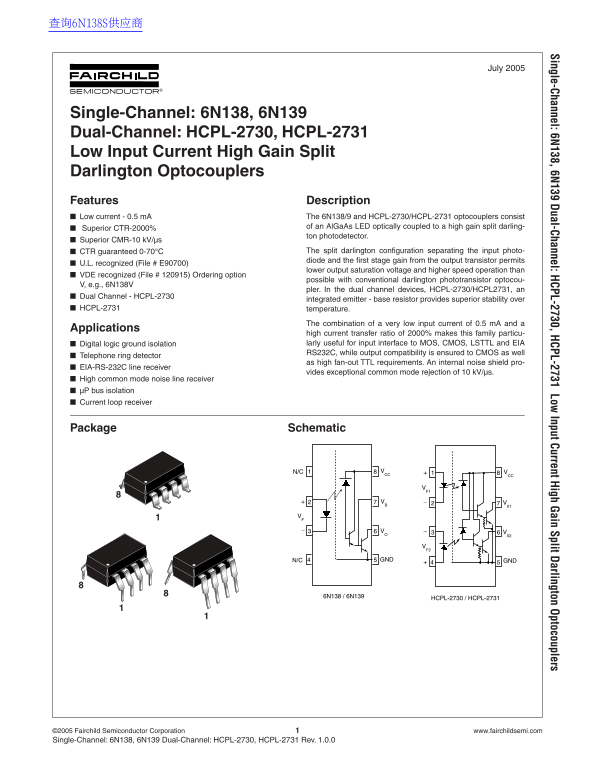
Single-Channel: 6N138, 6N139 Dual-Channel: HCPL-2730, HCPL-2731 Low Input Current High Gain Split Darlington Optocouplers Features Description Low current - 0.5 m A The 6N138/9 and HCPL-2730/HCPL-2731 optocouplers consist
of an Al Ga As LED optically coupled to a high gain split darling-
Superior CTR-2000%
ton photodetector.
Superior CMR-10 k V/µs
CTR guaranteed 0-70°C The split darlington configuration separating the input photo- diode and the first stage gain from the output transistor permits
U.L. recognized (File # E90700)
lower output saturation voltage and higher speed operation than
VDE recognized (File # 120915) Ordering option
possible with conventional darlington phototransistor optocou-
pler. In the dual channel devices, HCPL-2730/HCPL2731, an
Dual Channel - HCPL-2730
integrated emitter - base resistor provides superior stability over
HCPL-2731 temperature.
The combination of a very low input current of 0.5 m A and a
Applications
high current transfer ratio of 2000% makes this family particu- Digital logic ground isolation larly useful for input interface to MOS, CMOS, LSTTL and EIA RS232C, while output compatibility is ensured to CMOS as well
Telephone ring detector
as high fan-out TTL requirements. An internal noise shield pro-
EIA-RS-232C line receiver
vides exceptional common mode rejection of 10 k V/µs.
High common mode noise line receiver µP bus isolation Current loop receiver
Package Schematic
CC CC
N/C GND GND
6N138 / 6N139 HCPL-2730 / HCPL-2731
©2005 Fairchild Semiconductor Corporation www.fairchildsemi.com Single-Channel: 6N138, 6N139 Dual-Channel: HCPL-2730, HCPL-2731 Rev. 1.0.0
Page Summary Contents For FAIRCHILD Single-Channel 6N138, 6N139 Dual-Channel HCPL-2730, HCPL-2731 Low Input Current High Gain Split Darlington Optocouplers User Manual
Manual Details
| Brand | Fairchild |
|---|---|
| Pages | 16 |
| File Size | 563.33 KB |
| Published | June 16, 2026 |
Enter the captcha to get the download link:

Frequently Asked Questions
What signal standards can these optocouplers support?
They are useful for interfacing with MOS, CMOS, LSTTL, EIA, and RS-232C digital logic circuits.
How effective is the common mode noise rejection?
The device provides exceptional common mode rejection of 10 kV/µs for line receivers.
What are the operating temperature limits?
The operating temperature range (OPR) is -40 to +85°C, and the storage temperature (STG) is -55 to +125°C.
Why is the split darlington configuration beneficial?
It separates the input and output stages, allowing for lower output saturation voltage and higher speed operation than conventional designs.