FAIRCHILD FAN6204 - Synchronous Rectification Controller for Flyback and Forward Freewheeling Rectification Data Sheet
Summary
FAN6204 is a specialized synchronous rectification controller designed for efficient Flyback and Forward Free-Wheeling rectification circuits. This comprehensive guide details its application in various operating modes (CCM/DCM), utilizing proprietary Linear-Predict Timing (LPT) control that ensures noise immunity without complex primary side signaling. Key features include Green Mode functionality to maximize efficiency at light loads, along with built-in protections like OTP and OVP. The manual provides detailed design considerations for external components, circuit diagrams, and optimal implementation strategies for power electronics engineers building advanced converter systems.
Page 1 Text Content
www.fairchildsemi.com
AN-6204 FAN6204 — Synchronous Rectification Controller for Flyback and Forward Freewheeling Rectification
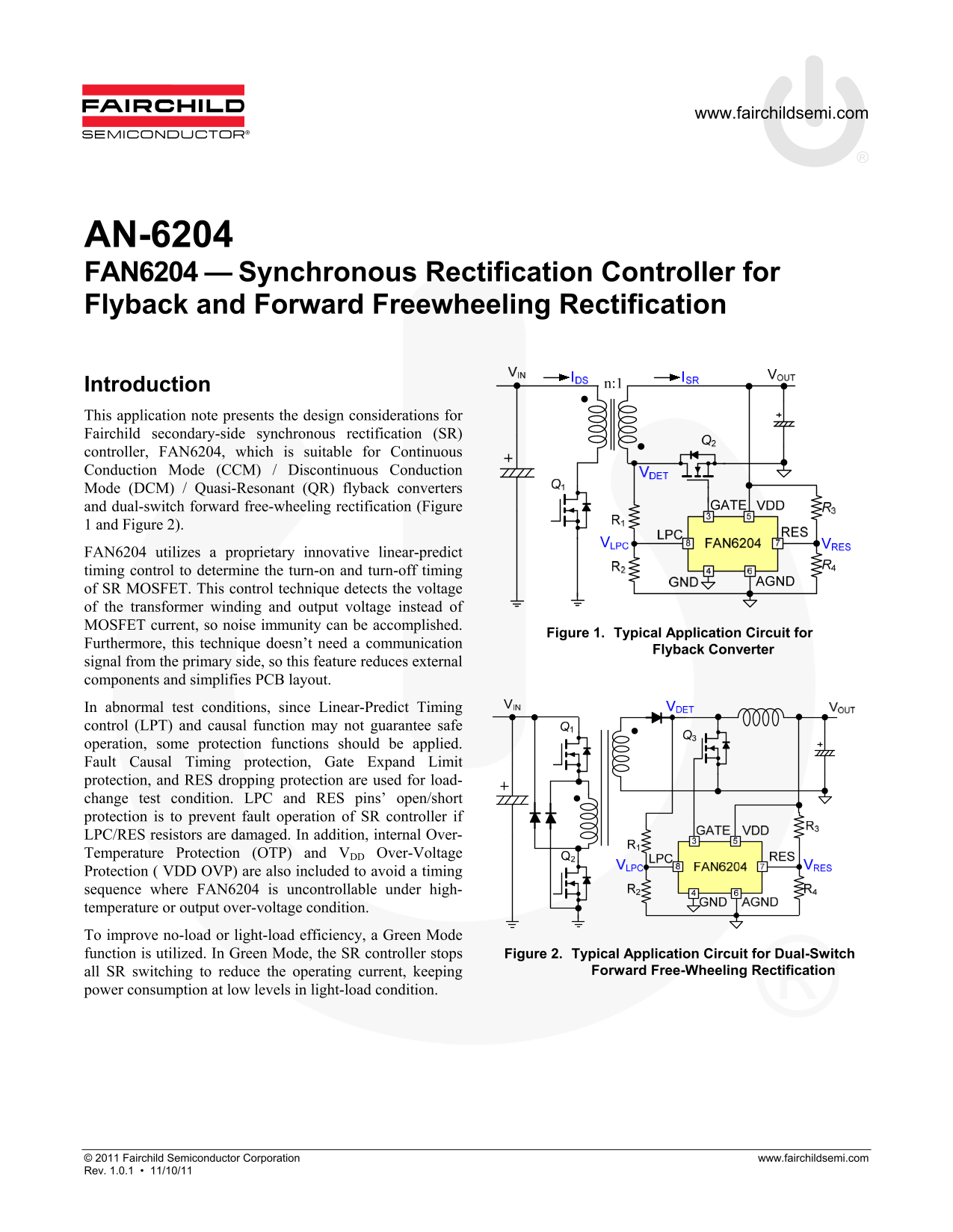
Introduction This application note presents the design considerations for Fairchild secondary-side synchronous rectification (SR) controller, FAN6204, which is suitable for Continuous Conduction Mode (CCM) / Discontinuous Conduction Mode (DCM) / Quasi-Resonant (QR) flyback converters and dual-switch forward free-wheeling rectification (Figure 1 and Figure 2). FAN6204 utilizes a proprietary innovative linear-predict timing control to determine the turn-on and turn-off timing of SR MOSFET. This control technique detects the voltage of the transformer winding and output voltage instead of MOSFET current, so noise immunity can be accomplished.
Figure 1. Typical Application Circuit for
Furthermore, this technique doesn’t need a communication
Flyback Converter
signal from the primary side, so this feature reduces external components and simplifies PCB layout. In abnormal test conditions, since Linear-Predict Timing control (LPT) and causal function may not guarantee safe operation, some protection functions should be applied. Fault Causal Timing protection, Gate Expand Limit protection, and RES dropping protection are used for load- change test condition. LPC and RES pins’ open/short protection is to prevent fault operation of SR controller if LPC/RES resistors are damaged. In addition, internal Over- Temperature Protection (OTP) and VDD Over-Voltage Protection ( VDD OVP) are also included to avoid a timing sequence where FAN6204 is uncontrollable under high- temperature or output over-voltage condition. To improve no-load or light-load efficiency, a Green Mode function is utilized. In Green Mode, the SR controller stops Figure 2. Typical Application Circuit for Dual-Switch
all SR switching to reduce the operating current, keeping Forward Free-Wheeling Rectification
power consumption at low levels in light-load condition.
© 2011 Fairchild Semiconductor Corporation www.fairchildsemi.com Rev. 1.0.1 • 11/10/11
Page Summary Contents For FAIRCHILD FAN6204 - Synchronous Rectification Controller for Flyback and Forward Freewheeling Rectification Data Sheet
Manual Details
| Brand | Fairchild |
|---|---|
| Pages | 8 |
| File Size | 673.51 KB |
| Published | July 06, 2026 |
Enter the captcha to get the download link:

Frequently Asked Questions
How does the FAN6204 protect against noise?
It uses Linear-Predict Timing Control (LPT), which determines turn-on/off timing by detecting transformer winding and output voltage instead of MOSFET current.
What safety protections are included in this controller?
The built-in protections include Fault Causal Timing protection, Gate Expand Limit protection, RES dropping protection, Over-Temperature Protection (OTP), and V Over-Voltage DD Protection (VDD OVP).
Is the FAN6204 effective for low power consumption?
Yes, its Green Mode function reduces synchronous rectification switching currents to keep power consumption low during light-load conditions.
Can this chip be used in life support medical devices?
No. The product is not authorized for use as critical components in life support systems without the express written approval of Fairchild Semiconductor Corporation.