Vishay 138D Data Sheet
Summary
These high-reliability, sintered anode TANTALEX capacitors feature a superior true glass-to-tantalum hermetic seal, providing outstanding resistance to thermal shock essential for demanding electronics. This comprehensive manual details the Type 138D series, covering full technical specifications including standard ratings, operational temperature ranges (-55°C to +125°C), detailed capacitance tolerances, and ordering information. It is vital reference material for electrical engineers and product designers requiring dependable, military-grade components that meet MIL-PRF standards.
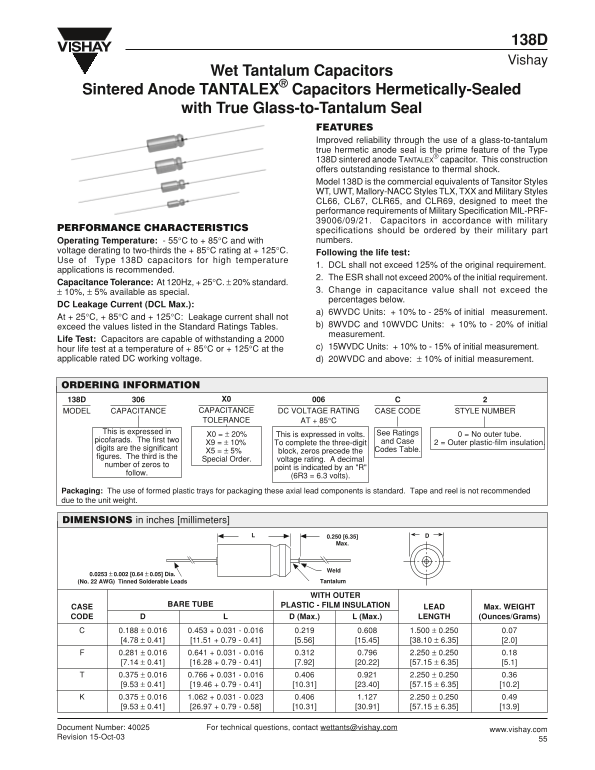
Page 1 Text Content
138D Vishay
Wet Tantalum Capacitors
Sintered Anode TANTALEX® Capacitors Hermetically-Sealed
with True Glass-to-Tantalum Seal
FEATURES Improved reliability through the use of a glass-to-tantalum true hermetic anode seal is the prime feature of the Type
® capacitor. This construction
138D sintered anode TANTALEX offers outstanding resistance to thermal shock. Model 138D is the commercial equivalents of Tansitor Styles WT, UWT, Mallory-NACC Styles TLX, TXX and Military Styles CL66, CL67, CLR65, and CLR69, designed to meet the performance requirements of Military Specification MIL-PRF- 39006/09/21. Capacitors in accordance with military
PERFORMANCE CHARACTERISTICS specifications should be ordered by their military part
Operating Temperature: - 55°C to + 85°C and with numbers.
voltage derating to two-thirds the + 85°C rating at + 125°C. Following the life test: Use of Type 138D capacitors for high temperature
1. DCL shall not exceed 125% of the original requirement.
applications is recommended.
2. The ESR shall not exceed 200% of the initial requirement.
Capacitance Tolerance: At 120Hz, + 25°C. ± 20% standard.
± 10%, ± 5% available as special. 3. Change in capacitance value shall not exceed the percentages below.
DC Leakage Current (DCL Max.):
a) 6WVDC Units: + 10% to - 25% of initial measurement.
At + 25°C, + 85°C and + 125°C: Leakage current shall not
b) 8WVDC and 10WVDC Units: + 10% to - 20% of initial
exceed the values listed in the Standard Ratings Tables.
measurement.
Life Test: Capacitors are capable of withstanding a 2000
c) 15WVDC Units: + 10% to - 15% of initial measurement.
hour life test at a temperature of + 85°C or + 125°C at the applicable rated DC working voltage. d) 20WVDC and above: ± 10% of initial measurement.
ORDERING INFORMATION
138D X0 MODEL CAPACITANCE CAPACITANCE DC VOLTAGE RATING CASE CODE STYLE NUMBER TOLERANCE AT + 85°C
This is expressed in See Ratings
X0 = ± 20% This is expressed in volts. 0 = No outer tube.
picofarads. The first two and Case
X9 = ± 10% To complete the three-digit 2 = Outer plastic-film insulation.
digits are the significant Codes Table.
X5 = ± 5% block, zeros precede the
figures. The third is the
Special Order. voltage rating. A decimal
number of zeros to
point is indicated by an "R"
follow.
(6R3 = 6.3 volts).
Packaging: The use of formed plastic trays for packaging these axial lead components is standard. Tape and reel is not recommended due to the unit weight.
DIMENSIONS in inches [millimeters]
0.250 [6.35] DL
0.0253 ± 0.002 [0.64 ± 0.05] Dia.
(No. 22 AWG) Tinned Solderable Leads Tantalum
WITH OUTER
BARE TUBECASE PLASTIC - FILM INSULATION
LEAD Max. WEIGHT
CODE D (Max.) L (Max.) LENGTH (Ounces/Grams)
Document Number: 40025 For technical questions, contact [email protected]
www.vishay.com
Revision 15-Oct-03
Page Summary Contents For Vishay 138D Data Sheet
Manual Details
| Brand | Vishay |
|---|---|
| Pages | 7 |
| File Size | 253.10 KB |
| Published | June 02, 2026 |
Enter the captcha to get the download link:

Frequently Asked Questions
What is the primary benefit of the Type 138D capacitor design?
It features a true glass-to-tantalum hermetic anode seal, offering outstanding resistance to thermal shock and improving reliability.
Is tape and reel packaging recommended for this component?
No, formed plastic trays are standard; tape and reel is not recommended due to the unit weight.
What solvents or cleaning methods should I use around Type 138D capacitors?
Customary cleaning solvents used in electronics are fine, but ultrasonic cleaning techniques must never be used.
What is the acceptable operating temperature range for this component?
The operating temperature range is from -55°C to +85°C (or derated to two-thirds of the +85°C rating at +125°C).
Can I apply reverse voltage to a Type 138D capacitor?
No, applying reverse voltage will cause internal damage, potentially leading to catastrophic short circuit.