Toshiba TPC6103 Data Handbook
Summary
The TPC6103 is a reliable P-Channel MOS Field Effect Transistor, designed for integration into general electronics applications such as notebook PCs and industrial control systems. This comprehensive manual details all necessary electrical characteristics, including voltage tolerances, thermal dissipation limits, and operational performance data. It serves engineers and design professionals who require precise, high-reliability components for power management and signal switching in consumer, office, or industrial equipment.
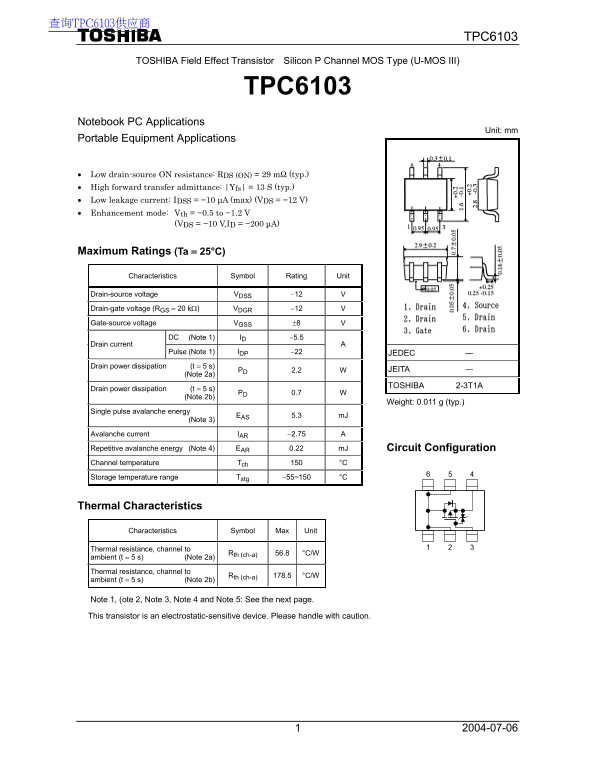
Page 1 Text Content
查询TPC6103供应商
TPC6103
TOSHIBA Field Effect Transistor Silicon P Channel MOS Type (U-MOS III)
TPC6103
Notebook PC Applications
Unit: mm
Portable Equipment Applications
• Low drain-source ON resistance: RDS (ON) = 29 mΩ (typ.) • High forward transfer admittance: |Yfs| = 13 S (typ.) • Low leakage current: IDSS = −10 µA (max) (VDS = −12 V) • Enhancement mode: Vth = −0.5 to −1.2 V
(VDS = −10 V,ID = −200 µA)
Maximum Ratings (Ta = 25°C)
Characteristics Symbol Rating Unit
Drain-source voltage VDSS −12 V
Drain-gate voltage (RGS = 20 kΩ) VDGR −12 V
Gate-source voltage VGSS ±8 V
DC (Note 1) ID −5.5
Drain current
Pulse (Note 1) IDP −22 JEDEC ―
Drain power dissipation (t = 5 s)
JEITA ―
(Note 2a) PD 2.2 W
TOSHIBA 2-3T1A
Drain power dissipation (t = 5 s) (Note 2b) PD 0.7 W
Weight: 0.011 g (typ.)
Single pulse avalanche energy (Note 3) EAS 5.3 m J
Avalanche current IAR −2.75 A
Repetitive avalanche energy (Note 4) EAR 0.22 m J Circuit Configuration Channel temperature Tch 150 °C
Storage temperature range Tstg −55~150 °C
Thermal Characteristics
Characteristics Symbol Max Unit
Thermal resistance, channel to 1 2 3
ambient (t = 5 s) (Note 2a) Rth (ch-a) 56.8
Thermal resistance, channel to
ambient (t = 5 s) (Note 2b) Rth (ch-a) 178.5
Note 1, (ote 2, Note 3, Note 4 and Note 5: See the next page.
This transistor is an electrostatic-sensitive device. Please handle with caution.
Page Summary Contents For Toshiba TPC6103 Data Handbook
Manual Details
| Brand | Toshiba |
|---|---|
| Pages | 7 |
| File Size | 222.20 KB |
| Published | June 01, 2026 |
Enter the captcha to get the download link:

Frequently Asked Questions
Is this semiconductor device sensitive to static electricity?
Yes, it is an electrostatic-sensitive device, and users must handle it with caution.
What is the maximum temperature allowed for operation?
The channel temperature must not exceed 150°C. Storage temperatures range from -55°C to 150°C.
Can I use this component in high-reliability medical or aerospace equipment?
No, it is not warranted for usage in equipment where failure could cause loss of human life, such as medical instruments or airplane instruments.