Toshiba TOSHIBA CMOS 8-Bit Microcontroller TMP88CS34N F, TMP88CP34N F Data Manual
Summary
The TMP88CS34/CP34 is a high-performance 8-bit single-chip microcontroller designed for complex embedded systems. It integrates various essential components including CPU core, ROM/RAM memory, multiple timers, serial communication interfaces (I2C), and advanced on-screen display (OSD) functionality. This documentation serves as a detailed technical reference for integrating the MCU, covering deep dives into its architecture, peripheral details, oscillating parameters, and usage precautions. It is essential reading for electronics designers, engineers, and developers implementing high-speed control and processing solutions into various electronic equipment.
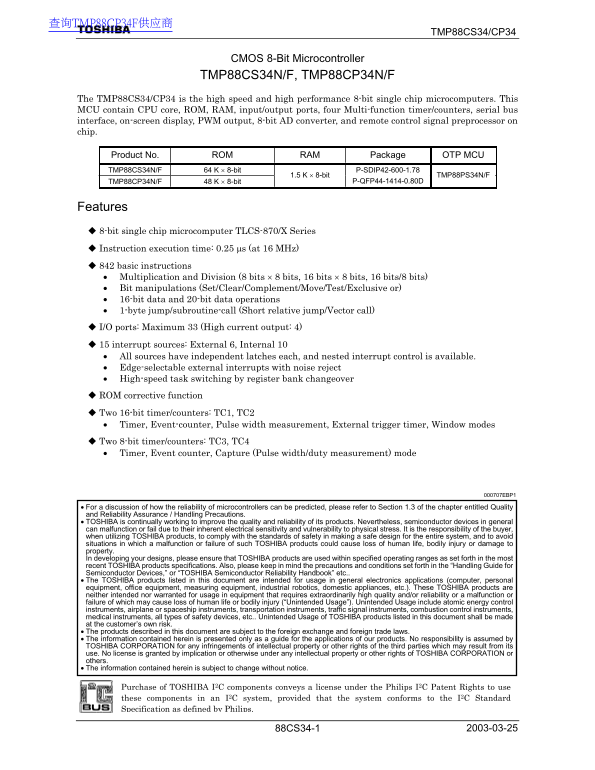
Page 1 Text Content
查询TMP88CP34F供应商
TMP88CS34/CP34
CMOS 8-Bit Microcontroller TMP88CS34N/F, TMP88CP34N/F
The TMP88CS34/CP34 is the high speed and high performance 8-bit single chip microcomputers. This MCU contain CPU core, ROM, RAM, input/output ports, four Multi-function timer/counters, serial bus interface, on-screen display, PWM output, 8-bit AD converter, and remote control signal preprocessor on chip.
Product No. ROM RAM Package OTP MCU
TMP88CS34N/F 64 K 8-bit P-SDIP42-600-1.78
1.5 K 8-bit TMP88PS34N/F
TMP88CP34N/F 48 K 8-bit P-QFP44-1414-0.80D
Features 8-bit single chip microcomputer TLCS-870/X Series Instruction execution time: 0.25 s (at 16 MHz) 842 basic instructions
Multiplication and Division (8 bits 8 bits, 16 bits 8 bits, 16 bits/8 bits) Bit manipulations (Set/Clear/Complement/Move/Test/Exclusive or) 16-bit data and 20-bit data operations 1-byte jump/subroutine-call (Short relative jump/Vector call) I/O ports: Maximum 33 (High current output: 4) 15 interrupt sources: External 6, Internal 10 All sources have independent latches each, and nested interrupt control is available. Edge-selectable external interrupts with noise reject High-speed task switching by register bank changeover ROM corrective function Two 16-bit timer/counters: TC1, TC2 Timer, Event-counter, Pulse width measurement, External trigger timer, Window modes Two 8-bit timer/counters: TC3, TC4 Timer, Event counter, Capture (Pulse width/duty measurement) mode
000707EBP1
For a discussion of how the reliability of microcontrollers can be predicted, please refer to Section 1.3 of the chapter entitled Quality and Reliability Assurance / Handling Precautions. TOSHIBA is continually working to improve the quality and reliability of its products. Nevertheless, semiconductor devices in general can malfunction or fail due to their inherent electrical sensitivity and vulnerability to physical stress. It is the responsibility of the buyer, when utilizing TOSHIBA products, to comply with the standards of safety in making a safe design for the entire system, and to avoid situations in which a malfunction or failure of such TOSHIBA products could cause loss of human life, bodily injury or damage to property. In developing your designs, please ensure that TOSHIBA products are used within specified operating ranges as set forth in the most recent TOSHIBA products specifications. Also, please keep in mind the precautions and conditions set forth in the “Handling Guide for Semiconductor Devices,” or “TOSHIBA Semiconductor Reliability Handbook” etc.. The TOSHIBA products listed in this document are intended for usage in general electronics applications (computer, personal equipment, office equipment, measuring equipment, industrial robotics, domestic appliances, etc.). These TOSHIBA products are neither intended nor warranted for usage in equipment that requires extraordinarily high quality and/or reliability or a malfunction or failure of which may cause loss of human life or bodily injury (“Unintended Usage”). Unintended Usage include atomic energy control instruments, airplane or spaceship instruments, transportation instruments, traffic signal instruments, combustion control instruments, medical instruments, all types of safety devices, etc.. Unintended Usage of TOSHIBA products listed in this document shall be made at the customer’s own risk. The products described in this document are subject to the foreign exchange and foreign trade laws. The information contained herein is presented only as a guide for the applications of our products. No responsibility is assumed by TOSHIBA CORPORATION for any infringements of intellectual property or other rights of the third parties which may result from its use. No license is granted by implication or otherwise under any intellectual property or other rights of TOSHIBA CORPORATION or others. The information contained herein is subject to change without notice.
Purchase of TOSHIBA I2C components conveys a license under the Philips I2C Patent Rights to use these components in an I2C system, provided that the system conforms to the I2C Standard Specification as defined by Philips.
2003-03-25 88CS34-1
Page Summary Contents For Toshiba TOSHIBA CMOS 8-Bit Microcontroller TMP88CS34N F, TMP88CP34N F Data Manual
Manual Details
| Brand | Toshiba |
|---|---|
| Pages | 11 |
| File Size | 231.60 KB |
| Published | June 05, 2026 |
Enter the captcha to get the download link:

Frequently Asked Questions
What is the primary function of the TMP88CS34/CP34?
It is a high speed and high performance 8-bit single chip microcontroller containing CPU core, ROM, RAM, I/O ports, timers, etc.
How many independent interrupt sources does it support?
The MCU supports 15 interrupt sources: External (6) and Internal (10).
What are the operating voltage requirements?
It is recommended to use a supply voltage between 4.5 V and 5.5 V.
How can the display start position be stabilized?
Changing L and C parameters from the recommended values may hamper stable OSD display, so caution is advised when tuning parameters.