Toshiba TLxE20 Series LEDs Data Handbook
Summary
These high-intensity Toshiba TLxE20 Series LEDs utilize advanced InGaAlP technology to provide reliable, vivid light emission across multiple colors. This comprehensive technical guide details the product's electrical and optical characteristics, providing maximum ratings, operational limits, and proper usage precautions for safe integration into your design. Ideal for engineers and developers in general electronics applications—including industrial controls, consumer appliances, and measuring equipment—seeking dependable visual indicators and signaling solutions.
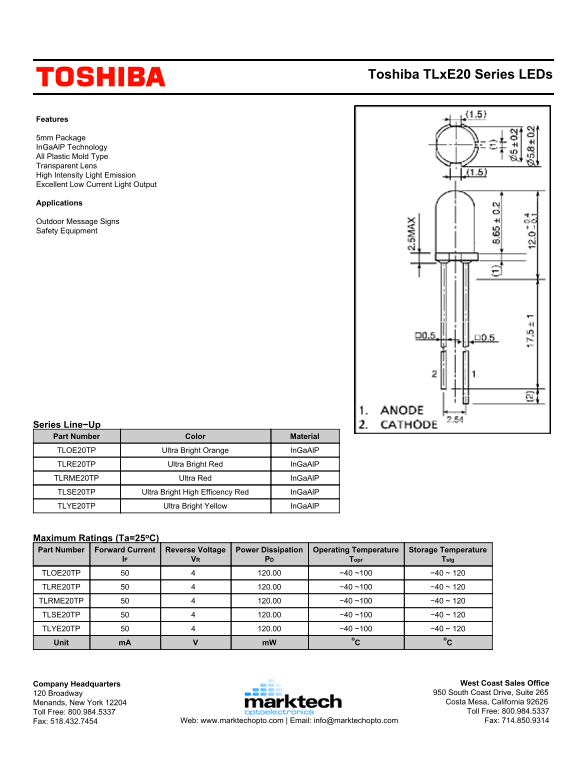
Page 1 Text Content
Toshiba TLx E20 Series LEDs
Features
5mm Package In Ga Al P Technology All Plastic Mold Type Transparent Lens High Intensity Light Emission Excellent Low Current Light Output
Applications
Outdoor Message Signs Safety Equipment
Series Line−Up Part Number Color Material TLOE20TP Ultra Bright Orange In Ga Al P TLRE20TP Ultra Bright Red In Ga Al P TLRME20TP Ultra Red In Ga Al P TLSE20TP Ultra Bright High Efficency Red In Ga Al P TLYE20TP Ultra Bright Yellow In Ga Al P
Maximum Ratings (Ta=25o C) Part Number Forward Current Reverse Voltage Power Dissipation Operating Temperature Storage Temperature
IF VR PD Topr Tstg
TLOE20TP 120.00 −40 ~100 −40 ~ 120 TLRE20TP 120.00 −40 ~100 −40 ~ 120 TLRME20TP 120.00 −40 ~100 −40 ~ 120 TLSE20TP 120.00 −40 ~100 −40 ~ 120 TLYE20TP 120.00 −40 ~100 −40 ~ 120 Unit m A m W
Company Headquarters West Coast Sales Office 120 Broadway 950 South Coast Drive, Suite 265 Menands, New York 12204 Costa Mesa, California 92626 Toll Free: 800.984.5337 Toll Free: 800.984.5337
Fax: 518.432.7454 Web: www.marktechopto.com | Email: [email protected] Fax: 714.850.9314
Page Summary Contents For Toshiba TLxE20 Series LEDs Data Handbook
Manual Details
| Brand | Toshiba |
|---|---|
| Pages | 7 |
| File Size | 369.37 KB |
| Published | May 29, 2026 |
Enter the captcha to get the download link:

Frequently Asked Questions
What are the recommended soldering parameters?
The maximum soldering temperature is 260°C, with a maximum soldering time of 3 seconds. Soldering must be performed after lead forming.
Are these LEDs suitable for critical safety applications?
No, they are not warranted for use in machinery requiring extraordinary reliability (e.g., traffic signals or medical instruments) due to "Unintended Usage" risks.
What warning is provided about IR light emission?
The LED lamp also emits some IR light; if a photodetector is located nearby, ensure it will not be affected by this visible source of IR light.
How should these semiconductor products be disposed of?
When disposing of the products, users must follow all appropriate regulations and must not dispose of them with other industrial waste or domestic garbage.