Toshiba Photocoupler Photo Relay TLP798GA Data Manual
Summary
This guide provides comprehensive specifications for the TLP798GA, an optocoupler designed to act as a bi-directional photo-MOS FET switch, offering reliable performance while replacing traditional mechanical relays. The manual details absolute maximum ratings, coupling characteristics, switching times, and recommended operating guidelines for integrating this semiconductor into general electronic circuits. It is ideal for engineers and designers building consumer, industrial control, or measurement equipment that requires robust electrical isolation.
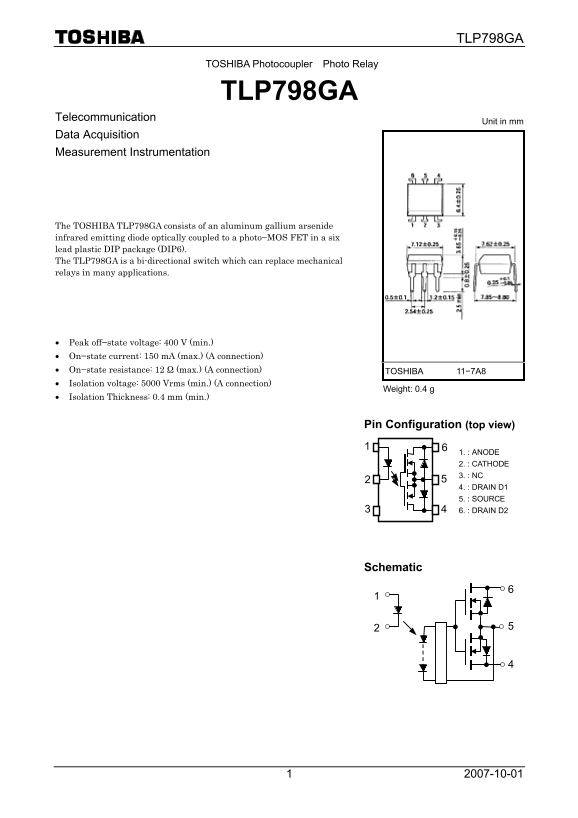
Page 1 Text Content
TLP798GA
TOSHIBA Photocoupler Photo Relay
TLP798GA
Telecommunication
Unit in mm
Data Acquisition Measurement Instrumentation
The TOSHIBA TLP798GA consists of an aluminum gallium arsenide infrared emitting diode optically coupled to a photo−MOS FET in a six lead plastic DIP package (DIP6). The TLP798GA is a bi-directional switch which can replace mechanical relays in many applications.
• Peak off−state voltage: 400 V (min.) • On−state current: 150 m A (max.) (A connection) • On−state resistance: 12 Ω (max.) (A connection) TOSHIBA 11−7A8 • Isolation voltage: 5000 Vrms (min.) (A connection)
Weight: 0.4 g
• Isolation Thickness: 0.4 mm (min.)
Pin Configuration (top view) 1. : ANODE
2. : CATHODE 3. : NC 4. : DRAIN D1 5. : SOURCE 6. : DRAIN D2
Schematic
Page Summary Contents For Toshiba Photocoupler Photo Relay TLP798GA Data Manual
Manual Details
| Brand | Toshiba |
|---|---|
| Pages | 5 |
| File Size | 155.99 KB |
| Published | June 01, 2026 |
Enter the captcha to get the download link:

Frequently Asked Questions
What is the minimum required isolation voltage?
The TLP798GA provides a high minimum isolation voltage of 5000 Vrms.
Which types of applications are strictly forbidden (Unintended Usage)?
It is not warranted for extremely demanding fields like medical instruments, aircraft systems, or safety devices.
How should I connect the device for AC and DC loads?
For DC loads, use pins 2 & 5; for AC loads, you should connect pins 1 & 6.
What is the recommended operating temperature range?
The typical operational temperature range provided for design guidelines is -20°C to 80°C.