Toshiba Photocoupler GaAs IRED & Photo-TRiac TLP260J Owner's Manual & User Guide
Summary
This manual provides comprehensive specifications and application guidelines for the TLP260J photocoupler, an optically coupled device featuring a photo-triac driven by a Gallium Arsenide Infrared-Emitting Diode (IRED). Designed for surface mount integration, this component ensures reliable electrical isolation in general industrial and commercial electronic systems. Ideal for engineers designing equipment ranging from office electronics to measuring instruments requiring precise signal coupling across different power domains.
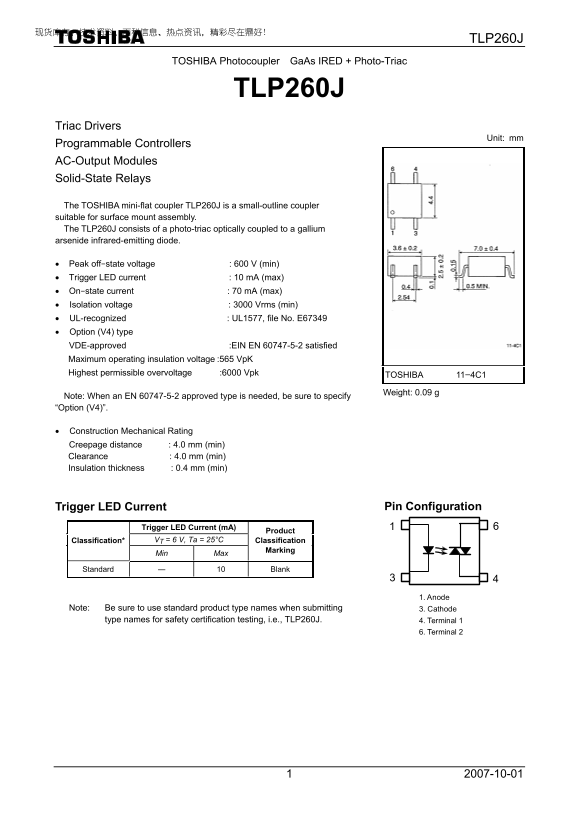
Page 1 Text Content
TLP260J
TOSHIBA Photocoupler Ga As IRED + Photo-Triac
TLP260J
Triac Drivers
Unit: mm
Programmable Controllers AC-Output Modules Solid-State Relays
The TOSHIBA mini-flat coupler TLP260J is a small-outline coupler suitable for surface mount assembly. The TLP260J consists of a photo-triac optically coupled to a gallium arsenide infrared-emitting diode.
• Peak off−state voltage : 600 V (min) • Trigger LED current : 10 m A (max) • On−state current : 70 m A (max) • Isolation voltage : 3000 Vrms (min) • UL-recognized : UL1577, file No. E67349 • Option (V4) type VDE-approved :EIN EN 60747-5-2 satisfied Maximum operating insulation voltage :565 Vp K Highest permissible overvoltage :6000 Vpk
TOSHIBA 11−4C1
Weight: 0.09 g
Note: When an EN 60747-5-2 approved type is needed, be sure to specify “Option (V4)”.
• Construction Mechanical Rating Creepage distance : 4.0 mm (min) Clearance : 4.0 mm (min) Insulation thickness : 0.4 mm (min)
Trigger LED Current Pin Configuration
Trigger LED Current (m A)
Product
VT = 6 V, Ta = 25°C Classification* Classification
Marking
Min Max
Standard ― 10 Blank
1. Anode
Note: Be sure to use standard product type names when submitting 3. Cathode
type names for safety certification testing, i.e., TLP260J. 4. Terminal 1
6. Terminal 2
Page Summary Contents For Toshiba Photocoupler GaAs IRED & Photo-TRiac TLP260J Owner's Manual & User Guide
Manual Details
| Brand | Toshiba |
|---|---|
| Pages | 6 |
| File Size | 210.67 KB |
| Published | June 05, 2026 |
Enter the captcha to get the download link:

Frequently Asked Questions
What is the minimum isolation voltage of this optocoupler?
The provided specifications list a minimum isolation voltage of 3000 Vrms.
Can I use this device in life-critical systems like medical equipment or aircraft instruments?
No. The manual warns that it is not intended for use in applications where failure could cause loss of human life (Unintended Usage).
Are there any specific material safety warnings for using the TLP260J?
Yes, the product uses GaAs (Gallium Arsenide), and its dust or vapor is harmful to the human body.
Does the device require special consideration when derating performance in field use?
Yes. Users must review reliability data and consider proper design regarding high temperature/current/voltage changes.