Texas Instruments SLTS203C Data Sheet
Summary
A robust, high-efficiency power module designed for simplifying complex digital system designs featuring multiple processors and microcontrollers. This series provides critical functions like Auto-Track™ sequencing and wide voltage adjustability (0.8V to 2.5V), supporting reliable output current up to 15A. Ideal for engineers developing multi-processor, high-speed applications requiring precise and controlled power management. The accompanying documentation details product features such as pin configurations, necessary external components, operational limits, and ordering information for seamless system integration.
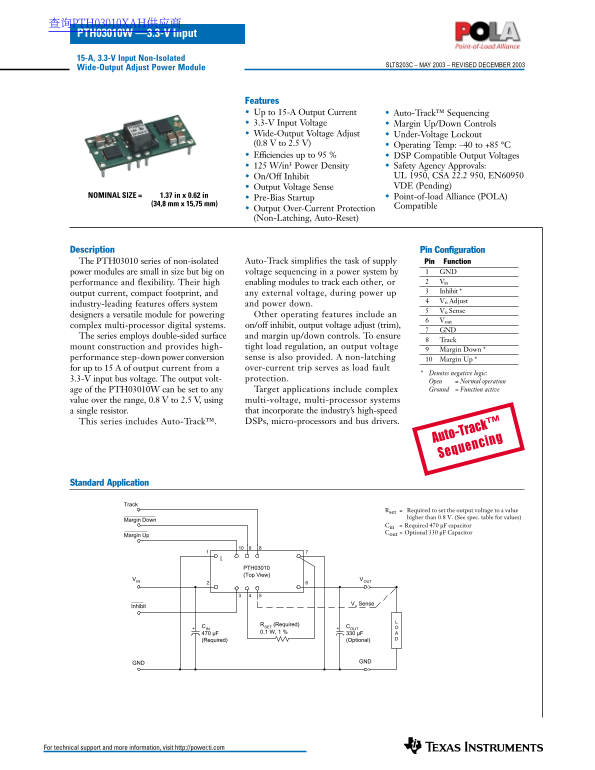
Page 1 Text Content
查询PTH03010XAH供应商 PTH03010W —3.3-V Input
15-A, 3.3-V Input Non-Isolated
SLTS203C – MAY 2003 – REVISED DECEMBER 2003
Wide-Output Adjust Power Module
Features Up to 15-A Output Current Auto-Track™ Sequencing 3.3-V Input Voltage Margin Up/Down Controls Wide-Output Voltage Adjust Under-Voltage Lockout (0.8 V to 2.5 V) Operating Temp: –40 to +85 °C Efficiencies up to 95 % DSP Compatible Output Voltages 125 W/in³ Power Density Safety Agency Approvals:
On/Off Inhibit UL 1950, CSA 22.2 950, EN60950 Output Voltage Sense VDE (Pending)
NOMINAL SIZE = 1.37 in x 0.62 in Point-of-load Alliance (POLA)
Pre-Bias Startup
(34,8 mm x 15,75 mm)
Compatible
Output Over-Current Protection (Non-Latching, Auto-Reset)
Description Pin Configuration
The PTH03010 series of non-isolated Auto-Track simplifies the task of supply Pin Function
power modules are small in size but big on voltage sequencing in a power system by GND performance and flexibility. Their high enabling modules to track each other, or Vin Inhibit *
output current, compact footprint, and any external voltage, during power up
Vo Adjust
industry-leading features offers system and power down.
Vo Sense
designers a versatile module for powering Other operating features include an
complex multi-processor digital systems. on/off inhibit, output voltage adjust (trim),
The series employs double-sided surface and margin up/down controls. To ensure
Track
mount construction and provides high- tight load regulation, an output voltage
Margin Down *
performance step-down power conversion sense is also provided. A non-latching Margin Up * for up to 15 A of output current from a over-current trip serves as load fault
Denotes negative logic:
3.3-V input bus voltage. The output volt- protection.
Open = Normal operation age of the PTH03010W can be set to any Target applications include complex Ground = Function active
value over the range, 0.8 V to 2.5 V, using multi-voltage, multi-processor systems
a single resistor. that incorporate the industry’s high-speed This series includes Auto-Track™. DSPs, micro-processors and bus drivers.
Auto-Track™ Sequencing
Standard Application
Track
Rset Required to set the output voltage to a value higher than 0.8 V. (See spec. table for values)
Margin Down
Cin Required 470 µF capacitor Cout Optional 330 µF Capacitor
Margin Up
PTH03010 (Top View)
VIN VOUT
Vo Sense
Inhibit
CIN RSET (Required) COUT 470 µF 0.1 W, 1 % 330 µF
(Required) (Optional)
GND GND
For technical support and more information, visit http://power.ti.com
Page Summary Contents For Texas Instruments SLTS203C Data Sheet
Manual Details
| Brand | Texas Instruments |
|---|---|
| Pages | 18 |
| File Size | 508.53 KB |
| Published | June 02, 2026 |
Enter the captcha to get the download link:

Frequently Asked Questions
How can I compensate for voltage drop?
Use the 'Vo Sense' input, which allows the regulation circuit to compensate for voltage drop between the module and the load.
What types of systems are this power module suitable for powering?
It is designed for complex multi-processor digital systems, DSPs, micro-processors and bus drivers.
How does the Auto-Track™ feature work?
Auto-Track™ Sequencing simplifies dynamic startup in power systems by ensuring sequential tracking of voltages during power up and down cycles.
What should I do if I don't use the Inhibit pin?
If unused, this input should be connected to V. If left open-circuit, it will produce an output when the voltage rises.