TEXAS INSTRUMENTS 54AC16822, 54ACT16822 74AC16822, 74ACT16822 20-BIT D-TYPE FLIP-FLOPS WITH 3-STATE OUTPUTS
Summary
This comprehensive guide for high-performance 20-bit D-type flip-flops outlines essential details for digital circuit designers. The product offers reliable data storage with 3-state outputs, optimized for minimizing signal noise in complex layouts. Engineers can utilize this manual to understand core concepts like flow-through architecture, compatible input thresholds (CMOS/TTL), and advanced operational modes, ensuring seamless integration into demanding electronic systems requiring precise logic control.
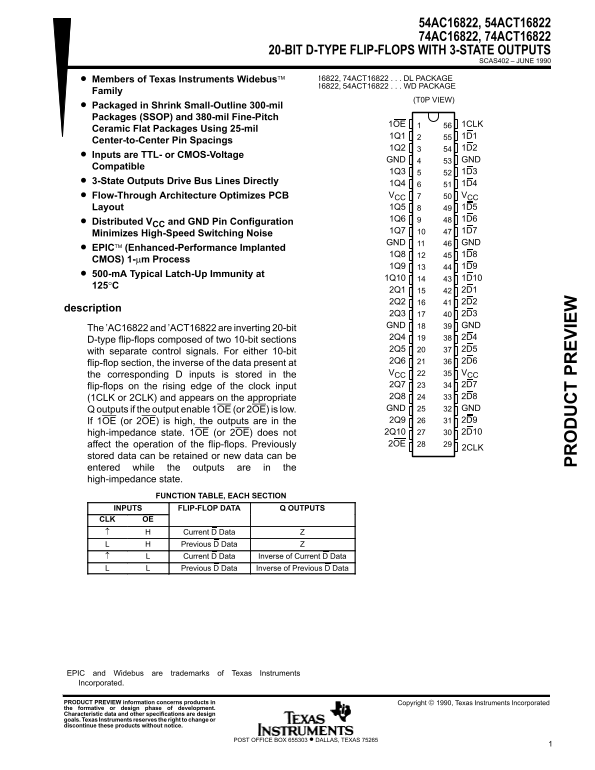
Page 1 Text Content
54AC16822, 54ACT16822 74AC16822, 74ACT16822
20-BIT D-TYPE FLIP-FLOPS WITH 3-STATE OUTPUTS
SCAS402 – JUNE 1990
Members of Texas Instruments Widebus 16822, 74ACT16822 DL PACKAGE 16822, 54ACT16822 WD PACKAGE
Family
(T0P VIEW)
Packaged in Shrink Small-Outline 300-mil Packages (SSOP) and 380-mil Fine-Pitch
1OE 1CLK
Ceramic Flat Packages Using 25-mil
Center-to-Center Pin Spacings
Inputs are TTL- or CMOS-Voltage
GND GND
Compatible
3-State Outputs Drive Bus Lines Directly 1Q4 1D4
Flow-Through Architecture Optimizes PCB VCC VCC Layout 1Q5 1D5 1Q6 1D6
Distributed VCC and GND Pin Configuration
Minimizes High-Speed Switching Noise
GND GND
EPIC (Enhanced-Performance Implanted
CMOS) 1-µm Process
500-m A Typical Latch-Up Immunity at
description
2Q3 2D3 GND GND
The ’AC16822 and ’ACT16822 are inverting 20-bit
D-type flip-flops composed of two 10-bit sections
with separate control signals. For either 10-bit
flip-flop section, the inverse of the data present at 2Q6 2D6 the corresponding D inputs is stored in the VCC VCC flip-flops on the rising edge of the clock input 2Q7 2D7 (1CLK or 2CLK) and appears on the appropriate 2Q8 2D8 Q outputs if the output enable 1OE (or 2OE) is low. GND GND If 1OE (or 2OE) is high, the outputs are in the 2Q9 2D9 high-impedance state. 1OE (or 2OE) does not 2Q10 2D10 affect the operation of the flip-flops. Previously 2OE
stored data can be retained or new data can be entered while the outputs are in the high-impedance state.
FUNCTION TABLE, EACH SECTION
INPUTS FLIP-FLOP DATA Q OUTPUTS CLK OE
Current D Data Previous D Data Current D Data Inverse of Current D Data Previous D Data Inverse of Previous D Data
EPIC and Widebus are trademarks of Texas Instruments Incorporated.
PRODUCT PREVIEW information concerns products in Copyright 1990, Texas Instruments Incorporated the formative or design phase of development. Characteristic data and other specifications are design goals. Texas Instruments reserves the right to change or discontinue these products without notice.
POST OFFICE BOX 655303 • DALLAS, TEXAS 75265
Page Summary Contents For TEXAS INSTRUMENTS 54AC16822, 54ACT16822 74AC16822, 74ACT16822 20-BIT D-TYPE FLIP-FLOPS WITH 3-STATE OUTPUTS
Manual Details
| Brand | Texas Instruments |
|---|---|
| Pages | 3 |
| File Size | 24.04 KB |
| Published | June 02, 2026 |
Enter the captcha to get the download link:

Frequently Asked Questions
What is the difference between the 'AC16822 and 'ACT16822?
The 'AC16822 has CMOS-compatible input thresholds, while the 'ACT16822 has TTL-compatible input thresholds.
How are the flip-flop outputs controlled regarding data flow?
Outputs appear on Q when 1OE is low. If 1OE is high, the outputs enter a high-impedance state.
What temperature range do the various versions support?
The 54AC/ACT series supports –55°C to 125°C, while the 74AC/ACT series supports operation from –40°C to 85°C.
Are these chips suitable for use in critical applications like life support systems?
No. These semiconductor products are not designed, intended, authorized, or warranted for use in life-support or other critical applications.