Siemens BB 689 User Guide and Manual
Summary
This high-performance silicon tuning diode is specifically engineered for advanced RF applications, including VHF, 2-Band, and Hyperband TV tuners. Featuring excellent capacitance ratios, low series inductance, and a compact SMD package, this component ensures superior uniformity and circuit stability. The comprehensive manual provides detailed technical guidance, covering maximum ratings, full electrical characteristics—including capacitance variation against voltage and frequency—and specific operational procedures for both matched and unmatched assemblies, making it an essential resource for RF circuit designers and electronics manufacturers.
Page 1 Text Content
BB 689
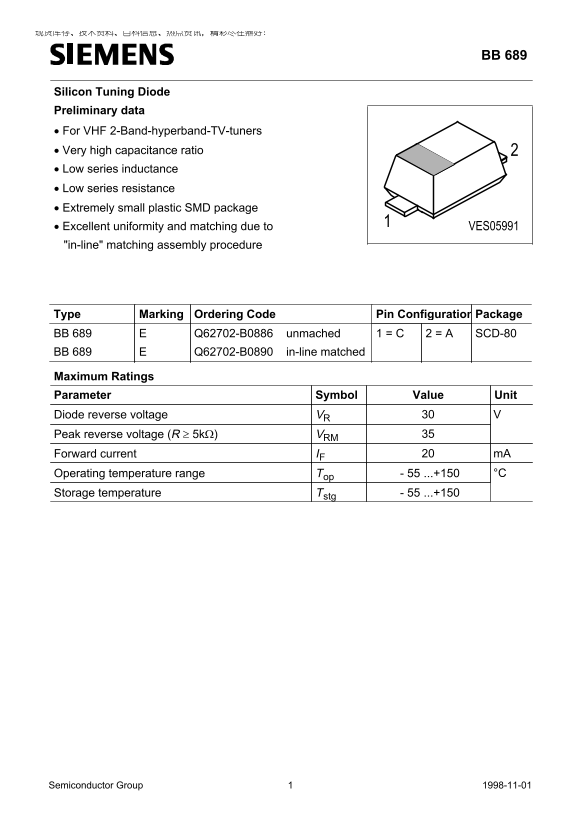
Silicon Tuning Diode Preliminary data • For VHF 2-Band-hyperband-TV-tuners • Very high capacitance ratio • Low series inductance • Low series resistance • Extremely small plastic SMD package • Excellent uniformity and matching due to VES05991 "in-line" matching assembly procedure
Type Marking Ordering Code Pin Configuration Package BB 689 Q62702-B0886 unmached 1 = C 2 = A SCD-80 BB 689 Q62702-B0890 in-line matched
Maximum Ratings Parameter Value Symbol Unit
30Diode reverse voltage VVR Peak reverse voltage (R ≥ 5kΩ) 35VRM IF 20Forward current m A
Operating temperature range - 55 ...+150 °C
Storage temperature Tstg - 55 ...+150
Semiconductor Group Mar-11-19981 Semiconductor Group 1998-11-01
Page Summary Contents For Siemens BB 689 User Guide and Manual
Manual Details
| Brand | Siemens |
|---|---|
| Pages | 3 |
| File Size | 32.10 KB |
| Published | June 05, 2026 |
Enter the captcha to get the download link:

Frequently Asked Questions
What is the maximum working temperature range for the BB 689 diode?
The operating temperature range (T) is from -55 to +150°C.
How does the component achieve excellent uniformity and matching?
It achieves this due to its VES05991 manufacturing process.
What is the typical capacitance ratio at 25V and 1MHz?
The minimum typical capacitance ratio (C/C T) at 25V, 1MHz is 14.5.
Does the component require specialized matching methods for optimal performance?
Yes, in-line matching can be done using a specific assembly procedure; refer to Application Note 047 for details.