Roland FP-90 Digital Piano FP-90 FP-60 MIDI Implementation User's Manual
Summary
Enhance your musical workflow with comprehensive control over every sound parameter. This detailed technical guide serves as a master reference, documenting the full spectrum of MIDI commands and controller functions for this digital piano. Whether you are a professional musician customizing your setup or a developer programming complex music applications, this manual provides precise information on note data, expressive controls—including modulation, sustain, resonance, and volume—and advanced bank management. Master granular control over your sound engine and achieve flawless audio integration.
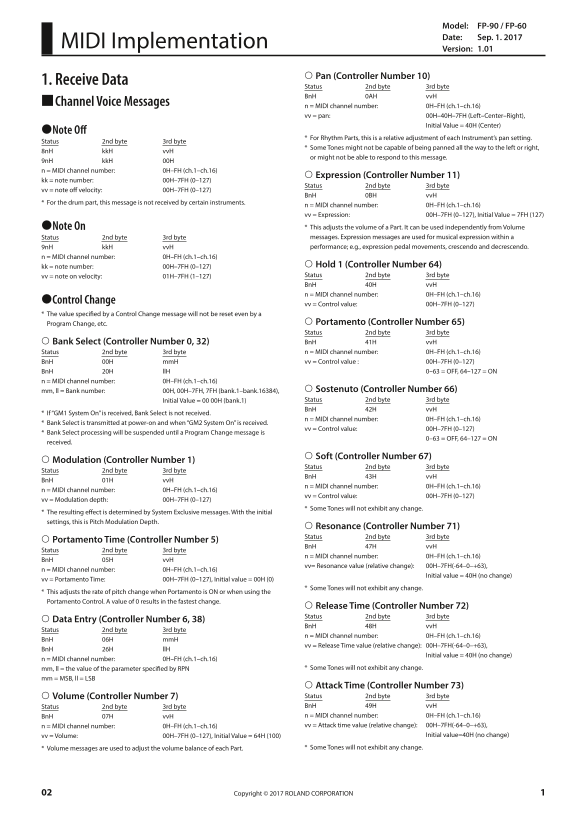
Page 1 Text Content
Model: FP-90 / FP-60 Date: Sep. 1. 2017
MIDI Implementation
Version: 1.01
Pan (Controller Number 10)
1. Receive Data
Status 2nd byte 3rd byte Bn H 0AH vv H
9Channel Voice Messages
n = MIDI channel number: 0H–FH (ch.1–ch.16) vv = pan: 00H–40H–7FH (Left–Center–Right), Initial Value = 40H (Center)
7Note Off
* For Rhythm Parts, this is a relative adjustment of each Instrument’s pan setting.
Status 2nd byte 3rd byte
* Some Tones might not be capable of being panned all the way to the left or right,
8n H kk H vv H
or might not be able to respond to this message.
9n H kk H 00H n = MIDI channel number: 0H–FH (ch.1–ch.16)
Expression (Controller Number 11)
kk = note number: 00H–7FH (0–127)
Status 2nd byte 3rd byte
vv = note off velocity: 00H–7FH (0–127)
Bn H 0BH vv H
* For the drum part, this message is not received by certain instruments.
n = MIDI channel number: 0H–FH (ch.1–ch.16) vv = Expression: 00H–7FH (0–127), Initial Value = 7FH (127) 7Note On * This adjusts the volume of a Part. It can be used independently from Volume Status 2nd byte 3rd byte messages. Expression messages are used for musical expression within a 9n H kk H vv H performance; e.g., expression pedal movements, crescendo and decrescendo.
n = MIDI channel number: 0H–FH (ch.1–ch.16)
kk = note number: 00H–7FH (0–127) Hold 1 (Controller Number 64) vv = note on velocity: 01H–7FH (1–127) Status 2nd byte 3rd byte Bn H 40H vv H n = MIDI channel number: 0H–FH (ch.1–ch.16)
7Control Change
vv = Control value: 00H–7FH (0–127)
* The value specified by a Control Change message will not be reset even by a
Program Change, etc. Portamento (Controller Number 65) Status 2nd byte 3rd byte Bank Select (Controller Number 0, 32) Bn H 41H vv H Status 2nd byte 3rd byte n = MIDI channel number: 0H–FH (ch.1–ch.16) Bn H 00H mm H vv = Control value : 00H–7FH (0–127) Bn H 20H ll H 0–63 = OFF, 64–127 = ON
n = MIDI channel number: 0H–FH (ch.1–ch.16)
mm, ll = Bank number: 00H, 00H–7FH, 7FH (bank.1–bank.16384), Sostenuto (Controller Number 66) Initial Value = 00 00H (bank.1) Status 2nd byte 3rd byte Bn H 42H vv H
* If “GM1 System On” is received, Bank Select is not received.
n = MIDI channel number: 0H–FH (ch.1–ch.16)
* Bank Select is transmitted at power-on and when “GM2 System On” is received.
vv = Control value: 00H–7FH (0–127)
* Bank Select processing will be suspended until a Program Change message is
0–63 = OFF, 64–127 = ON
received.
Soft (Controller Number 67)
Modulation (Controller Number 1)
Status 2nd byte 3rd byte
Status 2nd byte 3rd byte
Bn H 43H vv H
Bn H 01H vv H
n = MIDI channel number: 0H–FH (ch.1–ch.16)
n = MIDI channel number: 0H–FH (ch.1–ch.16)
vv = Control value: 00H–7FH (0–127)
vv = Modulation depth: 00H–7FH (0–127)
* Some Tones will not exhibit any change.
* The resulting effect is determined by System Exclusive messages. With the initial settings, this is Pitch Modulation Depth.
Resonance (Controller Number 71) Status 2nd byte 3rd byte
Portamento Time (Controller Number 5)
Bn H 47H vv H
Status 2nd byte 3rd byte
n = MIDI channel number: 0H–FH (ch.1–ch.16)
Bn H 05H vv H
vv= Resonance value (relative change): 00H–7FH(-64–0–+63),
n = MIDI channel number: 0H–FH (ch.1–ch.16)
Initial value = 40H (no change)
vv = Portamento Time: 00H–7FH (0–127), Initial value = 00H (0)
* Some Tones will not exhibit any change.
* This adjusts the rate of pitch change when Portamento is ON or when using the Portamento Control. A value of 0 results in the fastest change.
Release Time (Controller Number 72) Status 2nd byte 3rd byte
Data Entry (Controller Number 6, 38)
Bn H 48H vv H
Status 2nd byte 3rd byte
n = MIDI channel number: 0H–FH (ch.1–ch.16)
Bn H 06H mm H
vv = Release Time value (relative change): 00H–7FH(-64–0–+63),
Bn H 26H ll H
Initial value = 40H (no change)
n = MIDI channel number: 0H–FH (ch.1–ch.16)
mm, ll = the value of the parameter specified by RPN * Some Tones will not exhibit any change.
mm = MSB, ll = LSB
Attack Time (Controller Number 73) Volume (Controller Number 7) Status 2nd byte 3rd byte Status 2nd byte 3rd byte Bn H 49H vv H Bn H 07H vv H n = MIDI channel number: 0H–FH (ch.1–ch.16) n = MIDI channel number: 0H–FH (ch.1–ch.16) vv = Attack time value (relative change): 00H–7FH(-64–0–+63), vv = Volume: 00H–7FH (0–127), Initial Value = 64H (100) Initial value=40H (no change) * Volume messages are used to adjust the volume balance of each Part. * Some Tones will not exhibit any change.
Copyright © 2017 ROLAND CORPORATION02
Page Summary Contents For Roland FP-90 Digital Piano FP-90 FP-60 MIDI Implementation User's Manual
Manual Details
| Brand | Roland |
|---|---|
| Pages | 15 |
| File Size | 114.07 KB |
| Published | May 31, 2026 |
Enter the captcha to get the download link:

Frequently Asked Questions
How is the instrument's pan setting adjusted?
Pan adjustments use Controller Number 10 (Pan). A value of 40H provides Center; values range from 00H (Left) to 7FH (Right).
What MIDI function controls the volume balance of a specific part?
Volume is controlled using Controller Number 7. Volume messages can be used independently for adjustment.
Can I use RPN (Registered Parameter Number) messages?
Yes, RPN allows control of various functions, such as Cutoff (74) and Decay Time (75). You must first specify the parameter using dedicated RPN MSB/LSB messages.