Rockwell Automation Line Reactors and AC Drives User's Guide and Specifications
Summary
A comprehensive guide for technical professionals responsible for optimizing AC drive installations. This manual explains what line and output reactors are, defining them as inductors that add impedance to electrical circuits. It provides essential knowledge on how reactors function, the side effects (like voltage drop and heat), and most importantly, detailed guidelines on when and where they are genuinely needed—such as mitigating harmonics or providing necessary line buffering—ensuring correct hardware sizing for reliable operation.
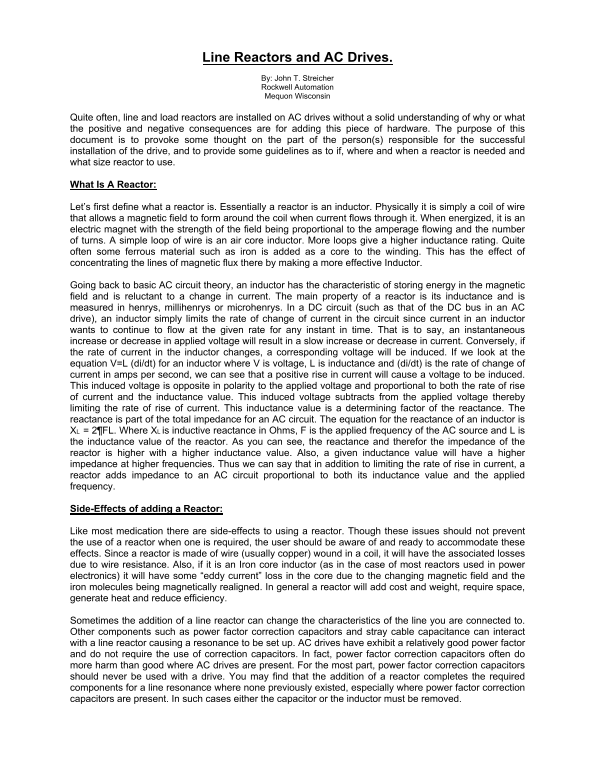
Page 1 Text Content
Line Reactors and AC Drives.
By: John T. Streicher Rockwell Automation Mequon Wisconsin
Quite often, line and load reactors are installed on AC drives without a solid understanding of why or what the positive and negative consequences are for adding this piece of hardware. The purpose of this document is to provoke some thought on the part of the person(s) responsible for the successful installation of the drive, and to provide some guidelines as to if, where and when a reactor is needed and what size reactor to use.
What Is A Reactor:
Let’s first define what a reactor is. Essentially a reactor is an inductor. Physically it is simply a coil of wire that allows a magnetic field to form around the coil when current flows through it. When energized, it is an electric magnet with the strength of the field being proportional to the amperage flowing and the number of turns. A simple loop of wire is an air core inductor. More loops give a higher inductance rating. Quite often some ferrous material such as iron is added as a core to the winding. This has the effect of concentrating the lines of magnetic flux there by making a more effective Inductor.
Going back to basic AC circuit theory, an inductor has the characteristic of storing energy in the magnetic field and is reluctant to a change in current. The main property of a reactor is its inductance and is measured in henrys, millihenrys or microhenrys. In a DC circuit (such as that of the DC bus in an AC drive), an inductor simply limits the rate of change of current in the circuit since current in an inductor wants to continue to flow at the given rate for any instant in time. That is to say, an instantaneous increase or decrease in applied voltage will result in a slow increase or decrease in current. Conversely, if the rate of current in the inductor changes, a corresponding voltage will be induced. If we look at the equation V=L (di/dt) for an inductor where V is voltage, L is inductance and (di/dt) is the rate of change of current in amps per second, we can see that a positive rise in current will cause a voltage to be induced. This induced voltage is opposite in polarity to the applied voltage and proportional to both the rate of rise of current and the inductance value. This induced voltage subtracts from the applied voltage thereby limiting the rate of rise of current. This inductance value is a determining factor of the reactance. The reactance is part of the total impedance for an AC circuit. The equation for the reactance of an inductor is XL = 2¶FL. Where XL is inductive reactance in Ohms, F is the applied frequency of the AC source and L is the inductance value of the reactor. As you can see, the reactance and therefor the impedance of the reactor is higher with a higher inductance value. Also, a given inductance value will have a higher impedance at higher frequencies. Thus we can say that in addition to limiting the rate of rise in current, a reactor adds impedance to an AC circuit proportional to both its inductance value and the applied frequency.
Side-Effects of adding a Reactor:
Like most medication there are side-effects to using a reactor. Though these issues should not prevent the use of a reactor when one is required, the user should be aware of and ready to accommodate these effects. Since a reactor is made of wire (usually copper) wound in a coil, it will have the associated losses due to wire resistance. Also, if it is an Iron core inductor (as in the case of most reactors used in power electronics) it will have some “eddy current” loss in the core due to the changing magnetic field and the iron molecules being magnetically realigned. In general a reactor will add cost and weight, require space, generate heat and reduce efficiency.
Sometimes the addition of a line reactor can change the characteristics of the line you are connected to. Other components such as power factor correction capacitors and stray cable capacitance can interact with a line reactor causing a resonance to be set up. AC drives have exhibit a relatively good power factor and do not require the use of correction capacitors. In fact, power factor correction capacitors often do more harm than good where AC drives are present. For the most part, power factor correction capacitors should never be used with a drive. You may find that the addition of a reactor completes the required components for a line resonance where none previously existed, especially where power factor correction capacitors are present. In such cases either the capacitor or the inductor must be removed.
Page Summary Contents For Rockwell Automation Line Reactors and AC Drives User's Guide and Specifications
Manual Details
| Brand | Rockwell Automation |
|---|---|
| Pages | 6 |
| File Size | 100.78 KB |
| Published | June 05, 2026 |
Enter the captcha to get the download link:

Frequently Asked Questions
What component is an inductor, and how does it function in an AC circuit?
A reactor is an inductor; it utilizes a coil of wire to form a magnetic field when current flows through it. Its primary property is inductance (Measured in henrys, millihenrys or microhenrys).
What are the potential disadvantages of adding a line or load reactor?
Side effects include added cost and weight, generating heat, reducing efficiency due to wire resistance, and "eddy current" loss if an iron core is used.
Why might power factor correction capacitors be detrimental when using AC drives with reactors?
The presence of both can interact with the line reactor, potentially creating a resonance. These capacitors often do more harm than good where AC drives are present, and should generally never be used with a drive.
How is an ideal input reactor sized for harmonic mitigation, and what factors affect its required impedance?
A 3% reactor must provide 3% of the drive impedance at full load. The calculation uses the formula L = XL/(2πFL), where F is the line frequency.