RICOH R5325K Series Seamless Dual 150mA LDO Data Sheet
Summary
The R5325K Series is a high-performance CMOS Dual LDO regulator providing seamless 150mA output power for sensitive electronics. Known for its ultra-low supply current, standalone/standby modes, and superior transient response technology, it ensures stable voltage regulation across critical applications. This manual details the comprehensive technical specifications, including line regulation, dropout characteristics, error amp diagrams, and selection guides for customizing dual output voltages (VOUT1/VOUT2). It is ideal for engineers designing reliable power sources for battery-powered equipment such as communication gear, cameras, and various consumer appliances.
Page 1 Text Content
R5325K Series Seamless Dual 150m A LDO
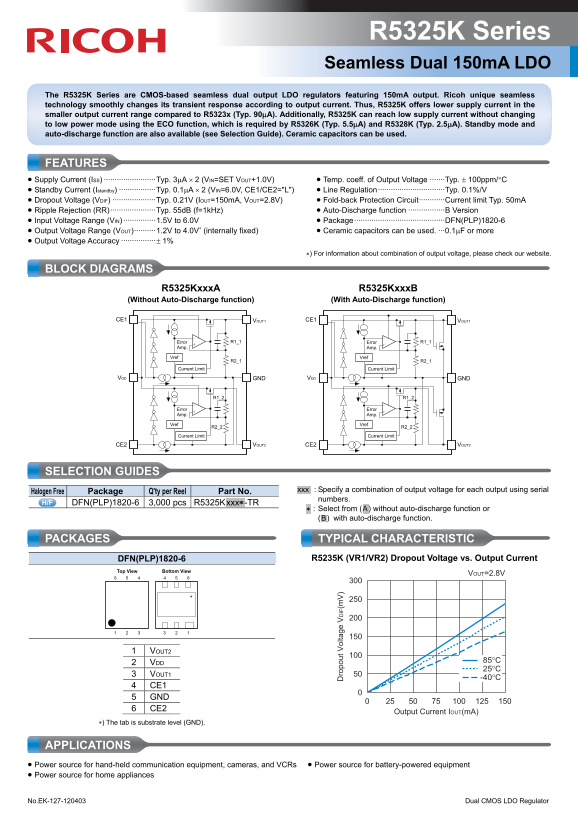
The R5325K Series are CMOS-based seamless dual output LDO regulators featuring 150m A output. Ricoh unique seamless technology smoothly changes its transient response according to output current. Thus, R5325K offers lower supply current in the smaller output current range compared to R5323x (Typ. 90μA). Additionally, R5325K can reach low supply current without changing to low power mode using the ECO function, which is required by R5326K (Typ. 5.5μA) and R5328K (Typ. 2.5μA). Standby mode and auto-discharge function are also available (see Selection Guide). Ceramic capacitors can be used.
FEATURES • Supply Current (ISS) ························Typ. 3μA × 2 (VIN=SET VOUT+1.0V) • Temp. coeff. of Output Voltage ·······Typ. ± 100ppm/°C • Standby Current (Istandby) ·················Typ. 0.1μA × 2 (VIN=6.0V, CE1/CE2="L") • Line Regulation·······························Typ. 0.1%/V • Dropout Voltage (VDIF) ····················Typ. 0.21V (IOUT=150m A, VOUT=2.8V) • Fold-back Protection Circuit············Current limit Typ. 50m A • Ripple Rejection (RR)·····················Typ. 55d B (f=1k Hz) • Auto-Discharge function ·················B Version • Input Voltage Range (VIN) ···············1.5V to 6.0V • Package··········································DFN(PLP)1820-6 • Output Voltage Range (VOUT)··········1.2V to 4.0V∗ (internally fixed) • Ceramic capacitors can be used. ···0.1μF or more • Output Voltage Accuracy ················± 1%
∗) For information about combination of output voltage, please check our website.
BLOCK DIAGRAMS R5325Kxxx A R5325Kxxx B (Without Auto-Discharge function) (With Auto-Discharge function)
CE1 VOUT1 CE1 VOUT1
ro lt Error IF (m R1_1 Error R1_1
Amp. Amp.
Vref Vref
Current Limit Current Limit
VDD GND VDD GND
Error Error Amp. Amp.
Vref Vref
Current Limit Current Limit
CE2 VOUT2 CE2 VOUT2
SELECTION GUIDES
.xxx : Specify a combination of output voltage for each output using serial
Halogen Free Package Q'ty per Reel Part No.
numbers.
DFN(PLP)1820-6 3,000 pcs R5325K.xxx∗ -TR
.∗ : Select from (.A.) without auto-discharge function or
(.B.) with auto-discharge function.
PACKAGES TYPICAL CHARACTERISTIC
DFN(PLP)1820-6 R5235K (VR1/VR2) Dropout Voltage vs. Output Current
Top View Bottom View
VOUT=2.8V
1 VOUT2
2 VDD
3 VOUT1
4 CE1 5 GND 6 CE2
Output Current IOUT(m A)
∗) The tab is substrate level (GND).
APPLICATIONS • Power source for hand-held communication equipment, cameras, and VCRs • Power source for battery-powered equipment • Power source for home appliances
No.EK-127-120403 Dual CMOS LDO Regulator
Page Summary Contents For RICOH R5325K Series Seamless Dual 150mA LDO Data Sheet
Manual Details
| Brand | Ricoh |
|---|---|
| Pages | 2 |
| File Size | 159.03 KB |
| Published | June 01, 2026 |
Enter the captcha to get the download link:

Frequently Asked Questions
What is the recommended capacitor type for this LDO regulator?
Ceramic capacitors are required; they must be 0.1μF or larger.
How does the R5325K handle low current consumption?
It offers lower supply current than R5323x and can maintain low performance without needing to switch to a dedicated low power mode like R5326K.
What are the typical standby current specifications?
The standby current (Istandby) is typically 0.1μA × 2 when operating at VIN=6.0V and CE1/CE2="L".
Are there safety warnings regarding system reliability?
Yes, customers must incorporate safety features like redundancy, firecontainment, and fail-safe measures to prevent injury or damage from component failure.