Panasonic Overcharge Overdischarge Overcurrent Safety Circuits User Manual
Summary
Optimize the performance and safety of your Li-Ion battery systems with this comprehensive guide. This technical documentation details essential knowledge for integrating and operating lithium ion battery packs equipped with advanced safety circuitry. It thoroughly covers critical functions like overcharge, overdischarge, and overcurrent protection; specifies optimal Constant Voltage/Constant Current charging protocols; and outlines best practices for proper battery management across various applications. Ideal for engineers and technicians designing or servicing reliable electronic power systems.
Page 1 Text Content
Overcharge/Overdischarge/Overcurrent Safety Circuits The Functions of the Safety Circuits (typical functions)
The voltages listed below are typical values and are not guaranteed. The charge voltage varies according to model number.
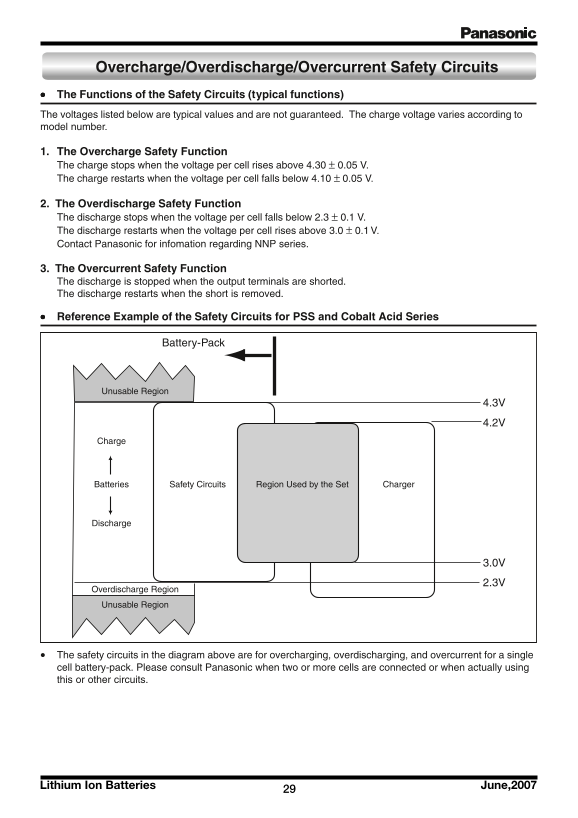
1. The Overcharge Safety Function The charge stops when the voltage per cell rises above 4.30 ± 0.05 V. The charge restarts when the voltage per cell falls below 4.10 ± 0.05 V.
2. The Overdischarge Safety Function The discharge stops when the voltage per cell falls below 2.3 ± 0.1 V. The discharge restarts when the voltage per cell rises above 3.0 ± 0.1 V. Contact Panasonic for infomation regarding NNP series.
3. The Overcurrent Safety Function The discharge is stopped when the output terminals are shorted. The discharge restarts when the short is removed.
Reference Example of the Safety Circuits for PSS and Cobalt Acid Series
Battery- Pack
Unusable Region
Charge
Batteries Safety Circuits Region Used by the Set Charger
Discharge
Overdischarge Region Unusable Region
The safety circuits in the diagram above are for overcharging, overdischarging, and overcurrent for a single cell battery-pack. Please consult Panasonic when two or more cells are connected or when actually using this or other circuits.
June,2007Lithium Ion Batteries
Page Summary Contents For Panasonic Overcharge Overdischarge Overcurrent Safety Circuits User Manual
Manual Details
| Brand | Panasonic |
|---|---|
| Pages | 4 |
| File Size | 145.43 KB |
| Published | June 01, 2026 |
Enter the captcha to get the download link:

Frequently Asked Questions
What is the upper voltage limit before overcharging occurs?
The charge must stop if the cell voltage rises above 4.30 V (per cell).
How do I restart charging after an overdischarge event?
Discharge restarts when the cell voltage rises above 3.0 ± 0.1 V (per cell).
What are the recommended charge current standards for PSS and Cobalt acid series cylindrical batteries?
The recommended charge current is 0.7 lt.
What safety measures must be included in the charging circuit design?
Include a total charge timer, a charge completion timer, and an overvoltage guard in the power supply.