LINEAR Monitor & Protect Automotive Systems w/ Integrated Current Sensing – Design Note 374
Summary
These high side current-sense amplifiers are specialized solutions for monitoring electrical loads in demanding automotive environments. Perfect for automotive designers and engineers developing fault protection systems, these parts ensure continuous, real-time measurement of crucial vehicle subsystems. The manual details using the series for precise sensing in complex applications like H-bridges and electric drive systems. They reliably detect faults—including load shorts, blown fuses, and transient events—while enduring extreme temperatures (–40°C to 125°C), enhancing overall vehicle safety and operational readiness.
Page 1 Text Content
Monitor and Protect Automotive Systems with Integrated Current Sensing – Design Note 374 John Munson
Introduction load and ground or an H-bridge. The circuit is program- mable to produce up to 1m A of full-scale output current
An automobile is an unforgiving environment for inte-
into ROUT, yet draws a mere 250µA supply current when
grated circuits, where under-the-hood operating tem-
the load is off.
peratures run from –40°C to 125°C and large transient excursions on the battery voltage bus are expected. In the
Figure 2 shows the LT6100 used as a combination
past, electronics were part of the well-protected and
current sensor and fuse monitor. This part includes on-
centralized Engine Control Unit (ECU), but the trend is
chip output buffering and was designed to operate with
toward more distributed electronics. Electrically driven
the low supply voltage (≥2.7V), typical of vehicle data
accessories and fault-protection monitoring functions are
acquisition systems, while the sense inputs monitor
leaving the protective umbrella of the ECU and migrating
signals at the higher battery bus potential. The LT6100
directly into vehicle subsystems.
, LTC and LT are registered trademarks of Linear Technology Corporation. All other trademarks are the property of their respective owners.
For example, many functions formerly driven by the engine—via belt and pulley or hydraulics—are now elec-
BATTERY BUS
trically driven (motorized), such as water pumps, steering mechanisms, brake actuators and various body controls.
RSENSE
These functions can become a safety risk if they are not 100Ω 0.01Ω
continually monitored for operational readiness and/or
LOAD –+
have a back-up mode of operation. In either case, real- time monitoring becomes necessary and generally involves accurately measuring the current draw of each subsystem.
LT6101
4.99V = 10A ROUT
Simple Current Monitoring Solutions
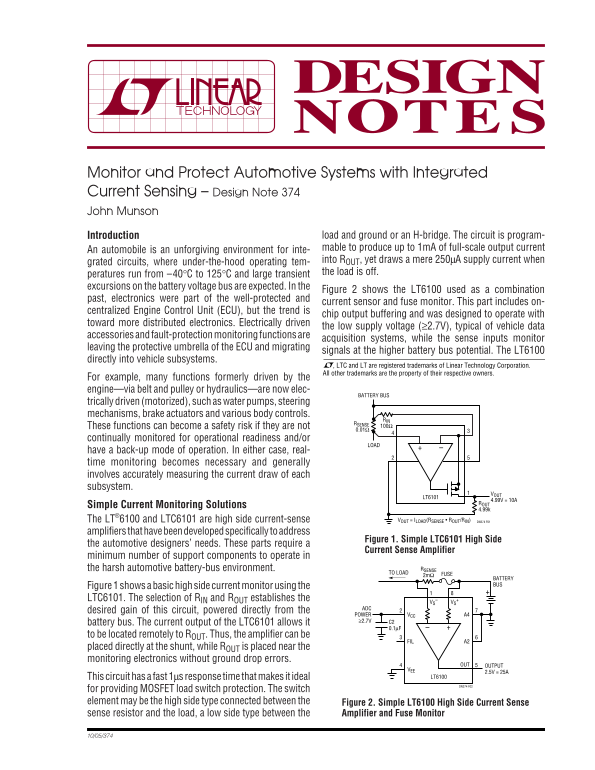
The LT®6100 and LTC6101 are high side current-sense VOUT = ILOAD(RSENSE • ROUT/RIN) DN374 F01
amplifiers that have been developed specifically to address
Figure 1. Simple LTC6101 High Side
the automotive designers’ needs. These parts require a
Current Sense Amplifier
minimum number of support components to operate in
the harsh automotive battery-bus environment. RSENSE
TO LOAD FUSE
BATTERY BUS
Figure 1 shows a basic high side current monitor using the LTC6101. The selection of RIN and ROUT establishes the
VS VS
desired gain of this circuit, powered directly from the
POWER VCC A4
battery bus. The current output of the LTC6101 allows it
to be located remotely to ROUT. Thus, the amplifier can be
FIL A2
placed directly at the shunt, while ROUT is placed near the monitoring electronics without ground drop errors.
OUT OUTPUT
2.5V = 25AVEE
This circuit has a fast 1µs response time that makes it ideal LT6100 DN374 F02
for providing MOSFET load switch protection. The switch element may be the high side type connected between the Figure 2. Simple LT6100 High Side Current Sense sense resistor and the load, a low side type between the Amplifier and Fuse Monitor
Page Summary Contents For LINEAR Monitor & Protect Automotive Systems w/ Integrated Current Sensing – Design Note 374
Manual Details
| Brand | Current |
|---|---|
| Pages | 2 |
| File Size | 82.39 KB |
| Published | May 28, 2026 |
Enter the captcha to get the download link:

Frequently Asked Questions
What is the operating temperature range for this product?
It is designed to operate in extreme automotive temperatures, from -40°C to 125°C.
How are these current sense amplifiers used in modern vehicles?
They monitor critical subsystems like water pumps and brake actuators for operational readiness by measuring current draw accurately.
What is the key benefit of using high side sensing on the LTC6101?
It provides rapid response to fault conditions, such as load shorts, which is crucial in harsh automotive environments.
Can the amplifier be placed near the monitoring electronics?
Yes; its current output allows it to be located remotely from the sense resistor (R) without ground drop errors.