LINEAR LTC4606 User Guide Manual
Summary
Designed for rigorous power supply challenges, these µModule Step-Down Regulators deliver both ultra-low noise and exceptional efficiency within a highly compact footprint. The manual details how these regulators simplify complex designs by providing Class B CISPR 22 compliance and high output fidelity that rivals linear components. Ideal for sophisticated electronics designers requiring high performance, superior thermal management, and minimal board space without compromising power quality.
Page 1 Text Content
L DESIGN FEATURES
Ultralow Noise 15mm ×15mm × 2.8mm µModule Step-Down Regulators Meet the Class B of CISPR 22 and Yield High Efficiency at up to 36VIN
by Judy Sun, Jian Yin, Sam Young and Henry Zhang
Introduction Power supply designers face many lead to high frequency EMI, but tradeoffs. Need high efficiency, large These µModule step-down some applications, especially those conversion ratios, high power and regulators are designed with large conversion ratios, require good thermal performance? Choose a a switcher.
to achieve both high
switching regulator. Need low noise? Fortunately, the LTM4606 and
power density and meet
Choose a linear regulator. Need it LTM4612 µModule regulators offer the
EMC (electromagnetic
all? Compromise. One compromise advantages of a switching regulator
is to follow a switcher with a linear compatibility) standards. while maintaining ultralow conducted
regulator (or regulators). Although this The integrated ultralow and radiated noise. These µModule cleans up the output noise relative to noise feature allows both step-down regulators are designed to a switcher-only solution, a good por- achieve both high power density and
devices to pass the Class
tion of the conducted and radiated meet EMC (electromagnetic compat-
B of CISPR 22 radiated
EMI remains—even if ferrite beads, ibility) standards. The integrated
emission limit, thus
π filters, and LC filters are used. The ultralow noise feature allows both
problem can always be traced back to eliminating expensive EMI devices to pass the Class B of CISPR
the switcher, where fast d I/dt transi- design and lab testing. 22 radiated emission limit, thus tions and high switching frequencies eliminating expensive EMI design and
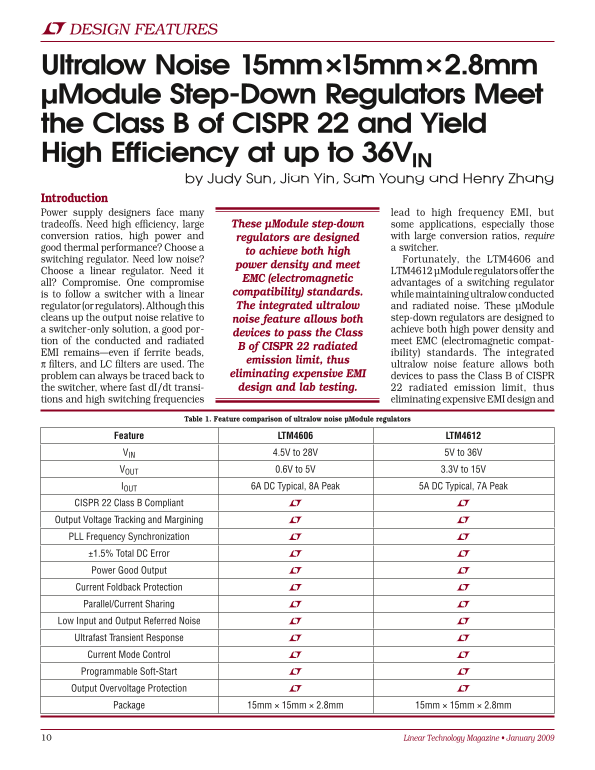
Table 1. Feature comparison of ultralow noise µModule regulators
Feature LTM4606 LTM4612 VIN 4.5V to 28V 5V to 36V VOUT 0.6V to 5V 3.3V to 15V IOUT 6A DC Typical, 8A Peak 5A DC Typical, 7A Peak
CISPR 22 Class B Compliant Output Voltage Tracking and Margining L PLL Frequency Synchronization L ±1.5% Total DC Error L Power Good Output L Current Foldback Protection L Parallel/Current Sharing L Low Input and Output Referred Noise L Ultrafast Transient Response L Current Mode Control L Programmable Soft-Start L Output Overvoltage Protection L Package 15mm × 15mm × 2.8mm 15mm × 15mm × 2.8mm
Linear Technology Magazine • January 2009
Page Summary Contents For LINEAR LTC4606 User Guide Manual
Manual Details
| Brand | Linear |
|---|---|
| Pages | 5 |
| File Size | 1.31 MB |
| Published | June 03, 2026 |
Enter the captcha to get the download link:

Frequently Asked Questions
What specific EMC compliance standards do these µModule regulators meet?
They are designed to pass the Class B of CISPR 22 both for conducted and radiated EMI standards.
How can I achieve high efficiency with low noise, like a switcher-linear combination?
The LTM4606 and LTM4612 µModule regulators offer an integrated ultralow noise feature that allows users to combine the benefits of switching regulators and linear regulators.
Are these modules suitable for paralleling to handle higher loads?
Yes, both parts can be easily paralleled, and output currents are automatically shared due to their current mode control.