LINEAR LTC400X User Guide Manual
Summary
The LTC4009 family provides powerful microprocessor-controlled ICs for developing sophisticated battery charging systems across multiple chemistries, including Li-ion and smart batteries. This documentation details the architecture of these high-efficiency chargers, which operate up to 50W while maintaining ultra-low current ripple in a small footprint. Suitable for engineers requiring precise control over charge profiles, adjustable output voltages, and robust protection features, it facilitates reliable battery management solutions for demanding applications.
Page 1 Text Content
L DESIGN FEATURES
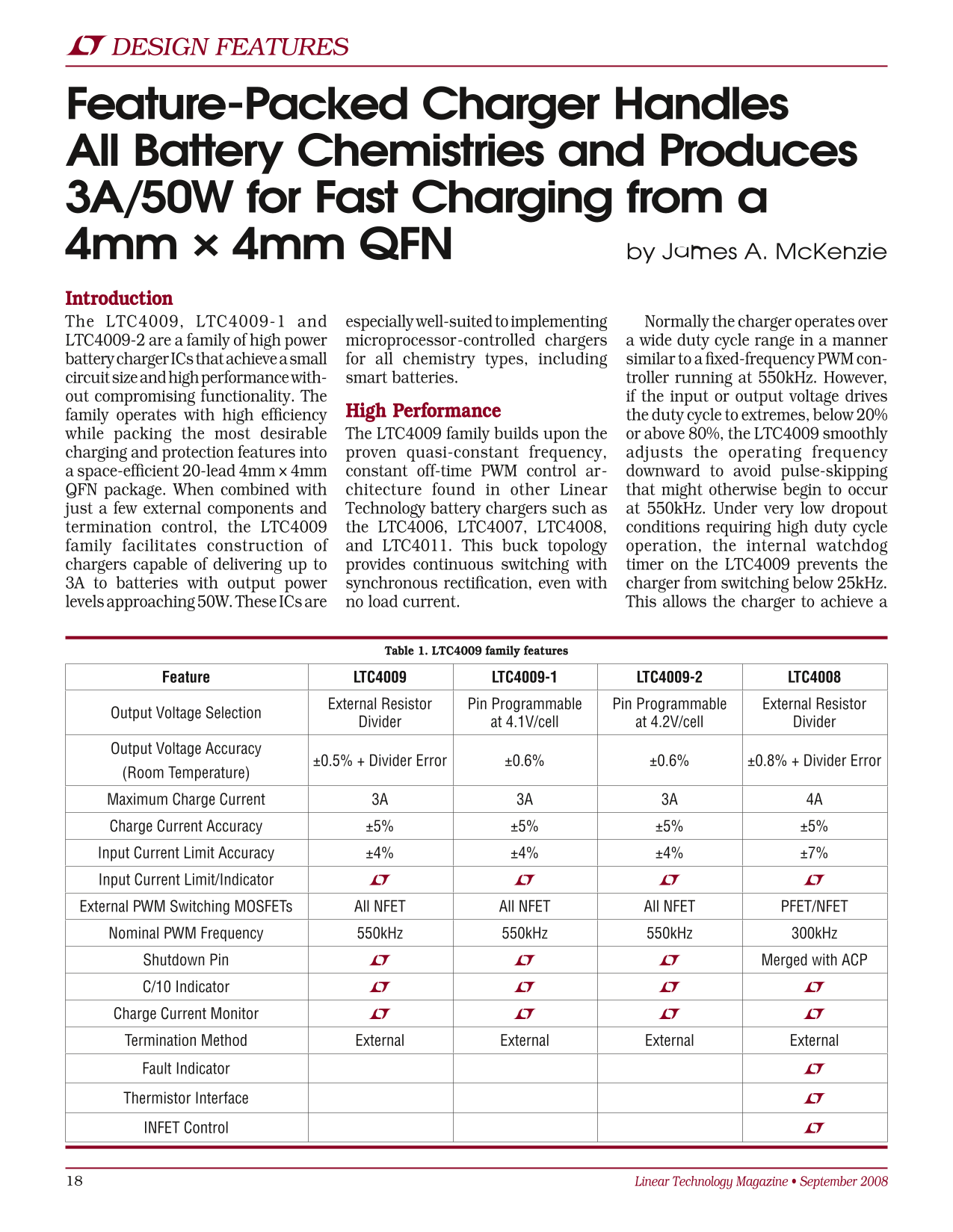
Feature-Packed Charger Handles All Battery Chemistries and Produces 3A/50W for Fast Charging from a 4mm × 4mm QFN by James A. Mc Kenzie Introduction The LTC4009, LTC4009-1 and especially well-suited to implementing Normally the charger operates over LTC4009-2 are a family of high power microprocessor-controlled chargers a wide duty cycle range in a manner battery charger ICs that achieve a small for all chemistry types, including similar to a fixed-frequency PWM con- circuit size and high performance with- smart batteries. troller running at 550k Hz. However, out compromising functionality. The if the input or output voltage drives
family operates with high efficiency High Performance the duty cycle to extremes, below 20%
while packing the most desirable The LTC4009 family builds upon the or above 80%, the LTC4009 smoothly charging and protection features into proven quasi-constant frequency, adjusts the operating frequency a space-efficient 20-lead 4mm × 4mm constant off-time PWM control ar- downward to avoid pulse-skipping QFN package. When combined with chitecture found in other Linear that might otherwise begin to occur just a few external components and Technology battery chargers such as at 550k Hz. Under very low dropout termination control, the LTC4009 the LTC4006, LTC4007, LTC4008, conditions requiring high duty cycle family facilitates construction of and LTC4011. This buck topology operation, the internal watchdog chargers capable of delivering up to provides continuous switching with timer on the LTC4009 prevents the 3A to batteries with output power synchronous rectification, even with charger from switching below 25k Hz. levels approaching 50W. These ICs are no load current. This allows the charger to achieve a
Table 1. LTC4009 family features
Feature LTC4009 LTC4009-1 LTC4009-2 LTC4008
External Resistor Pin Programmable Pin Programmable External Resistor
Output Voltage Selection
Divider at 4.1V/cell at 4.2V/cell Divider
Output Voltage Accuracy
±0.5% + Divider Error ±0.6% ±0.6% ±0.8% + Divider Error
(Room Temperature) Maximum Charge Current 3A 3A 3A 4A Charge Current Accuracy ±5% ±5% ±5% ±5% Input Current Limit Accuracy ±4% ±4% ±4% ±7% Input Current Limit/Indicator External PWM Switching MOSFETs All NFET All NFET All NFET PFET/NFET Nominal PWM Frequency 550k Hz 550k Hz 550k Hz 300k Hz Shutdown Pin Merged with ACP C/10 Indicator Charge Current Monitor Termination Method External External External External Fault Indicator Thermistor Interface INFET Control
Linear Technology Magazine • September 2008
Page Summary Contents For LINEAR LTC400X User Guide Manual
Manual Details
| Brand | Linear |
|---|---|
| Pages | 4 |
| File Size | 464.05 KB |
| Published | July 15, 2026 |
Enter the captcha to get the download link:

Frequently Asked Questions
What types of battery chemistries does the LTC4009 family support?
It supports all common battery chemistries, including Li-ion and Li-Polymer.
How high can the charger achieve in terms of power output?
It is capable of delivering up to 3A at over 95% efficiency, potentially approaching 50W output power levels.
What features help reduce system size?
The ICs feature small surface mount packages and use synchronous rectification with N-channel MOSFETs, minimizing board space.
Does the charger handle faults and restarts?
Yes, it includes internal watchdogs and fault handling to allow startup and restart from conditions like over-temperature or unexpected voltage reversal.