LINEAR DESIGN FEATURES LTMag-V18N02-14-LTC4355_57 - Meilissa Lum User Manual, Technical Guide
Summary
The LTC4358 ideal diode is a superior MOSFET-based solution designed to replace bulky Schottky diodes in high-availability power systems. This guide details how the component significantly boosts efficiency and reduces voltage drop, enabling reliable power isolation without costly heat sinks. It is essential reading for engineers designing redundant or mission-critical electronic circuits who need optimized PCB layout techniques for ideal diode integration.
Page 1 Text Content
L DESIGN IDEAS
CU RR EN (A
Ideal Diode Betters a Schottky by a Factor of Four in Power and Space
Consumption by Meilissa Lum
Introduction High availability systems often use
parallel power supplies or battery IN DRAIN
VIN = 12V VOUT TO 5A LOAD
feeds to achieve redundancy and
enhance system reliability. Tradition-
LTC4358 VDD
ally, Schottky ORing diodes are used to connect these supplies at the point
of load and prevent backfeeding into a faulty power supply. Unfortunately, the forward voltage drop of these diodes
Figure 1. No external components are needed for a 12V/5A ideal diode.
reduces the available supply voltage and dissipates significant power at high currents—costly heat sinks and and LTC4358 enable MOSFET-based elaborate layouts are needed to keep ideal diode solutions for various ap-
With one-fourth the
the diodes cool. plications—the choice depends on the
When power dissipation is a dissipated power, system current and operating voltage of the
concern, the Schottky diode can be application. Table 1 compares these
efficiency is increased and
replaced with a MOSFET-based ideal devices.
diode. This reduces the voltage drop PCB layout is simplified—no
and power dissipation, thereby reduc- Ideal Diode Easier to Use
need for costly and bulky
ing the complexity, size and cost of the Than a Schottky
PO ER IS SI PA TI ON (W heat sinks.
thermal layout and increasing system Of particular interest is the LTC4358, efficiency. The LTC4355, LTC4357 which includes an internal 20mΩ
DIODE (B530C) 1.5
DIODE (B530C)
FET (LTC4358)
POWER SAVED
FET (LTC4358)
VOLTAGE DROP (m V) CURRENT (A)
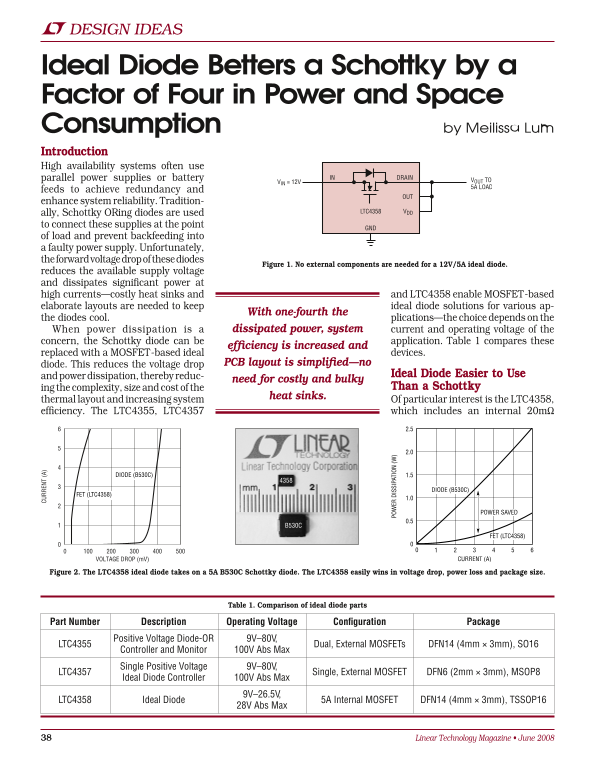
Figure 2. The LTC4358 ideal diode takes on a 5A B530C Schottky diode. The LTC4358 easily wins in voltage drop, power loss and package size.
Table 1. Comparison of ideal diode parts
Part Number Description Operating Voltage Configuration Package
Positive Voltage Diode-OR 9V–80V,
LTC4355 Dual, External MOSFETs DFN14 (4mm × 3mm), SO16
Controller and Monitor 100V Abs Max Single Positive Voltage 9V–80V,
LTC4357 Single, External MOSFET DFN6 (2mm × 3mm), MSOP8
Ideal Diode Controller 100V Abs Max
LTC4358 Ideal Diode 5A Internal MOSFET DFN14 (4mm × 3mm), TSSOP16
28V Abs Max
Linear Technology Magazine • June 2008
Page Summary Contents For LINEAR DESIGN FEATURES LTMag-V18N02-14-LTC4355_57 - Meilissa Lum User Manual, Technical Guide
Manual Details
| Brand | Linear |
|---|---|
| Pages | 2 |
| File Size | 488.87 KB |
| Published | June 16, 2026 |
Enter the captcha to get the download link:

Frequently Asked Questions
How much better is LTC4358 compared to a Schottky diode?
The LTC4358 offers a factor of four improvement in voltage drop, power loss, and package size over a Schottky diode.
What does the LCC4358 replace?
It can directly replace a 5A B530C Schottky diode in applications ranging from 9V to 26.5V.
How is heat dissipation improved with the LTC4358?
Using proper PCB layout (e.g., vias) can increase maximum current by 10% and improve heat removal without requiring bulky heat sinks.