LINEAR DESIGN FEATURES LTMag- V18N02-04 - LTM9002 - Todd Nelson Technical Manual
Summary
Master high-performance signal detection with this advanced dual-channel ADC module, engineered for complex RF and baseband communications systems. Designed specifically for MIMO arrays and IF receivers, it integrates dual 14-bit conversion into a compact µModule package, guaranteeing superior channel matching, noise isolation, and dynamic range. This technical resource details the LTM9002's full capabilities, covering optimal integration methods, performance scaling (SNR/SFDR), and application guidelines for professional RF engineers designing low-noise, high-density receiving architectures.
Page 1 Text Content
L DESIGN FEATURES
Complete Dual-Channel Receiver Combines 14-Bit, 125Msps ADCs, Fixed-Gain Amplifiers and Antialias Filters in a Single 11.25mm × 15mm μModule Package by Todd Nelson Introduction Multichannel
Extensive hands-on applications his expertise lies in the RF or digital ADC Applications
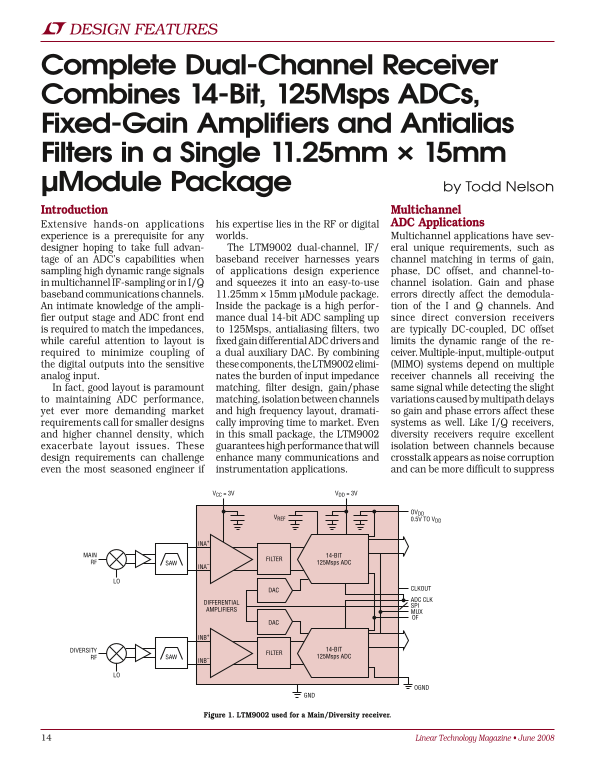
experience is a prerequisite for any worlds. Multichannel applications have sev- designer hoping to take full advan- The LTM9002 dual-channel, IF/ eral unique requirements, such as tage of an ADC’s capabilities when baseband receiver harnesses years channel matching in terms of gain, sampling high dynamic range signals of applications design experience phase, DC offset, and channel-to- in multichannel IF-sampling or in I/Q and squeezes it into an easy-to-use channel isolation. Gain and phase baseband communications channels. 11.25mm × 15mm µModule package. errors directly affect the demodula- An intimate knowledge of the ampli- Inside the package is a high perfor- tion of the I and Q channels. And fier output stage and ADC front end mance dual 14-bit ADC sampling up since direct conversion receivers is required to match the impedances, to 125Msps, antialiasing filters, two are typically DC-coupled, DC offset while careful attention to layout is fixed gain differential ADC drivers and limits the dynamic range of the re- required to minimize coupling of a dual auxiliary DAC. By combining ceiver. Multiple-input, multiple-output the digital outputs into the sensitive these components, the LTM9002 elimi- (MIMO) systems depend on multiple analog input. nates the burden of input impedance receiver channels all receiving the In fact, good layout is paramount matching, filter design, gain/phase same signal while detecting the slight to maintaining ADC performance, matching, isolation between channels variations caused by multipath delays yet ever more demanding market and high frequency layout, dramati- so gain and phase errors affect these requirements call for smaller designs cally improving time to market. Even systems as well. Like I/Q receivers, and higher channel density, which in this small package, the LTM9002 diversity receivers require excellent exacerbate layout issues. These guarantees high performance that will isolation between channels because design requirements can challenge enhance many communications and crosstalk appears as noise corruption even the most seasoned engineer if instrumentation applications. and can be more difficult to suppress
VCC = 3V VDD = 3V
VREF 0.5V TO VDD
MAIN 14-BIT
FILTER
RF SAW 125Msps ADC
DAC CLKOUT ADC CLK
DIFFERENTIAL
AMPLIFIERS
MUX OF
DIVERSITY 14-BIT
FILTER
RF SAW 125Msps ADC
Figure 1. LTM9002 used for a Main/Diversity receiver.
Linear Technology Magazine • June 2008
Page Summary Contents For LINEAR DESIGN FEATURES LTMag- V18N02-04 - LTM9002 - Todd Nelson Technical Manual
Manual Details
| Brand | Linear |
|---|---|
| Pages | 3 |
| File Size | 547.87 KB |
| Published | June 18, 2026 |
Enter the captcha to get the download link:

Frequently Asked Questions
What is the primary function of the LTM9002 chip?
It combines dual 14-bit, 125Msps ADCs with fixed-gain amplifiers and antialias filters into a single package for complex receiver front ends.
How can I adjust the performance metrics like SNR or FFDR on the LTM9002?
Performance parameters can be adjusted in three ways: by changing the SENSE pin connection, adjusting the amplifier gain, or filtering bandwidth.
What physical dimensions does the LTM9002 occupy?
It is packaged in a small 11.25mm × 15mm µModule package that covers approximately two square inches of board area.
Does the system need external circuits for high performance?
No, many necessary components are integrated into the chip, but careful layout is paramount to maintaining ADC performance and isolation between channels.