Linear Design Features LTMag-V18N01-10-LTC4357-Lum Technical Manual
Summary
Ideal diode controllers revolutionize redundant power supply design by replacing bulky Schottky diodes. This technology dramatically reduces voltage drop and heat loss, significantly enhancing system efficiency while ensuring precise load sharing across parallel sources. It is a critical component for engineers designing high-availability systems that require compact, reliable, low-dissipation solutions operating over extended voltage ranges (9V to 80V).
Page 1 Text Content
DESIGN IDEAS L
9V to 80V Ideal Diode Reduces Heat Dissipation by Order of Magnitude
over Schottky by Meilissa Lum
Introduction
FDB3632
High availability systems often employ VINA = 48V
parallel-connected power supplies or battery feeds to achieve redun-
IN GATE OUT
dancy and enhance system reliability.
LTC4357 VDD VOUT TO LOAD
Schottky ORing diodes have long been used to connect these supplies at GND the point of load. Unfortunately, the forward voltage drop of these diodes
FDB3632
VINB = 48V
reduces the available supply voltage and dissipates significant power at high currents. Costly heat sinks and IN GATE OUT elaborate layouts are needed to keep
LTC4357 VDD
the Schottky diode cool.
A better solution is to replace the GND
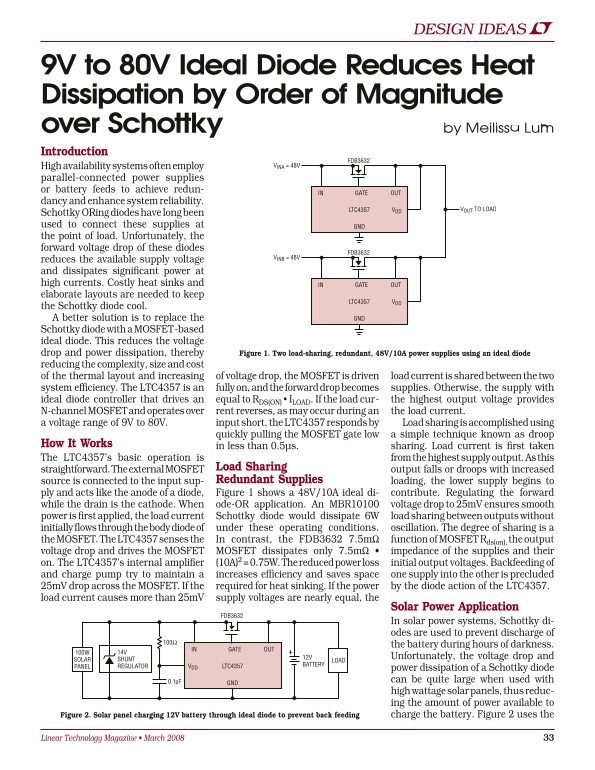
Schottky diode with a MOSFET-based ideal diode. This reduces the voltage drop and power dissipation, thereby Figure 1. Two load-sharing, redundant, 48V/10A power supplies using an ideal diode reducing the complexity, size and cost of the thermal layout and increasing of voltage drop, the MOSFET is driven load current is shared between the two system efficiency. The LTC4357 is an fully on, and the forward drop becomes supplies. Otherwise, the supply with ideal diode controller that drives an equal to RDS(ON) • ILOAD. If the load cur- the highest output voltage provides N-channel MOSFET and operates over rent reverses, as may occur during an the load current. a voltage range of 9V to 80V. input short, the LTC4357 responds by Load sharing is accomplished using
quickly pulling the MOSFET gate low a simple technique known as droop
How It Works in less than 0.5µs. sharing. Load current is first taken The LTC4357’s basic operation is from the highest supply output. As this
straightforward. The external MOSFET Load Sharing output falls or droops with increased source is connected to the input sup- Redundant Supplies loading, the lower supply begins to
ply and acts like the anode of a diode, Figure 1 shows a 48V/10A ideal di- contribute. Regulating the forward while the drain is the cathode. When ode-OR application. An MBR10100 voltage drop to 25m V ensures smooth power is first applied, the load current Schottky diode would dissipate 6W load sharing between outputs without initially flows through the body diode of under these operating conditions. oscillation. The degree of sharing is a the MOSFET. The LTC4357 senses the In contrast, the FDB3632 7.5mΩ function of MOSFET Rds(on), the output voltage drop and drives the MOSFET MOSFET dissipates only 7.5mΩ • impedance of the supplies and their on. The LTC4357’s internal amplifier (10A)2 = 0.75W. The reduced power loss initial output voltages. Backfeeding of and charge pump try to maintain a increases efficiency and saves space one supply into the other is precluded 25m V drop across the MOSFET. If the required for heat sinking. If the power by the diode action of the LTC4357. load current causes more than 25m V supply voltages are nearly equal, the
Solar Power Application
FDB3632
In solar power systems, Schottky di- odes are used to prevent discharge of
the battery during hours of darkness.
IN GATE OUT
12V Unfortunately, the voltage drop and
SOLAR SHUNT LOAD
REGULATOR LTC4357 BATTERYVDD
PANEL
power dissipation of a Schottky diode 0.1µF can be quite large when used with
high wattage solar panels, thus reduc- ing the amount of power available to
Figure 2. Solar panel charging 12V battery through ideal diode to prevent back feeding charge the battery. Figure 2 uses the
Linear Technology Magazine • March 2008
Page Summary Contents For Linear Design Features LTMag-V18N01-10-LTC4357-Lum Technical Manual
Manual Details
| Brand | Linear |
|---|---|
| Pages | 2 |
| File Size | 143.75 KB |
| Published | June 18, 2026 |
Enter the captcha to get the download link:

Frequently Asked Questions
How does using an ideal diode improve power supply efficiency?
The MOSFET-based ideal diode reduces voltage drop and power dissipation compared to Schottky diodes, increasing system efficiency.
What are the operating voltage guidelines for the LTC4357 controller?
The LTC4357 operates over a wide input voltage range of 9V to 80V.
How does load sharing work with redundant supplies using this technique?
When an external supply drops, the LTC4357 drives the MOSFET, allowing the remaining source to share the load current seamlessly.