Linear Design Features LTMag- V18N4-08 - LT3782A Narayan Raja User Guide Technical Manual
Summary
Optimize your power supply design with this guide to 2-Phase Synchronous Boost Converters. Learn how replacing traditional diodes with cool MOSFETs dramatically boosts efficiency, reduces heat dissipation, and eliminates the need for cumbersome heat sinks in high-power DC/DC applications. This manual is essential for engineers designing compact industrial or automotive systems that require superior thermal management and reliable, high-efficiency performance.
Page 1 Text Content
DESIGN IDEAS L
High Power 2-Phase Synchronous Boost Replaces Hot Diodes with Cool FETs—No Heat Sinks Required
by Narayan Raja, Tuan Nguyen and Theo Phillips
Introduction For low power designs, non-synchro- nous boost converter, with the diode ogy offers controller ICs that simplify nous boost converters offer a simple replaced with a lower forward voltage the design of high power synchronous solution. However, as power levels in- drop switch, significantly improves ef- boost applications. The LT3782A boost crease, the heat dissipated in the boost ficiency and relieves many issues with controller, for instance, includes pre- diode becomes a significant design thermal layout. Although the topology drive outputs for external synchronous problem. In such cases, a synchro- is more complicated, Linear Technol- switch drivers. It also integrates strong
PD3S160
VCC BST
LTC4440-5 GND TG
IN TS DFLS160
SGATE1 VOUT
L1 24V AT 8A
VIN 475k 10V TO 14V 1%
BG1BG1 Q3Q2
VCC1 1%
SENSE1+
SGATE2 SGATE2 BGATE1 BG1
SGATE1 SGATE1 BGATE2 BG2
SENSE1–
SENSE1+
LT3782A
10Ω SYNC GBIAS
DELAY GBIAS1
PD3S160
DCL GBIAS2
SENSE1+
4.7µF VCC BST DFLS1601µF
SENSE1– SENSE1– 1µF
LTC4440-5
VEE1 GND TG
SLOPE VEE2
IN TS
RSET GND SGATE2
SENSE2– SENSE2– 2.2n F
SENSE2+ FB
Q5 BG2BG2 Q6
SS VC SENSE2+
220p F 15k SENSE2–
SENSE2+ Q1–Q6 = HAT2266
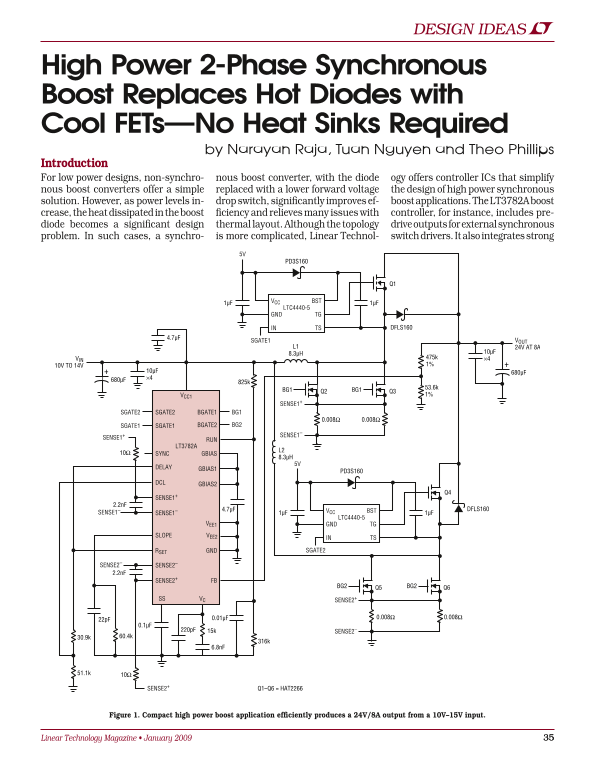
Figure 1. Compact high power boost application efficiently produces a 24V/8A output from a 10V–15V input.
Linear Technology Magazine • January 2009
Page Summary Contents For Linear Design Features LTMag- V18N4-08 - LT3782A Narayan Raja User Guide Technical Manual
Manual Details
| Brand | Linear |
|---|---|
| Pages | 3 |
| File Size | 560.99 KB |
| Published | June 20, 2026 |
Enter the captcha to get the download link:

Frequently Asked Questions
Do I need heat sinks when using this boost circuit?
No, the design uses cool FETs and requires no external heat sinks.
How does synchronous boosting compare to diode-based boosting?
Synchronous boosting is significantly more efficient than using diodes because the switches are actively driven, reducing power dissipation due to lower forward voltage drop.
What advantages does this 2-phase architecture offer?
The 2-phase operation helps reduce EMI, improves thermal performance by spreading heat over two phases, and reduces output ripple.