EMERSON 66 Series Installation Guide
Summary
These instructions guide the installation, start-up, and adjustment of Type 66, 66Z, and 66ZZ vacuum regulators and breakers. Designed for industrial applications maintaining differential pressure control, these components are crucial safety accessories that prevent equipment damage from dangerous overvacuum conditions. The manual provides qualified personnel with comprehensive technical specifications, operational procedures, material details (like NBR/FKM elastomers), and critical safety warnings needed to ensure reliable performance in pressurized fluid systems.
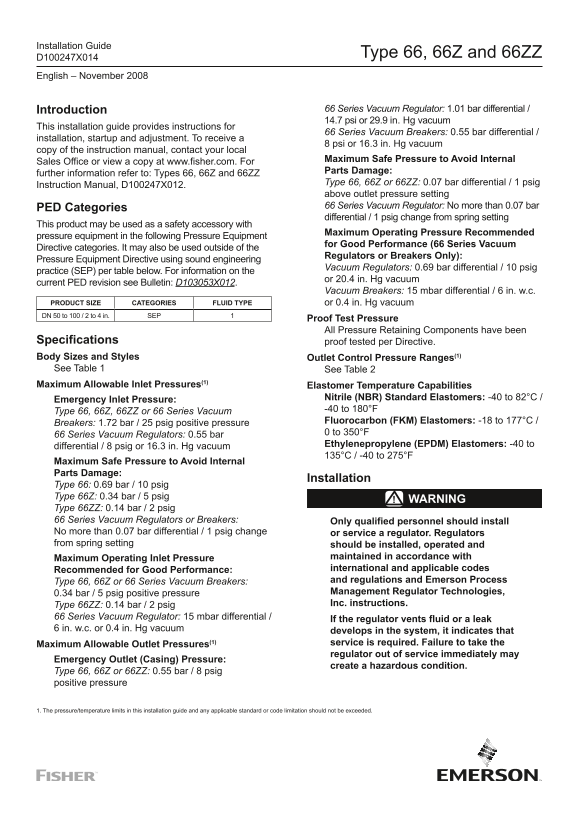
Page 1 Text Content
Type 66, 66Z and 66ZZInstallation Guide
D100247X014 English – November 2008
Introduction 66 Series Vacuum Regulator: 1.01 bar differential / 14.7 psi or 29.9 in. Hg vacuum
This installation guide provides instructions for
66 Series Vacuum Breakers: 0.55 bar differential /
installation, startup and adjustment. To receive a
8 psi or 16.3 in. Hg vacuum
copy of the instruction manual, contact your local
Maximum Safe Pressure to Avoid Internal
Sales Office or view a copy at www.fisher.com. For
Parts Damage:
further information refer to: Types 66, 66Z and 66ZZ
Type 66, 66Z or 66ZZ: 0.07 bar differential / 1 psig
Instruction Manual, D100247X012.
above outlet pressure setting PED Categories 66 Series Vacuum Regulator: No more than 0.07 bar differential / 1 psig change from spring setting
This product may be used as a safety accessory with
Maximum Operating Pressure Recommended
pressure equipment in the following Pressure Equipment
for Good Performance (66 Series Vacuum
Directive categories. It may also be used outside of the
Regulators or Breakers Only):
Pressure Equipment Directive using sound engineering
Vacuum Regulators: 0.69 bar differential / 10 psig
practice (SEP) per table below. For information on the
or 20.4 in. Hg vacuum
current PED revision see Bulletin: D103053X012.
Vacuum Breakers: 15 mbar differential / 6 in. w.c.
PRODUCT SIZE CATEGORIES FLUID TYPE or 0.4 in. Hg vacuum DN 50 to 100 / 2 to 4 in. SEP
Proof Test Pressure All Pressure Retaining Components have been
Specifications proof tested per Directive. Body Sizes and Styles Outlet Control Pressure Ranges(1) See Table 1 See Table 2 Maximum Allowable Inlet Pressures(1) Elastomer Temperature Capabilities
Emergency Inlet Pressure: Nitrile (NBR) Standard Elastomers: -40 to 82°C / Type 66, 66Z, 66ZZ or 66 Series Vacuum -40 to 180°F Breakers: 1.72 bar / 25 psig positive pressure Fluorocarbon (FKM) Elastomers: -18 to 177°C / 66 Series Vacuum Regulators: 0.55 bar 0 to 350°F differential / 8 psig or 16.3 in. Hg vacuum Ethylenepropylene (EPDM) Elastomers: -40 to 135°C / -40 to 275°F
Maximum Safe Pressure to Avoid Internal Parts Damage:
Installation
Type 66: 0.69 bar / 10 psig Type 66Z: 0.34 bar / 5 psig
WARNING
Type 66ZZ: 0.14 bar / 2 psig 66 Series Vacuum Regulators or Breakers: Only qualified personnel should install No more than 0.07 bar differential / 1 psig change or service a regulator. Regulators from spring setting should be installed, operated and
Maximum Operating Inlet Pressure maintained in accordance with Recommended for Good Performance: international and applicable codes Type 66, 66Z or 66 Series Vacuum Breakers: and regulations and Emerson Process 0.34 bar / 5 psig positive pressure Management Regulator Technologies, Type 66ZZ: 0.14 bar / 2 psig Inc. instructions.
66 Series Vacuum Regulator: 15 mbar differential /
If the regulator vents fluid or a leak
6 in. w.c. or 0.4 in. Hg vacuum
develops in the system, it indicates that Maximum Allowable Outlet Pressures(1) service is required. Failure to take the regulator out of service immediately may
Emergency Outlet (Casing) Pressure:
create a hazardous condition.
Type 66, 66Z or 66ZZ: 0.55 bar / 8 psig positive pressure
1. The pressure/temperature limits in this installation guide and any applicable standard or code limitation should not be exceeded.
Page Summary Contents For EMERSON 66 Series Installation Guide
Manual Details
| Brand | Emerson |
|---|---|
| Pages | 4 |
| File Size | 515.30 KB |
| Published | June 06, 2026 |
Enter the captcha to get the download link:

Frequently Asked Questions
What steps must be taken if the inlet pressure exceeds the maximum operating outlet?
Provide overpressure protection devices or reliving valves to prevent injury or equipment damage.
If I detect a leak or void in the system, what does this mean about my regulator?
It indicates that service is required and the unit must be taken out of service immediately.
Which temperature range can Nitrile (NBR) elastomers handle?
Nitrile elastomers are rated for a standard operating range of -40 to 82°C.
Who is qualified to install, operate, or service the regulator?
Only qualified personnel should install, operate, and maintain the regulator.