Dell Vostro 15 3510 Statement of Volatility
Summary
Statement of Volatility for Dell Vostro 15 3510 laptop documenting non-volatile components including panel EDID EEPROM, system BIOS, embedded controller, memory SPD EEPROMs, battery-backed CMOS, TPM controller, and SSD storage. Intended for security and compliance personnel assessing data remanence in this small business laptop.
Page 1 Text Content
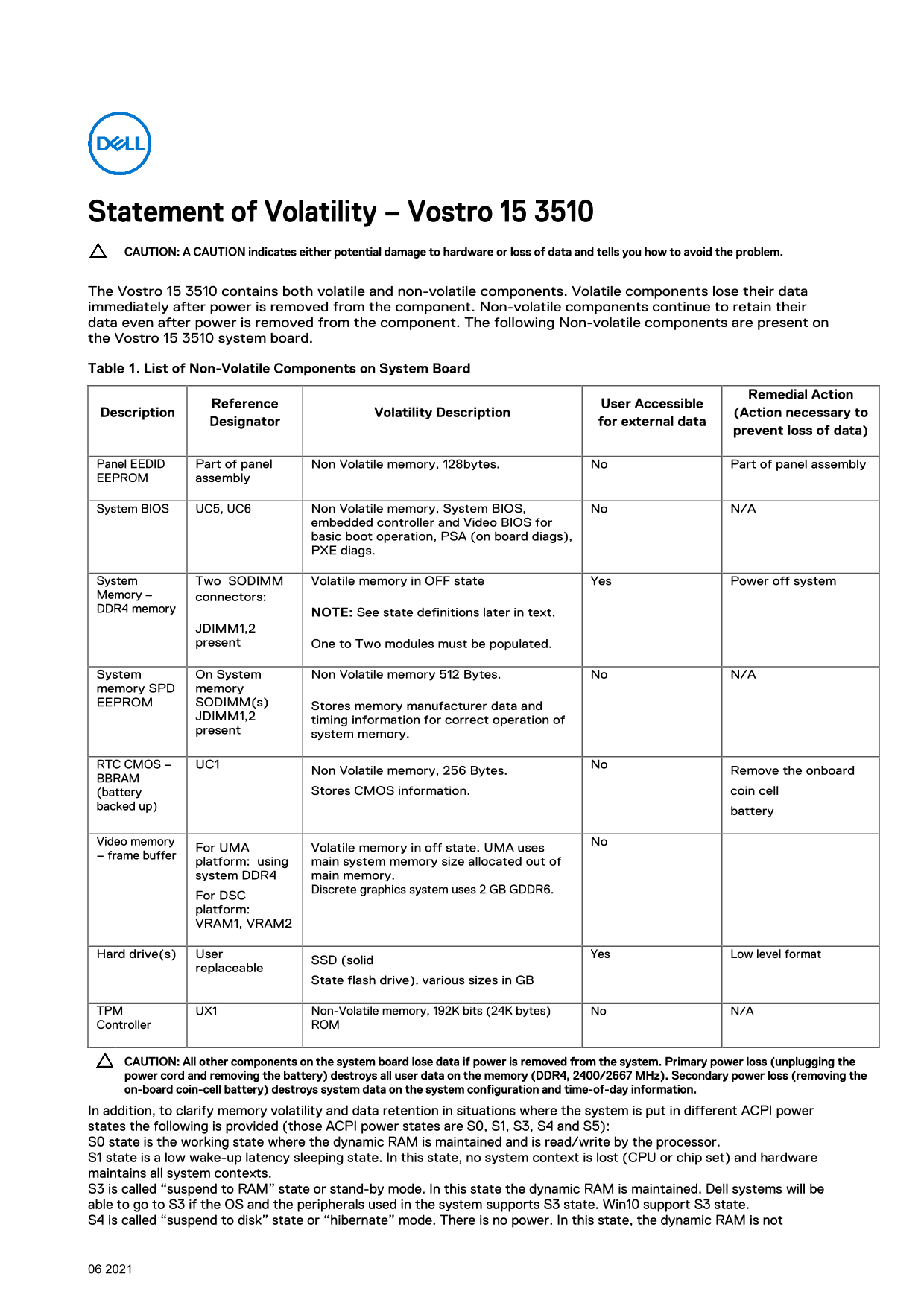
Statement of Volatility – Vostro 15 3510 CAUTION: A CAUTION indicates either potential damage to hardware or loss of data and tells you how to avoid the problem. The Vostro 15 3510 contains both volatile and non-volatile components. Volatile components lose their data immediately after power is removed from the component. Non-volatile components continue to retain their data even after power is removed from the component. The following Non-volatile components are present on the Vostro 15 3510 system board. Table 1. List of Non-Volatile Components on System Board
Remedial Action
Reference User Accessible
Description Volatility Description (Action necessary to
Designator for external data
prevent loss of data)
Panel EEDID Part of panel Non Volatile memory, 128bytes. No Part of panel assembly EEPROM assembly
System BIOS UC5, UC6 Non Volatile memory, System BIOS, No N/A
embedded controller and Video BIOS for basic boot operation, PSA (on board diags), PXE diags.
System Two SODIMM Volatile memory in OFF state Yes Power off system Memory – connectors: DDR4 memory
NOTE: See state definitions later in text.
JDIMM1,2 present One to Two modules must be populated.
System On System Non Volatile memory 512 Bytes. No N/A memory SPD memory
EEPROM SODIMM(s)
Stores memory manufacturer data and
JDIMM1,2
timing information for correct operation of
present
system memory.
RTC CMOS – UC1 Non Volatile memory, 256 Bytes. No Remove the onboard BBRAM
(battery Stores CMOS information. coin cell
backed up)
battery
Video memory No
For UMA Volatile memory in off state. UMA uses
– frame buffer
platform: using main system memory size allocated out of system DDR4 main memory.
Discrete graphics system uses 2 GB GDDR6.
For DSC platform: VRAM1, VRAM2
Hard drive(s) User Yes Low level format
SSD (solid
replaceable
State flash drive). various sizes in GB
TPM UX1 Non-Volatile memory, 192K bits (24K bytes) No N/A Controller ROM
CAUTION: All other components on the system board lose data if power is removed from the system. Primary power loss (unplugging the power cord and removing the battery) destroys all user data on the memory (DDR4, 2400/2667 MHz). Secondary power loss (removing the on-board coin-cell battery) destroys system data on the system configuration and time-of-day information. In addition, to clarify memory volatility and data retention in situations where the system is put in different ACPI power states the following is provided (those ACPI power states are S0, S1, S3, S4 and S5): S0 state is the working state where the dynamic RAM is maintained and is read/write by the processor. S1 state is a low wake-up latency sleeping state. In this state, no system context is lost (CPU or chip set) and hardware maintains all system contexts. S3 is called “suspend to RAM” state or stand-by mode. In this state the dynamic RAM is maintained. Dell systems will be able to go to S3 if the OS and the peripherals used in the system supports S3 state. Win10 support S3 state. S4 is called “suspend to disk” state or “hibernate” mode. There is no power. In this state, the dynamic RAM is not
Page Summary Contents For Dell Vostro 15 3510 Statement of Volatility
Manual Details
| Brand | Dell |
|---|---|
| Pages | 2 |
| File Size | 139.54 KB |
| Published | June 25, 2026 |
Enter the captcha to get the download link:

Frequently Asked Questions
What happens to data if I lose primary power on the Vostro 15 3510?
All user data on the volatile memory (DDR4) will be destroyed if primary power is removed (unplugging the cord and removing the battery).
How do I prevent loss of system configuration data?
To prevent loss of system configuration and time-of-day information, remove the onboard coin-cell battery during power loss.
Does the Vostro 15 3510 support hibernation (S4 state)?
Yes, the Vostro 15 3510 supports S4 suspend-to-disk state, provided the OS and peripherals support it (Win10 supports this state).
What is the difference between S3 and S5 power states?
S3 maintains dynamic RAM (suspend to RAM) while S5 is a soft-off state with no power, meaning no data remains and a full boot is required.
Is the video memory on the Vostro 15 3510 volatile?
Yes, for UMA (integrated graphics) it uses main system memory, which is volatile; for discrete graphics, it uses 2 GB of GDDR6 memory.