Dell PowerEdge MX7000 Chassis Thermal Airflow Architecture Specification User Guide
Summary
Dell EMC PowerEdge MX7000 Chassis Thermal Airflow Architecture technical note. Describes the patent-pending multiple airflow zone design with three independent cooling zones: Zone 1 (blue) for eight compute/storage sleds cooled by five rear fans, Zone 2 (yellow) with four front fans for I/O modules, and Zone 3 for power supplies. This dedicated airflow path architecture ensures fresh air delivery to each component, enabling higher power density and future-generation scalability. Authored by Rick Eiland.
Page 1 Text Content
Direct from
Power Edge Product Group Development
Power Edge MX7000 Chassis Thermal Airflow Architecture
Modular infrastructures enable customers to be flexible in configuration, agile in management, and efficient in design, over several generations of compute,
Tech Note by:
storage, and networking needs. The unique thermal design of the new Dell Rick Eiland EMC Power Edge MX7000 chassis ensures that customers can confidently grow over many generations of IT technology, satisfying forthcoming demands for scalable expansion and performance while providing excellent investment SUMMARY protection. The multiple airflow zone architecture of the MX7000 is engineered Creating a modular to ensure fresh air is delivered to each component of the chassis, enabling infrastructure that can efficiently enhanced cooling of higher power and dense system configurations.
cool the high-power, high-
density workloads of today and CHASSIS ARCHITECTURE
tomorrow requires intelligent,
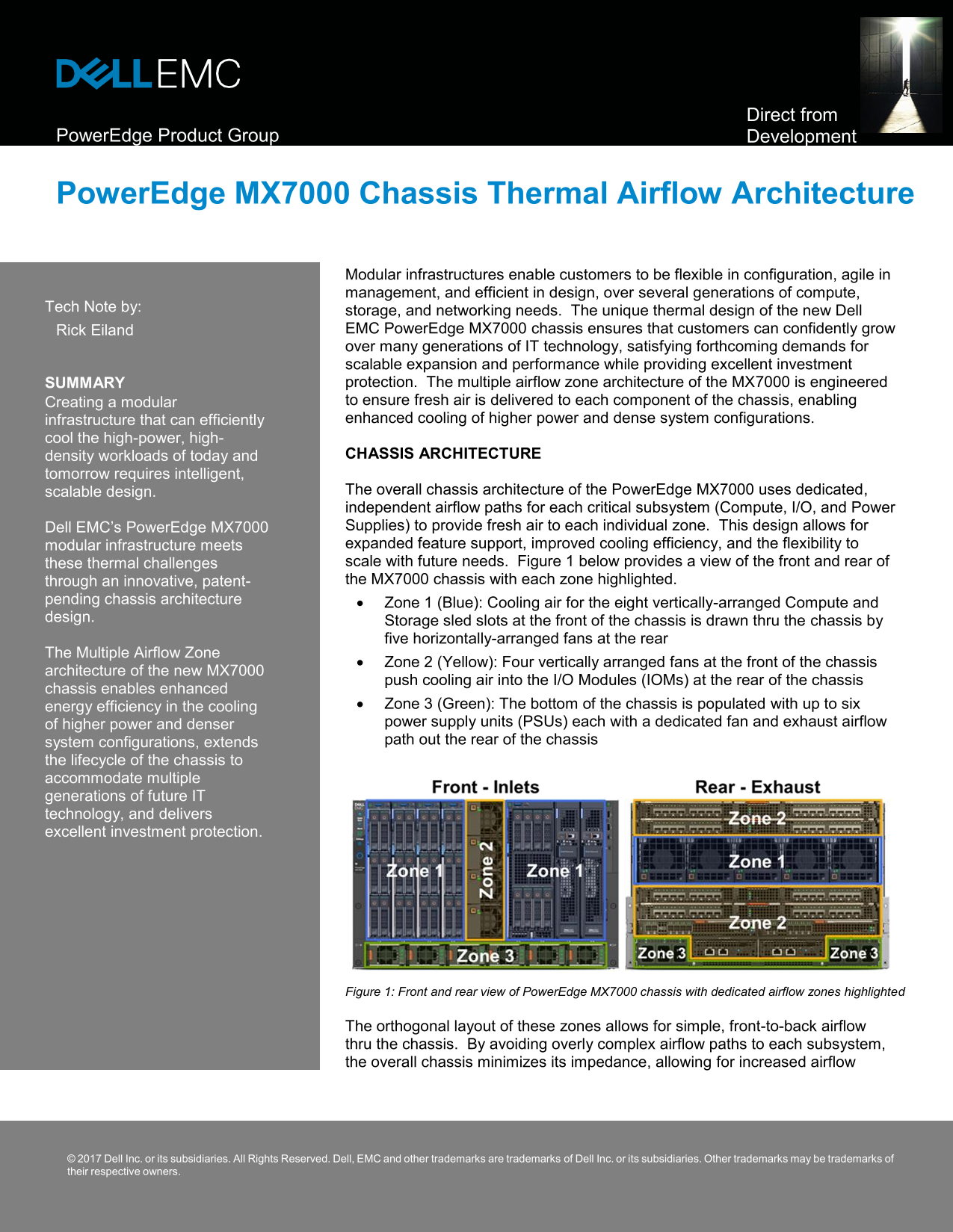
scalable design. The overall chassis architecture of the Power Edge MX7000 uses dedicated, independent airflow paths for each critical subsystem (Compute, I/O, and Power Dell EMC’s Power Edge MX7000 Supplies) to provide fresh air to each individual zone. This design allows for modular infrastructure meets expanded feature support, improved cooling efficiency, and the flexibility to these thermal challenges scale with future needs. Figure 1 below provides a view of the front and rear of through an innovative, patent- the MX7000 chassis with each zone highlighted.
pending chassis architecture
Zone 1 (Blue): Cooling air for the eight vertically-arranged Compute and
design.
Storage sled slots at the front of the chassis is drawn thru the chassis by five horizontally-arranged fans at the rear
The Multiple Airflow Zone
Zone 2 (Yellow): Four vertically arranged fans at the front of the chassis
architecture of the new MX7000
push cooling air into the I/O Modules (IOMs) at the rear of the chassis
chassis enables enhanced
energy efficiency in the cooling Zone 3 (Green): The bottom of the chassis is populated with up to six of higher power and denser power supply units (PSUs) each with a dedicated fan and exhaust airflow system configurations, extends path out the rear of the chassis
the lifecycle of the chassis to accommodate multiple generations of future IT technology, and delivers excellent investment protection.
Figure 1: Front and rear view of Power Edge MX7000 chassis with dedicated airflow zones highlighted
The orthogonal layout of these zones allows for simple, front-to-back airflow thru the chassis. By avoiding overly complex airflow paths to each subsystem, the overall chassis minimizes its impedance, allowing for increased airflow
© 2017 Dell Inc. or its subsidiaries. All Rights Reserved. Dell, EMC and other trademarks are trademarks of Dell Inc. or its subsidiaries. Other trademarks may be trademarks of their respective owners.
Page Summary Contents For Dell PowerEdge MX7000 Chassis Thermal Airflow Architecture Specification User Guide
Manual Details
| Brand | Dell |
|---|---|
| Pages | 3 |
| File Size | 497.71 KB |
| Published | July 03, 2026 |
Enter the captcha to get the download link:

Frequently Asked Questions
How does the MX7000 handle airflow through compute sleds?
It uses direct orthogonal interconnects and 80mm fan modules, eliminating vertical midplanes that restrict airflow.
What is an advantage of the multiple zone architecture?
It delivers fresh air to every component (Compute, I/O, Power) independently, enhancing cooling and minimizing impedance.
How large of a power supply can the chassis support in Zone 3?
The PMUs can reliably deliver up to 3000W because they have an independent airflow path with no downstream components.