Dell PowerEdge MX7000 Direct Orthogonal Connectors User's Manual
Summary
Dell EMC PowerEdge MX7000 Direct Orthogonal Connectors technical note. Describes the elimination of the traditional midplane in favor of direct orthogonal connectors for internal interconnection of compute, storage, and switch modules. This innovative design optimizes airflow and cooling, improves high-speed signal transmission by reducing trace lengths, and enhances power delivery to high-power processors and DIMMs compared to traditional blade enclosure midplane architectures. Authored by Ray Heistand and Tad Walsh.
Page 1 Text Content
Direct from Power Edge Product Group Development
Power Edge MX7000 Direct Orthogonal Connectors
Modular systems (such as the Dell EMC Power Edge M1000e blade enclosure) integrating both compute/storage modules and switch (I/O) modules require an intricate method of interconnection within the chassis. A traditional interconnect
Tech Note by:
architecture contains vertical compute/storage modules and horizontal switch
Ray Heistand modules, and a midplane enabling interconnection between these modules, as
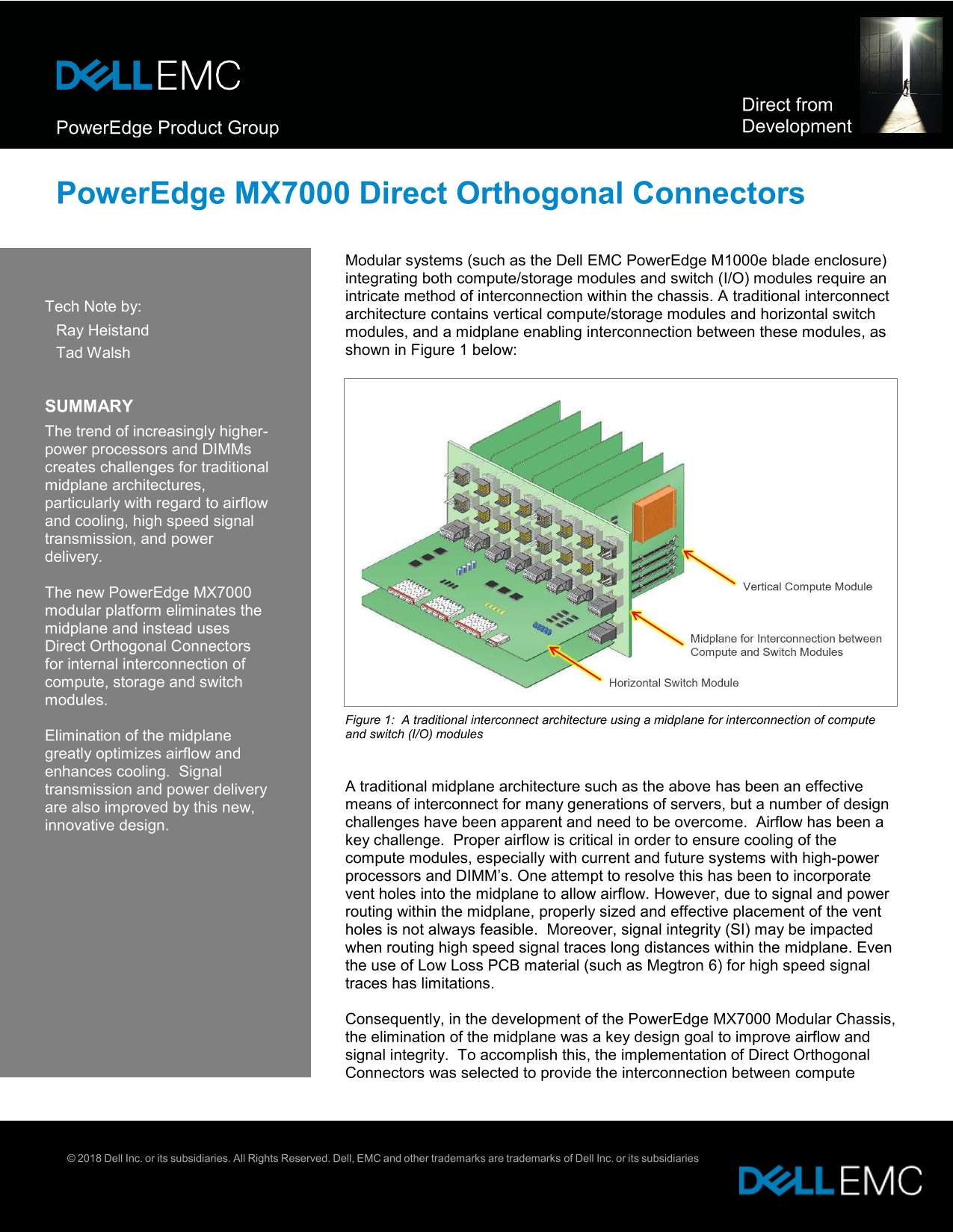
Tad Walsh shown in Figure 1 below:
SUMMARY The trend of increasingly higher- power processors and DIMMs creates challenges for traditional midplane architectures, particularly with regard to airflow and cooling, high speed signal transmission, and power delivery.
The new Power Edge MX7000 modular platform eliminates the midplane and instead uses Direct Orthogonal Connectors for internal interconnection of compute, storage and switch modules.
Figure 1: A traditional interconnect architecture using a midplane for interconnection of compute Elimination of the midplane and switch (I/O) modules
greatly optimizes airflow and enhances cooling. Signal
transmission and power delivery A traditional midplane architecture such as the above has been an effective are also improved by this new, means of interconnect for many generations of servers, but a number of design innovative design. challenges have been apparent and need to be overcome. Airflow has been a key challenge. Proper airflow is critical in order to ensure cooling of the compute modules, especially with current and future systems with high-power processors and DIMM’s. One attempt to resolve this has been to incorporate vent holes into the midplane to allow airflow. However, due to signal and power routing within the midplane, properly sized and effective placement of the vent holes is not always feasible. Moreover, signal integrity (SI) may be impacted when routing high speed signal traces long distances within the midplane. Even the use of Low Loss PCB material (such as Megtron 6) for high speed signal traces has limitations.
Consequently, in the development of the Power Edge MX7000 Modular Chassis, the elimination of the midplane was a key design goal to improve airflow and signal integrity. To accomplish this, the implementation of Direct Orthogonal Connectors was selected to provide the interconnection between compute
© 2018 Dell Inc. or its subsidiaries. All Rights Reserved. Dell, EMC and other trademarks are trademarks of Dell Inc. or its subsidiaries
Page Summary Contents For Dell PowerEdge MX7000 Direct Orthogonal Connectors User's Manual
Manual Details
| Brand | Dell |
|---|---|
| Pages | 3 |
| File Size | 716.72 KB |
| Published | July 03, 2026 |
Enter the captcha to get the download link:

Frequently Asked Questions
What is the main advantage of the PowerEdge MX7000 over traditional midplane systems?
It uses Direct Orthogonal Connectors to eliminate the midplane, greatly optimizing airflow, enhancing cooling, and improving signal integrity.
How do the new connectors physically interlink modules?
Orthogonal connectors provide a direct, right-angle interconnection between vertical compute/storage modules (PWA) and horizontal switch (I/O) modules.
Why was eliminating the midplane necessary for this platform?
Traditional midplanes suffer from challenges related to airflow impedance, signal integrity compromises over long traces, and difficulty in proper vent hole placement due to routing constraints.