Toshiba TLP541G TLP542G User manuals (2)
Summary
The Toshiba TLP541G and TLP542G are high-isolation photo-thyristor optocouplers, functioning as reliable solid-state relays for signal separation. This detailed manual provides comprehensive technical specifications, including maximum ratings, operating conditions, electrical characteristics, and tested performance curves. Designed for critical general electronic applications—such as industrial controls, machinery, and measurement equipment—these components ensure safe, robust power transfer through optical isolation.
Page 1 Text Content
TLP541G, TLP542G
TOSHIBA Photocoupler Ga As Ired & Photo-Thyristor
TLP541G,TLP542G
Programmable Controllers AC−Output Module
Unit in mm
Solid State Relay
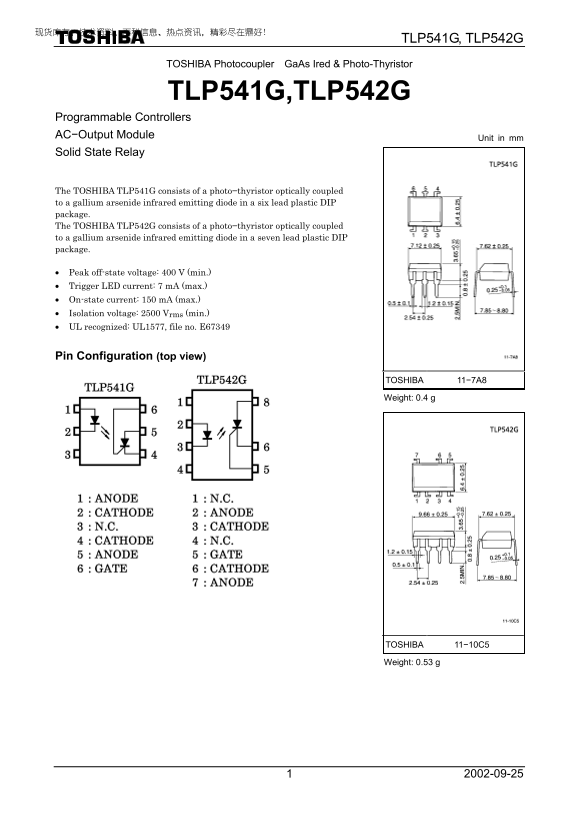
The TOSHIBA TLP541G consists of a photo−thyristor optically coupled to a gallium arsenide infrared emitting diode in a six lead plastic DIP package. The TOSHIBA TLP542G consists of a photo−thyristor optically coupled to a gallium arsenide infrared emitting diode in a seven lead plastic DIP package.
Peak off-state voltage: 400 V (min.) Trigger LED current: 7 m A (max.) On-state current: 150 m A (max.) Isolation voltage: 2500 Vrms (min.) UL recognized: UL1577, file no. E67349
Pin Configuration (top view)
TOSHIBA 11−7A8
Weight: 0.4 g
TOSHIBA 11−10C5
Weight: 0.53 g
Page Summary Contents For Toshiba TLP541G TLP542G User manuals (2)
Manual Details
| Brand | Toshiba |
|---|---|
| Pages | 6 |
| File Size | 551.06 KB |
| Published | June 06, 2026 |
Enter the captcha to get the download link:

Frequently Asked Questions
What is the minimum required isolation voltage for this optocoupler?
The minimum isolation voltage (AC, 1 min., R.H. ≤ 60%) is 2500 V rms.
Can I use this device in life-support or medical equipment?
No; the product warns against 'Unintended Usage' in areas like medical instruments or airplane/spaceship equipment due to reliability requirements.
When designing my circuit, how should I connect the leads?
The device must be considered a two-terminal unit: LED side pins are shorted together, and detector side pins are shorted together.