TEXAS INSTRUMENTS RI-ANT-G01E, RI-ANT-G02E, RI-ANT-G04E, RI-ANT-S01C, RI-ANT-S02C, RI-ANT-P02A Data Sheet
Summary
This range of specialized low frequency antennas provides reliable connections to Radio Frequency Modules (RFM) for reading 134.2 kHz transponders. Available as robust Gate or focused Stick antennas, these units are essential for establishing reading zones across demanding industrial environments. Suitable for applications such as Access Control, Vehicle Identification, Asset Management, and Waste Management, the manual covers detailed specifications—including inductance, mounting options, and environmental ratings—for multiple models designed to function in harsh operational conditions.
Page 1 Text Content
查询RI-ANT-S01C-00供应商
RI-ANT-G01E, RI-ANT-G02E, RI-ANT-G04E
RI-ANT-S01C, RI-ANT-S02C, RI-ANT-P02A
www.ti.com
SCBS845–MARCH
SERIES ANTENNAS
FEATURES APPLICATIONS
Best in Class Performance Through Patented Access Control•
HDX Technology Vehicle Identification
Protection Class IP and Higher (Exception: Container Tracking•
RI-ANTG04E) Asset Management
Form Factors available Waste Management•
Proven in Harsh Industrial Environments
Easy to Install and Use
DESCRIPTION
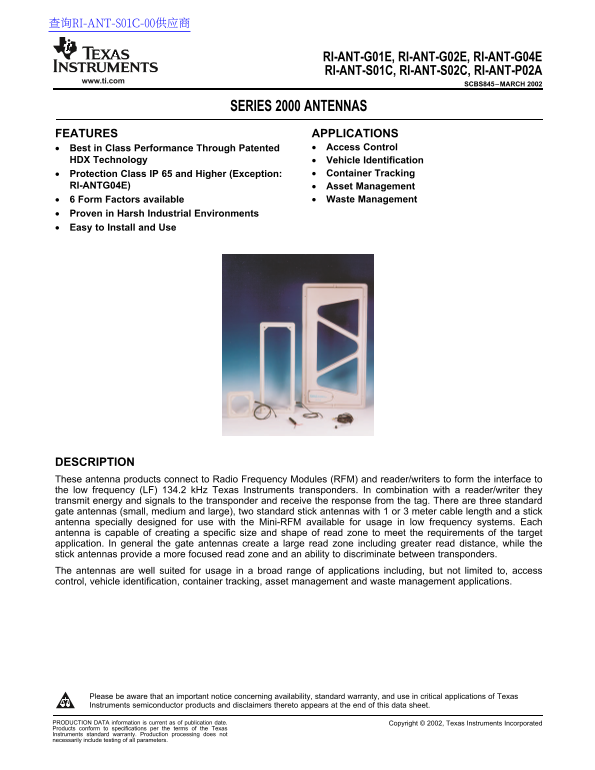
These antenna products connect to Radio Frequency Modules (RFM) and reader/writers to form the interface to
the low frequency (LF) 134.2 k Hz Texas Instruments transponders. In combination with reader/writer they
transmit energy and signals to the transponder and receive the response from the tag. There are three standard
gate antennas (small, medium and large), two standard stick antennas with or meter cable length and stick
antenna specially designed for use with the Mini-RFM available for usage in low frequency systems. Each
antenna is capable of creating specific size and shape of read zone to meet the requirements of the target
application. In general the gate antennas create large read zone including greater read distance, while the
stick antennas provide more focused read zone and an ability to discriminate between transponders.
The antennas are well suited for usage in broad range of applications including, but not limited to, access
control, vehicle identification, container tracking, asset management and waste management applications.
Please be aware that an important notice concerning availability, standard warranty, and use in critical applications of Texas
Instruments semiconductor products and disclaimers thereto appears at the end of this data sheet.
PRODUCTION DATA information is current as of publication date. Copyright 2002, Texas Instruments Incorporated
Products conform to specifications per the terms of the Texas
Instruments standard warranty. Production processing does not
necessarily include testing of all parameters.
Page Summary Contents For TEXAS INSTRUMENTS RI-ANT-G01E, RI-ANT-G02E, RI-ANT-G04E, RI-ANT-S01C, RI-ANT-S02C, RI-ANT-P02A Data Sheet
Manual Details
| Brand | Texas Instruments |
|---|---|
| Pages | 5 |
| File Size | 281.05 KB |
| Published | June 20, 2026 |
Enter the captcha to get the download link:

Frequently Asked Questions
What temperature range can these antennas operate in?
Gate antennas operate from –30 to +60°C, while stick antennas support a wider range of –30 to +70°C.
How does the antenna design affect read performance?
Gate antennas create a large read zone and greater read distance, while stick antennas offer a more focused read zone and discrimination capability.
What are some key applications for these LF transponders?
They are suitable for access control, vehicle identification, container tracking, asset management, and waste management.
What materials should be used when mounting the antenna?
It is required to use non-metallic clamps when mounting the antenna; mounting material itself is not supplied.