Texas Instruments bq2058 Data Sheet & Manual
Summary
The bq2058 is a lithium-ion pack supervisor IC for 3-cell and 4-cell battery packs. It monitors individual cells for overvoltage/undervoltage, detects overcurrent, and drives external FET switches for charge/discharge control. Features include selectable overvoltage thresholds, configurable delay timers, and minimal external components. It protects batteries from overcharge, overdischarge, and short-circuit conditions. Target users are battery pack designers and portable electronics manufacturers needing reliable protection for multi-cell Li-Ion packs.
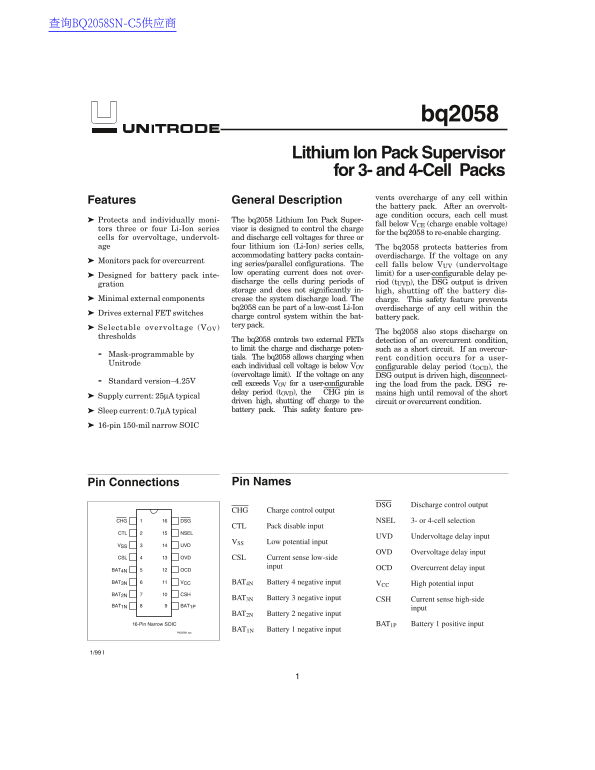
Page 1 Text Content
查询BQ2058SN-C5供应商
bq2058
Lithium Ion Pack Supervisor for 3- and 4-Cell Packs
vents overcharge of any cell within
Features General Description
the battery pack. After an overvolt- age condition occurs, each cell must
Protects and individually moni- The bq2058 Lithium Ion Pack Super-
fall below VCE (charge enable voltage)
tors three or four Li-Ion series visor is designed to control the charge
for the bq2058 to re-enable charging.
cells for overvoltage, undervolt- and discharge cell voltages for three or age four lithium ion (Li-Ion) series cells, The bq2058 protects batteries from accommodating battery packs contain- overdischarge. If the voltage on any
Monitors pack for overcurrent
ing series/parallel configurations. The cell falls below VUV (undervoltage low operating current does not over- limit) for user-configurable delay pe-
Designed for battery pack inte-
discharge the cells during periods of riod (t UVD), the DSG output is driven
gration
storage and does not significantly in- high, shutting off the battery dis-
Minimal external components crease the system discharge load. The charge. This safety feature prevents
bq2058 can be part of low-cost Li-Ion overdischarge of any cell within the
Drives external FET switches
charge control system within the bat- battery pack. tery pack.
Selectable overvoltage (VOV)
The bq2058 also stops discharge on
thresholds
The bq2058 controls two external FETs detection of an overcurrent condition, to limit the charge and discharge poten- such as short circuit. If an overcur-
Mask-programmable by
tials. The bq2058 allows charging when rent condition occurs for user-
Unitrode
each individual cell voltage is below VOV configurable delay period (t OCD), the (overvoltage limit). If the voltage on any DSG output is driven high, disconnect-
Standard version–4.25V
cell exceeds VOV for user-configurable ing the load from the pack. DSG re- delay period (t OVD), the CHG pin is mains high until removal of the short
Supply current: 25µA typical
driven high, shutting off charge to the circuit or overcurrent condition. Sleep current: 0.7µA typical battery pack. This safety feature pre-
16-pin 150-mil narrow SOIC
Pin Connections Pin Names
DSG Discharge control output
CHG Charge control output
CHG DSG NSEL 3- or 4-cell selection
CTL Pack disable input
CTL NSEL
UVD Undervoltage delay input
VSS Low potential input
VSS UVD
OVD Overvoltage delay input
CSL OVD CSL Current sense low-side
input OCD Overcurrent delay input
BAT4N OCD
BAT3N VCC BAT4N Battery 4 negative input
VCC High potential input
BAT2N CSH
BAT3N Battery 3 negative input CSH Current sense high-side
BAT1N BAT1P
input
BAT2N Battery 2 negative input
16-Pin Narrow SOIC BAT1P Battery 1 positive input
PN205801.eps BAT1N Battery 1 negative input
Page Summary Contents For Texas Instruments bq2058 Data Sheet & Manual
Manual Details
| Brand | Texas Instruments |
|---|---|
| Pages | 14 |
| File Size | 139.46 KB |
| Published | June 16, 2026 |
Enter the captcha to get the download link:

Frequently Asked Questions
How do I configure the bq2058 for a 3-cell versus a 4-cell pack?
Connect the NSEL pin to V_CC for a 4-cell pack or to V_SS for a 3-cell pack.
What happens if a cell is overcharged?
If any cell exceeds V_OV for the delay period, the CHG pin goes high to shut off charging until cell voltages fall below V_CE.
How is the overcurrent delay period set?
An external capacitor connected from the OCD pin to V_CC sets the overcurrent delay timing.
What is the typical operating current consumption?
The supply current is typically 25µA, with a sleep current of 0.7µA.